Two Mysteries at Hanamenu Bay, Hiva Oa
June 10
Murre raced across Canal Bordelais for Hiva Oa making six knots under jib and mizzen alone. Winds were fresh out of the east and the swell boisterous and warm, and Coot danced and spun at Murre’s stern, straining her painter to the breaking point. But behind the island the sloping plain dropped right away creating a high, sheer headland that became increasingly arid and barren near Kiukiu Point, and here the wind did not blow at all, though the swell persisted. We motored around Bonard Point and into Hanamenu Bay in mid afternoon, anchoring in twenty five feet of water a quarter mile from shore. Inside the bay, wind gusted toward the beach and then each way over the bluffs, so I put out a second anchor holding Murre’s head toward the ocean’s low swell.
This northwest corner is the island’s dry side, and to eyes now so accustomed to jungle, first impressions were those of desolation. The high hills surrounding the the narrow bay were covered sparsely with dead grass and a small, yellow-flowered bush, but these could not hide the structure of the sun-baked earth beneath, which was sheet upon sheet of crumbling volcanic rock. Below these hills bay water became a dull brown, and the beach, though heavy with palms, looked to be more mud and rock than sand. A bluff of exposed rock just back from the beach split the land into two narrow valleys, Hanaheka and Hanamenu, both of which turned quickly east, closing off any interior view. Small, drab dwellings could be seen below the palms.
Two Marquesan men put off from shore in a dingy and powered out to a locally-built motor cruiser moored nearby where they exchanged boats on the mooring and prepared to depart. The pilot knocked the top off a coconut with a machete and drank before climbing to the fly-bridge and putting his hand to the throttle. The cruiser sped away toward Atuona, and then we were alone.
I walked to the bow to check how Murre rode her anchor. Circling there was a brown shark eight feet long. An hour later while cast fishing, I caught a four foot shark, brown-gray with black tipped fins that fought spiritedly for twenty minutes before snapping the line on Murre’s rudder and escaping with my favorite lure. The water color and its obvious inhabitants suggested there would be no swimming here.
Next day ashore presented two mysteries. The first had to do with the dwellings. Two were obvious from shore, but behind the sandy beach and palms were more. Eight small cottages in all made up a small compound with a wide dirt path between and a common hall at the center–a dirt floored palapa with two long tables made of local wood. The cottages were small and plain, tin roofs and painted plywood for siding, but well kept and several of them had manicured lawns positioned around shade trees (a hammock hung from one), neat fences with picket gates, small gardens. Here and there a hose and sprinkler quietly watered a young breadfruit tree or a row of ti plants. To the west, a small stream flowed down from the hills into an architectured pool, bordered by grass and two, log-carved sitting benches below a single palm tree. Chickens roamed freely, giving the grounds a sense of movement and life. But the compound was empty of people. The windows of the cottages were boarded over, the doors padlocked.
I followed the path out of the compound to a wooden gate and through it as it continued. The path was wide enough for a small car, raised a few inches and lined with tightly fitted volcanic stone, and it soon lead into an area heavily shaded with large, old mango trees. Here, to the right of the path was a now common sight–an ancient stone foundation, square, made of volcanic rock. But next to it was a rectangular cement sepulcher, also very old and long ago broken into. A wild horse stood to one side watching me, its rib and hip bones pressed tightly against its hide.
The path continued in this manner to a stream, and across it as a trail, without the stone works or the care, it lead off into the valley’s dense undergrowth becoming less and less obvious and finally petering out at a small grove where six more thin horses watched me approach before scattering into the low forest. This was not a road into town, as I had thought. I turned back.
After recrossing the stream I turned from the path and headed straight up the hillside to the east, hoping to break free of the valley’s covering and get a view. But almost immediately I encountered another path, half as wide as the first, also finely built-up with volcanic rock. I first followed it back down into the valley to find it began in the mango grove with the sepulcher and just where that path turned toward the stream. But over growth had hidden it.
I then followed it up.
For a ways the path was wide and well traveled and bordered with rock. In one stretch black rock had been neatly piled into a bridge to fill a small ravine. The bridge was ten feet high and thirty feet in length, and the rock had been evenly stacked to form symmetrical sides and sharp, precise corners. A low, rock lip on either side framed the wide dirt path. From a little distance its design reminded one of a Roman aqueduct.
The trail proceeded slowly up the mountain from here. For some time it continued to be rock lined and well traveled (at least by the wild horses for droppings were frequent), and its grade was minimal. Above the loose forest that grew up around the valley floor, ground covering quickly thinned. Small grass and the yellow-flowered bush, wasps, the caw of myna birds. But the view up canyon and toward the island’s interior revealed even higher mountains, entirely green, covered with cloud.
As the trail continued up it became increasingly steep and as it became steep it ceased to be wide; a little further it ceased to be rock lined; then its way ceased to be obvious until within a hundred feet of the summit it simply ceased to be. Suddenly I was scrambling on all fours over rock and loose dirt at a precarious angle that made slipping a thing to be avoided. By this time it was late in the day. The sun had dropped over the eastern hills and cloud was beginning to cover the valley, so I returned to the bay.
This trail out of the compound, past ancient stone foundations and up into the mountain where it died was the second mystery. The first mystery had a tentative solution: Hanamenu, it appeared, was now a weekend get-away, an escape from the continual rain of the island’s south side, for a select few Atuonans who could afford a second home maintained by others. But it had also been the site of an ancient village that extended from the beach and back to the stone-works in the grove of impossibly old mangoes. Now, as then, it was accessible only by boat.
But the second mystery failed to resolve. Why so much energy had been expended on a rock lined, rock-bridged path that faded into the mountain before it crested the summit I could not understand.
Back on the valley floor and while there was light I harvested a few mangoes, but not too many. The ground covered with pits and the horse’s evil eye suggested they were a prized staple, and he was skinnier than I. Then I spent an hour on the beach breaking into a coconut, whose juice was lightly sweet and meat, hearty. An efficient method for getting through a coconut husk is a third mystery whose resolution I’ll save for later.
Resolution Bay
Without that brilliant but pesky ship’s naturalist, Sir Joseph Banks, to suggest that ENDEAVOR enter bays and sounds with interesting flora but decidedly contrary winds, winds from which no beamy square rigged ship could escape, Cook could land where pleased. And when he made the southern islands of the Marquesas in 1774 (?) on his second circumnavigation, he chose Vaitahu, the only large bay on Tahuata with strong, down-canyon winds. If a cable parted, RESOLUTION would be blown out to sea, and the bight was almost wide enough to wear ship without making the captain nervous. It helped that the island’s largest village was there at the beach and that Tahuata was the only island in the group with one chief, but all that was convenience–mostly it was about the ship. She rode safely and comfortably for the first time in a long while, and so he named the bay RESOLUTION.
This may seem a dull name for such an exotic place, but explorers are a dull lot when it comes to naming. The Spaniards were the first to arrive in 1595, and they applied the types of names they always do: Tahuata became Santa Christina; Mohotani, San Pedro, and Hiva Oa, Dominica. In 1791 an American expedition lead by Joseph Ingram on the HOPE landed in the northern islands, and suddenly the island of Ua Huka became Washington; Ua Pou, Adams; and lucky Nuku Hiva, Federal. A month later the sails of a French expedition under Etienne Marchand graced the horizon, and soon thereafter Nuku Hiva was Beaux, Ua Huka, LE SOLIDAD (Marchand’s ship), and Ua Pou, Isle Marchand.
Not done.
Captain Richard Hergest, a Brit, landed a year later and, waving his sword, proclaimed Nuku Hiva to be the island of Sir Henry Martin; Ua Huka became Riou, and Ua Pou, Trevennen. Another American expedition under Roberts gave Ua Huka the name Massachusetts (presumable due to similarities in the weather) and later Commodore David Porter changed Taiohae to Madisonville after the president.*
None of these names made the cut. Even Resolution Bay is a mere parenthetical reference on my US chart.
The beach is just as rocky as when Cook landed, the surf as serious, and my shore-boat is smaller than his, so from MURRE I watched the wave patterns at the quay and a small sandy patch, the creek’s mouth, for a long time. The quay’s landing and steps were routinely submerged, and sometimes waves flowed up onto the road, which explained why the line of pirogues was set back fifty feet from shore. But there were calm periods of nearly a minute in between. Near the creek I could see children playing volleyball on grounds just above the boat ramp and below the church. At one point their ball got loose, bounced down the ramp and into the water. A girl descended the ramp to the surf line and called for the ball’s return, swinging both arms in the air broadly, but without the desired result. She waited, waded in, dove and went under. A wave hit the ramp and sent water streaming up into the near parking lot. Then I saw her head. She retrieved the ball and swam ashore. It all seemed very easy.
I chose to land at the quay, but when I got there, the calm periods seemed less calm and the drop more severe. The quay’s cement works were like jagged teeth chewing at the water. I was still pondering when a young Marquesan motioned me forward. “Francaise? Inglis?” he yelled. I replied, and then without speaking he made motions toward a moored pirogue. He wanted a lift.
I’d noticed that locals used one of two methods for getting to their boats on moorings. Either a member of the party swam out or a small pirogue from shore was launched and left on the mooring while the larger boat (usually of the size and general design of an American water ski tow boat and always made of brightly painted plywood) went about its business.
During the row over I asked the young man if he spoke English. He made the now usual Marquesan reply. He raised a hand and put thumb and forefinger together in a pinch while saying “Veery Leetl” with a smile. Very little was still pretty good. He asked where I was from and when delivered to his destination asked if I’d like fruits in exchange.
I returned to the quay to ponder, but nothing had changed. The surf was too heavy. Just as I was putting back to MURRE for a stern anchor, the Marquesan, who had by this time landed his pirogue near the creek, whistled and began waving us in. “Hurry, Hurry,” he yelled as I got closer. We ran Coot up the beach and onto a ramp I had not seen just as a large set made its first approach.
On the grass above the break water and under the shade of a large tree sat a line of larger pirogues and a number of Marquesans. I was introduced to two of the nearer men, one of whom had enough English to explain that the plywood for the boats came from Pepeete, but the framing timbers and pontoons were made from Marquesan wood. “Good for you … and for your wife,” he said patting a pirogue on its flank. Everyone laughed. I didn’t laugh, didn’t get it was a joke until too late, so he repeated it. Then we all laughed, though I still didn’t get the joke.
He asked if Murre had any extra rope (not a chance); he said the swell would moderate in three days; the village was 500 residents, and he pointed out the first magazin (market) right up the road where I could buy bread, and with that I took off.
A small bridge crossed the stream at the first magazin and lead to the village center, a church, a remarkable church, Eglise Sainte Marie de L’Enfant Jesus, whose walls and buttresses were made of even, river-rounded rock neatly mortared. The arching entranceway doors were ornate blond wood and louvered stained glass windows, squares of red, brown, yellow, orange opened and revealed a quite sanctuary as cool as the river and forest from which it was built. A tree stump, sensuously carved and glowing with varnish became the pulpit, and above it, a large stained glass window, the primary shrine, shown brightly.
At the center of this window, the virgin Mary sat cross legged in an oval of aqua-marine and holding a naked baby Jesus whose right hand was held up, first two fingers extended, in the typical pose. But that was all that was typical. The two were surrounded by breadfruit hanging from large-leafed limbs and were, themselves, distinctly Polynesian–dark haired, dark skinned, and the virgin wore a gown oddly similar to those worn by Gauguin’s women. In the west we attempt most futilely to make our Christian icons historically authentic. But I’ve noticed, first in the Catholic church in Atuona and now here on Tahuata that Polynesians make no such attempt. The reef fish in the Marquesas may not have radiated much, but the Virgin and Jesus have and with a vengeance.
I explored the tiny museum of archeology (closed) next to the school and there was accosted by children on recess who wanted to show me the game they were playing, which involved making beads on a small mettle ring circle and circle and vibrate in the process. The girls were the ones who approached me and were playing the game. The boys only gawked. None of the several parents in the yard took any notice of me at all. No one offered to open the museum.
On a walk up into the hills I met a shirtless man with gold fillings who asked if I’d like some fruit. I did, and he immediately began unloading a nearby grapefruit tree of its produce, then the lime next to it. “Wait,” he said in English, and he went into the house and came out with bananas. All the while, an older woman sitting on the ground under a tree spoke to him loudly, disapprovingly. The man made motions I should ignore her. I tried to give him money. “No money,” he said. He wanted something else. He sat in the shade to explain, but I couldn’t make it out. Actually he wanted two things, the first had to do with soup. I made motions that to me this request made no sense. His second request had to do with fishing. I got the words “lobster” and “you bateau”. He wanted to go with me on my boat? It was a guess. I found myself agreeing, but to what I was unsure.
Back at the magazin I placed a few cans of French pate (the local SPAM equivalent but quite tasty) and two six-packs of beer on the counter. The woman running the store asked me if I spoke French, two which I answered “non”. But then she pointed at my pockets. She was asking if I had money. “Why?” I asked. She pointed to the beer and punched a number into the adding machine that come to $30 US. I returned the beer to the cooler.
Back at the beach the Marquesans had all wondered off, and I was left to launch Coot on my own, only narrowly avoiding a disaster that in any event soaked me and my bags of fruit and groceries. And I immediately began preparing Murre to get underway for Hanamenu on the north east end of Hiva Oa. This had been the plan all along–Resolution Bay isn’t much fun for a small boat–but was made the more urgent by thoughts of having to play host to a poorly defined fishing expedition. We sailed off anchor as Resolution would have, if maybe not as neatly, and just as I was raising the mizzen a scooter came tearing down to the quay. A man jumped off the bike, ran to the edge of the ramp and pointed out into the water. Was he pointing at us?
*History of naming from EXPLORING THE MARQUESAS, Joe Russell, 1999.
end
Hanamoenao, Day Two, and Resolution Bay
Just aft of the beach of Hanamoenao Bay is the open-air cabin, and just aft of the cabin begins the jungle and the jungle refuses to give up a trail out of the valley or up into the hills. Not a long disused road, not even a pig track. I tried for two hours to find a way or any evidence that a way had ever existed and only very late in the day realized that the cabin’s owner and supplies probably arrived by boat. There was no road and never had been.
The mosquitos of Hiva Oa were curious but benign. On Tahuata they are just hungry. After a time their repeated attempts at my legs and arms wore through the repellant, and I had to put back.
On the return I harvested more limes and a few coconuts and only by chance happened upon a small piece of plywood in the sand below a tree, which I turned over without thinking. The side in the sand was hand painted with the word “TABU” in big yellow letters. At one time it had been nailed to the tree. It is interesting how other peoples’ superstitions can act upon one’s mind. I returned the limes (that they numbed my tongue had worried me anyway) and the coconuts and left the beach.
The paucity of bird life on this part of the island is worth noting. Both the Myna bird and chicken are conspicuously, blessedly absent. In the jungle I noted only a type of Java Sparrow, a type of Chestnut Mannequin, and a type of Flycatcher, and these only fleetingly. In crevices of the lava cliffs on the north side of the bay, two or three pairs of a gray tern (just like the fairy tern, but not white) are roosting. A charcoal grey egret with yellow legs passes by with frequency. A lone brown boobie dives. Occasionally a Frigate. And that’s it.
The three swims yielded more results, however. In total I’ve spent four hours underwater in two days and have tallied 35 fish species, nearly 20 of which are positive identifications (i.e. I have a photo). My guides are HAWAIIAN REEF FISHES, Hoover; REEF FISH IDENTIFICATION, BAJA TO PANAMA, Humann and Deloach. As noted earlier, I lack any guides to French Polynesia.
The number of species common to all three areas is large and the fact of it fascinating. How did they arrive, in tact, in three areas separated by such great expanses of water? Once here, why have they not radiated into different forms? The Sergeant Major seems to be bigger, less blue and yellow, but the Moorish Idol, the Achilles Tang, the Spotted Puffer, the Ornate Butterflyfish, and the Convict Tang appear to be identical to their brethren I’ve observed elsewhere. Why aren’t the spots on the Achilles Tang blue or purple or yellow instead of orange; why isn’t it bigger or smaller. Why isn’t the Idol’s tail pink or triple stranded? One could posit that the similarities are due to similarities in food types, habitat structures, etc. But if that’s so, why are the hills not full of Honeycreepers as they were on Hawaii before colonization?
In fact, some fish do appear to have radiated, or at least changed color. Here and not in Hawaii or Baja (according to the guides) is a cleaner wrasse with an electric sapphire blue stripe; a tang with a powder blue stripe, a pure white dascyllus.
Naming is the first part of wisdom, says Confucius, and at that first part I am beginning to make some small progress.
This afternoon and after the final swim we weighed and motored the two miles to Resolution Bay (Vaitahu) and then on another two miles to Hapatoni Bay. Hapatoni was the more idyllic, but the wind wrapped around the mountainous cliffs and blew from the west and into the anchorage. And the water was deep right up to the rocky shoreline. That COLUMBINE was anchored there beneath a shock of palms and offered to share a dinner of freshly caught yellow tail did add to the attraction, but I wanted to visit Resolution Bay. We returned and anchored in 25 feet of water (reported as patches of rock and sand, but the water appeared evenly dark to me). Spinner dolphins spun as we approached, and a silver fish leapt gracefully in great schools as the dolphins passed. The beach below the village is rock and a significant western swell rolled in and boomed continuously making how to land a dingy a question of some weight. Beyond the village, the verdant mountains stood straight up to three thousand feet. A strong wind fell down the canyon, out into the bay and out to sea. Murre rolled and pitched and and pulled unhappily at her anchor.
Cook may have been a genius of navigation, but his choice of anchorages leaves much to be desired.
Hanamoenao Bay, Tahuata
Hanamoenao Bay, Island of Tahuata (See “Where’s Murre?” tab for specific coordinates)
The New Zealander on PAPILLON called it shifting, as in, “we’ll shift tomorrow to an anchorage on the north side, but only if it’s not raining.”
And we have finally done same. Most boats stay but a few days in Atuona, long enough to check into the country, have a shower, buy some fresh bread. But Murre and I stayed eleven. On seven of these it rained torrentially, but that wasn’t the reason we stayed. The infamously rough and insect infested anchorage was, for us, neither, but was rather a relief from the constant demands of the passage. After twenty six days of ***going*** it was delicious to ***stop*** and stay stopped.
But now we have shifted, if not very far.
Hanamoenao Bay is on the north west side of Tahuata Island and is just fifteen miles out of Atuona, around its bay’s southern point, through the Bordelais (Haava in Polynesian) Channel, and down a bit. The channel is rough, a mix of accelerated wind waves and waves that refract off the two islands, but they are warm and soft, and Murre’s motion in them is heavy, solid. Within moments she is streaming seawater again and screaming along at six knots in a steady easterly breeze.
Tahuata is but a quarter the size of Hiva Oa, but from the water it looks as large and imposing as its northern neighbor. High mountains, sheer cliffs, and the north side is a saw tooth of tiny bays each with a tan colored beach lined with coconut palms–one after another.
Hanamoenao is one of those bays. It’s a horseshoe between two uncharted points (“zone non hydrographiee”), and even here, on the lee side of the island, a slow swell rolls in and cannons off the bay’s rocky sides as if the two are at war. But the “zone” is remarkably different from Atuona. The trades blow steadily out to sea. The cloud over the mountains dissipates over the bay and has, thus far, refused to threaten precipitation. I can see the sandy bottom where Murre’s anchor rests at a depth of twenty five feet.
And I was the only boat here, for a brief time.
Ashore and half hidden by palms is a lone, large shack. The yard is fenced with wire, but has been cut along one section, so I explore. The shack is a single room, a floor made of plank with spaces between and raised three feet off the ground, a corrugated roof, and small storage area (pad locked). No walls. A mattress hangs from rope to keep it aired, but otherwise the room is empty. There’s a water catchment tank in back and an out house further on.
Rumor is one can find fruit trees–mango, papaya, banana, breadfruit–in such yards with fruit for the taking, but here there is only coconut and a lime whose zest numbs my tongue. Coconut trees are so dense they provide complete shade. And the nuts are piled or scattered randomly and rotting. No husking spike has been set up, however, so I leave with just a branch of limes.
To the north side of the beach, a fire pit and a makeshift picnic table in the shade. Something draws my attention to a tree–a touch of orange. Fifty feet from the water and in a notch of limbs at waste height, a hermit crab. The drab, bark-colored shell is as big as a billiard ball and the animal too. I think it must be dead–placed there by some previous tourist as a curiosity–but as I reach, its eyes retract and it shoots water. Mosquitos swarm, so I retreat.
No stream enters the bay. The ever-present cloud is either previously drained or the low hills of the near surroundings are too low to drive out its moisture in quantity. So the water of Hanamoenao is turquoise and clear. In the afternoon I explore the northern reef where a hard, fan-like coral and dark urchins with needle-thin spines of two feet and more describe the depth at twenty feet. The sheer black cliffs enter the water and stay sheer to the sandy bottom forming sharp precipices and overhangs coated in a rainbow of sponges. The fish are so recognizable…and yet not.
I can immediately make out Angels, Triggers, Surgeons, Sergeant Majors, Moorish Idols, Parrots and Wrasse, Damsels and Chromis, but though the shapes are diagnostic, fish coloration and even size are different from those of the Sea of Cortez. The Sergeant Major seems as prolific here, but it is larger and has none of the yellowish, bluish tints I’m so use to seeing in Mexico. The Moorish Idol and Convict Tang are the same in size and color, but the small “cleaner” Wrasses lack color though not stripes. I recognize none of the Angels, Triggers, Surgeons or Tangs.
The water is warm, much warmer than the gulf and warmer, I think, than Hawaii, but without a wet suit I am still deeply chilled after an hour and a half.
The sun sets to the west and straight out to sea. Once at the horizon it sinks quickly, brassy at first, then burnt orange, and no green flash. The moon is a sliver and starlight is piercing. The Big Dipper points to a spot well below the horizon. I turn; the Southern Cross rides high over the hills.
end
Climbing Toward Mt Tema
From the harbor the closest northern peak is imposing and cloud soaked Mt Tema*. Its southwestern face drops four thousand feet straight into the sea. To the east and in a previous age, great chunks have eroded away in crescent shaped bites. Sometimes the earth slid all the way to the coast, and now the village of Atuona is built over it. But sometimes the fall retained much of its altitude. Even from the harbor’s shore, one can see a light green berm of earth propped up against this northern mountain to half its height, and over it a brown zig-zag of trail up its face. This is not an invitation, it’s a command.
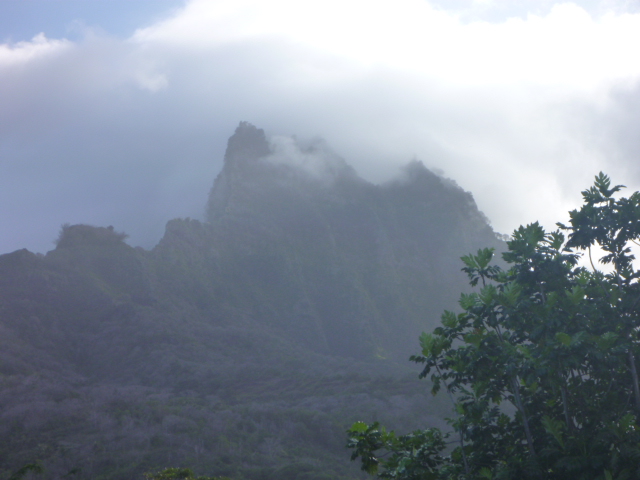
Mt Tema
The couple on Columbine, Cynthia and Glenn, and I decide to ascend. I have general directions from Gail on Ri Ri (right at the bank, right at the school, go up) but even she has said that the road’s rights and lefts are a mystery and we’ll have to experiment. I anticipate getting lost with a certain excitement.
Less so Cynthia. When we meet the yacht agent, Sondra, and husband in town, directions are the first thing she requests. Sondra’s husband clouds over. “Oh, ze trail it is not safe in zis weazur. We do not recommend such a hike now. Better to walk the road to the village or come to our house and use the internet.”
Nothing recommends a trail more highly than being warned off by a local. We thank Sondra’s husband and continue on as planned.

Getting Directions
Right at the bank, right at the school and at the next intersection we are immediately lost. The carved stone marker presents us with two choices in Marquesan, neither of which we recognize. I spy a man in his back yard. He is smoking, watching us, and with an arm raised he is waving us to the left. He comes to the road and explains in detail, in French, how to get to the trail head. We understand none of it, but we return his smiles and follow his repeated gestures.
Within fifty feet, another intersection with a house on the corner. We stop to consider and here another man leans out of his window and points to the road at our right. We follow. We assume we are being directed to “our” trail but have no idea.
The roads are crude, rough cement and very vertical. We pass more houses. Some are single story shacks with tin roofs and plywood walls and these are painted in bright colors like aqua-marine and magenta. Others are conservative, Victorian cottages with stone walk ways and separate garages. Dogs bark gruff warning and often chase us but with tails wagging. Soft words of greeting and then they take our petting.
We meet more intersections but houses are below us now, and each time we choose the way most obviously upward.
We pass a cemetery where a long dead stump has been carved with a tiki, and soon after the paved road becomes dirt and mud, and it continues up.
Through a forest and single track trail we climb, passing here and there a broad platform of volcanic rock, an ancient building’s foundation. One has a small stone tiki at the highest point. None are cordoned off or posted with signs saying “tabu”, and we guess as to their original use–hunting lodge, temple, platforms for human sacrifices?
The trial exits forest and continues up and at the crest of the hill, a shanty of wood pole, palm leaf walls and a blue tarp for a roof. Inside clothes are hung on lines and mattresses are turned on end against the damp. Doors are padlocked. No automobile tracks. “1000 feet of altitude,” says Glenn, who is carrying a GPS.

The berm and trail from far below
Now we approach the berm that is visible from the bay. The green covering is a monoculture of small fern, acres and acres of it with not a tree or bush, and the dirt path, wet but not muddy, is wide, evenly graded, and completely plant free. Here and there a burn patch to destroy the larger plants. At the switch backs, trenches direct rain water away from the trail. The shanty, we now decide, is the maintenance crews’ quarters, for this immaculate trail is a small marvel of engineering and must need constant attention.
Switch backs they may be, but they are extraordinarily steep. Our sea legs complain bitterly. Only Glenn, a barefooted trail marathoner in the states, powers ahead. To him this is a kind of heaven, and he has been waiting at the top for twenty minutes by the time Cynthia and I collapse near him.
“Over 2,000 feet up,” he says. “Hmmph!” is all I can muster. Glenn opens another beer.
We lunch at the highest point on the berm. The view expands outward and toward the ocean to the south and reveals an island that is mountain after mountain, ravine after ravine. There aren’t any flat spaces, no plateaus or wide valleys that I can see, and I wonder where the tomatoes, cucumbers, lettuces that I buy from the vegetable truck are grown.
By this time we are in cloud, or rather just under it. Where the trade winds meet sheer Mt Tema they are scooped up, condense, and blanket the peak. Cloud is forming right above us. We watch it pile and rise and flow over the peak like an inverted river. Tropic birds circle and squawk near the cliff. Other unknown bird song calls from the jungle.
The trail continues into the mountain, but compared to the smooth freeway of berm, it is rough going–overgrown, wet, rocky and often log jammed. The forest drips quietly. Ancient, long-leafed ferns droop from the crooks of moss covered trees. Wild orchids hang from muddy banks. We crest two rises thinking each the summit, and each time the summit is still far up in the cloud.
The trail, we are told, descends into the next valley and leads to the northern village, but we have gotten a late start, and after another mile we turn back. The drop back into town, back into the sun of the coastline, takes half the time we’ve anticipated. It has not rained all day.
—
*I think. My chart is a black and white photocopy and both the name and altitude of the peak are partly overprinted. The only map available in town ($30) fails to show the peaks or this trail.

View of the island from the top
He’s what? Why? And you’re ok with this? Wow! He’s so brave. You’re the best wife in the world.
These are the questions and comments I get each and every time I tell someone that Randall is off sailing around the Pacific alone for the next year eighteen months. I start to laugh as soon as the look of incredulity spreads across the face of the person I’m talking to. The questions and the open-mouthed gape are the same each and every time the reality of what I’ve just said dawns on the listener. The good news is that I’ve got really good at answering the questions and REALLY good at humbly accepting the title of Best Wife in the World.
It occurred to me that the folks on here might be interested in hearing the answers too. Plus really, I’m thoroughly amused by the whole thing so I thought you might find it amusing too. Just know that you’re getting me answering the questions, not my poetic husband. When it comes to writing style Randall is to Arthur Miller as I am to Marilyn Munroe. You have been warned.
Let me start at the beginning. I start all the way back then as the beginning was August 2001 on my second date with Randall. He mentioned casually that he’d always dreamed of going on a long distance sailing trip. I was still in that rose colored glasses phase of the relationship so my response was something to the tune of “Oooo really? How lovely! I Luuuurve sailing. Did I tell you I came from a long line of sailors? How romantic, sailing together around the world.” Blah blah blah … Lucky for me this didn’t totally scare him off. Lucky for him ten years have passed, and while the glasses came off the idea was firmly planted.
I learned a lot about Randall over the ten years. I learned that he really really really wanted sail off into the sunset and explore. It was a frequent topic of conversation over many evenings anchored out on Murre on the San Francisco bay. While I’d wistfully coo over the adorable multi-million dollar cottages tucked up on the shore just above our anchorage, he’d be talking about where, when and how he’d set out on his journey. Really, we’re a match made in heaven. Can’t you tell?
Randall had a big dream. However, the more important thing I learned about Randall was that the idea of actually going on this great voyage was 100% scary. Like parachuting out of a plane scary. It looks and sounds totally awesome; but you have to actually jump, jump out of a plane! And, like most of us with a slightly frightening dream, finding some excuse NOT to accomplish the dream is often easier than the doing part.
Now if you know me, you know I’m one of those people who jumps and jumps with some frequency. Parachuting? Yes! I’m totally in! Randall however, is not much of a jumper. He starts to think about silly things like 15,000 feet in the air and the ground. Jumping bad. Jumping scary. And when it came to a grand voyage, what would be a really easy excuse to delay jumping? You got it, the wife. I figured out pretty quickly that with the jumping and the wife excuse, I’d practically have to shove the Randall and boat under the Golden Gate Bridge myself.
Randall – honey, I love you, but you know what I just wrote is true.
So that’s what I did. We set some reasonable guidelines on the when part of the equation, aka have enough money in the bank to pay your half of the mortgage when you’re gone. And as soon as that requirement looked like it would be a reality, Randall moved (and I gently nudged) into planning mode. I transformed into the ever adoring and supporting wife mode. I spouted words like “yes”, “absolutely”, “of course”, “why not?”. I encouraged and supported Randall to the very edge and in the end didn’t need to push him out the plane. And I cheered and clapped as Randall jumped.
Well, ok. It wasn’t quite like that. But close. I am the best wife ever. Remember?
All kidding aside, I couldn’t be happier for Randall. He’s getting to live his dream. And who of us really have such an amazing and fabulous dream like that? I don’t know many people who do so there was NO WAY I was going to stop someone who did. And on the jumping part? Well, I believe that by doing this very scary and amazing thing I’m going to get an even more interesting person for a husband.
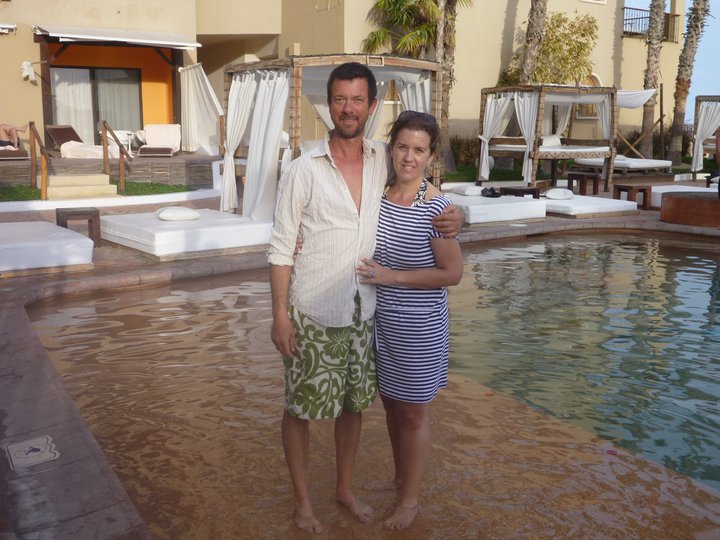 Don’t worry about me. Yes, I miss Randall a lot. But I’m having a bit of an adventure too. I get to have the coolest story in pretty much any situation. AND I have to fly to tropical locations to meet up with him. Really? Can you feel bad for someone who’s forced to go to Tahiti? Yeah, I didn’t think so either.
So here we are, both living our own adventure in our own way. Jumping.
See you in Paradise.
Jo
B.W.W.
Paul Gauguin
What is more unlikely, that painter Paul Gauguin would find his way to this tiny island late in life and from here produce his most famous works or that now the largest building and compound in the town of Atuona–a rarely touristed village of 2,000, mostly native Marquesans, a village that lacks a library, a bookstore, a movie theatre, a coffee shop–is the Paul Gauguin cultural center?
***
 I arrive at two o’clock on an afternoon that is somewhere between partly sunny and torrentially wet. The decorative wooden gate supported by a mossy, volcanic rock wall is propped open and the broad path leads to an immaculately groomed garden of grass, tall trees and flowering plants surrounding seven neatly maintained buildings.
In front of the largest are ensconced three Marquesan women at a card table, one coos a baby, another holds a battery operated fly swatter, and the third smokes a cigarette. The soft patter of talk stops as I approach and the woman holding the fly swatter notes my arrival with a question. Presuming the question has something to do with my admission into the gallery, I remark, “Oui,” to which she makes hand gestures suggesting I should stop where I am. I stop.
Quickly she tidies the card table, which only contains a small box and a pad of paper; then she unlocks the door to the museum, turns on the lights, steps behind the greeting desk, puts on a name tag, lays a few brochures onto the counter, and having accomplished these tasks, she smiles my way and motions for me to enter.
Business at the Paul Gauguin museum is not brisk today.
I enter and Sylvia (per the name tag) softly asks a few more questions to which I answer “Oui, Non, Oui” at random but in a way that apparently suits for my 6000 franc admission is taken and I am given a receipt stating that I should “Please retain this ticket as guarantee at all times for display to the docent.”
In pitch perfect English and a sweeping wave of her arm Sylvia says, “You may now visit the museum grounds including Gauguin’s house at the rear.”
“May I look into the gallery first?” I ask. Sylvia has no idea what I’ve said but smiles in the direction I am pointing and nods agreement.
***
My ability to grok the plastic arts is limited. Contemporary painting in particular relies so heavily on personal context–the artist’s other works, the tradition in which he paints or to which he is reacting, his dreams, feelings, specific physical surroundings–that without a background in that painter’s objectives, I find one is often able to appreciate color and composition and not much else.
Besides, I like words. If a picture is worth a thousand of them, I’ll take the words every time. They are more evocative, require more participation, are a more complete experience. Though the words and the stories they become may benefit from a knowledge of the author and his milieu, they rarely require it, and one does not have to go to a museum or hike up to some great stone in the jungle to appreciate them.
This is personal bias and is only meant, here, to explain why when I entered the Paul Gauguin museum my expectations were low.
But I stayed the rest of the day.
***
The main hall is five large, dimly lit, cream colored rooms connected by gently sloping ramps bordered with tiki logs. The walls of each room are crowded with Gauguin’s paintings, all professional replicas, the museum plaques are quick to explain, to original size and color scheme. Gauguin’s work is now in the public domain, so the replicas are even free to carry the artist’s signature.
No order, chronological or otherwise, is immediately obvious, and though there are paintings from the artist’s time in Brittany, for example, most of the paintings were done in the islands.
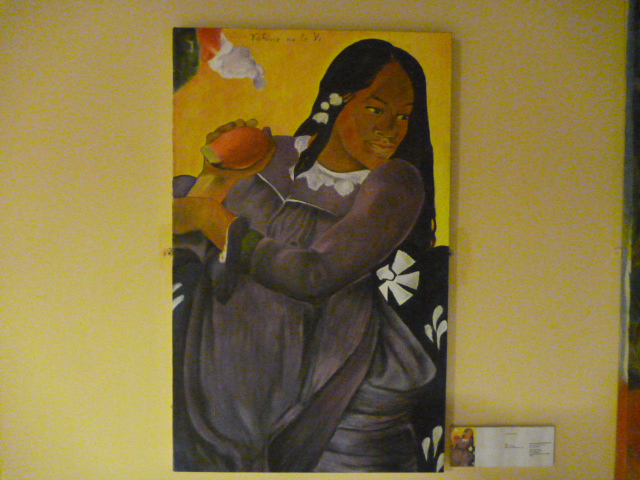 When painting from the islands, Tahiti and later Hiva Oa, Gauguin concentrates almost exclusively on two themes. One is the women. Room after room, painting after painting of Polynesian women, often alone or in groups of two or three, usually sitting, but sometimes standing or reclining, usually in doors or in an abstract space. Full nudes are rare though half nudes are not and frequently the women are clothed in a colorful, shape-covering gown from the neck down that leaves the face as the only body feature on which to focus. The women’s features are strong: there is a bluntness, even brutishness, about them. Lips, jaws, cheeks, shoulders, thighs, hands and feet all seem exaggeratedly large, thick, heavy. None of the women are moving. All are silent. And their expressions are within a narrow range of feeling; they are not sad, remorseful, grieving so much as they appear to be bored, depressed, sullen. There is no sensuality whatever. And there are no men.
The museum explains it thusly:
The quest for the primitive, the savage, which was Gauguin’s driving force throughout his life as an artist, was dissociable from his profound cultural immersion in the societies in which he lived in the course of his various voyages. In this respect, Brittany and French Polynesia are significant insofar as Gauguin’s works drew to a considerable extent from the representation of the Other and the material and religious culture of both places. However, it was in Tahiti that the relation to exoticism was most obvious, even if the artist’s plans were different, namely to avoid making too systematic a use of Greek canons of beauty…
Which is museum speak for “we have no idea what‘s going on in these paintings.”
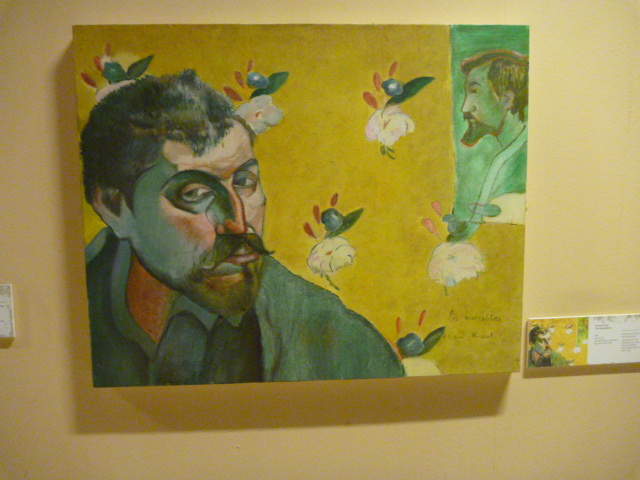 The other theme is Gauguin himself. One whole wall of the main room is dedicated to his self portraits which are then sprinkled throughout the exhibit. His aquiline nose and jutting, clenched jaw are consistently prominent. There is a stubbornness, a pugnaciousness in him. He is self assured tending toward self-righteousness.
Most remarkable is how little of the island made it into Gauguin’s painting. Here there is a beach, there a stylized ocean, a mango, a dog, a flower, a tiki, and that’s about it. No mountains, no valleys, no lush, steaming jungle or birds or clouds. And I don’t even think he got the women right. In my very brief time here, I don’t find sullenness; the weather may be cloudy and tempestuous, but the people are playful, open.
In his writing Gauguin makes it clear he wasn’t trying for realism. Printed and hung throughout the museum, his letters, specifically those to his wife Mette who remained in Paris, reveal a man who knew he had genius but whose struggle was finding it. He wasn’t here for the stark beauty of the place so much as its isolation. Noisy, opinionated Europe was not here; his critics were not here. On the island he could here himself think. As he wrote it, his paintings were buried deeply within “the logic of his mind”, but they were shy and took coaxing.
So the women, their separation from community and family, their isolation, even from one another when in groups–their silence, reserve, stasis–these too are self portraits.
***
Endlessly we apply words to paintings as if words are a kind of paint the painting requires in order to be complete. Art history classes, meaty coffee table books, museum chatter smothers painting in meaning and intent, but the medium, its power, is essentially ineffable. The words we use never quite cut it–that’s why we use so many.
I don’t know what Gauguin was trying to say. The colors are striking, the composition unusual and compelling, but the surfaces reach down and into a depth I cannot describe, though I was there.
Sometimes beauty just is.

A Walk in the Rain
Rain is the most persistent feature of the landscape, a pulsing, squally rain. Mountainous cloud cells roll in from the ocean, collide with Hiva Oa’s mountainous south coast, ricochet up and release. Day after day wave after wave of rain cloud imitates in slow mime its denser, frenetic cousins that pound the tide-line.
The rain can be torrential, rocks drumming the cabin top. Sometimes it’s a soaking mist. Usually it’s just plain heavy. And always it comes in squalls whose brief spells of dry between may allow a moment of sun. The jungle steams; insects fill the cabin. And then more rain knocks everything down.
Murre is entirely wet–decks are as awash as when we were at sea, wrapped sails, coiled line, flags droop as if in mourning, and I am perpetually bailing the dingy. Murre lacks any kind of cover over the cockpit or companionway hatch, so water enters the cabin any time I do or when I finally open a port for fresh air. My clothes are wet, and hung in the cabin they do not dry even though the thermometer hovers near 80 degrees. Towels used to wipe up the floor and counters near the hatches are soaked through. Bedding feels damp as do all the sitting cushions. Already mildew spots grow on the ceiling.
The dominant odor in the cabin is wet, unwashed dog. My most worn clothes and shoes smell of wet, unwashed dog six days dead. Except that it’s so very exotic, it’s kind of miserable.
Finally a break in the weather allows a row over to talk to Gail on boat Ri Ri, who I’ve come to learn is the hiker (a rarity) in this impromptu community of ocean crossing yachts. I ask for trails and she points out two, one leads to ancient petroglyphs and another rides up and over the northern mountain to the island‘s other village. This day looks like it might be less wet if not exactly dry, so at ten o’clock I row ashore for my first serious walk in a month.

Wet horse blocks streaming road to petroglyphs
As soon as I’ve secured the dingy, cloud covers the bay like a lead blanket and dumps. But by now its sneak attack fails to surprise and my attire–nothing more than shorts, sandals, and a bandana–anticipates the inevitable. The rain is cool on bare skin and the release from any hope of staying dry excites me into a run.
The trail is a dirt road announced by a canopied wooden sign-board, Site Historique de Tehueto Petroglyphes, and its track runs with cocoa colored water or is simply unadulterated mud. Entrance into dense, wet jungle is immediate, and even under dark skies, the intensity of color–all a gloss of green in various shades–is blinding.
Gail has mentioned a selection of unsigned turns needed to access the carved rock, but I have forgotten the sequence, so at the first intersection I pass to the right as I do at the second. Rain is heavy and constant and I frequently towel off my face with the bandana.

Path becoming dense with nettles
Over the next two hours the trail climbs into the narrow valley and becomes more and more chocked with weed. Foot prints disappear as do tire tracks and soon I’m wading through a continuous stand of soft, shoulder-high nettles, the only indication of road being the boarder of taller jungle on either side. Puddles are covered in mosquito larvae, and each time I stop to consider my way, a swarm of mosquitoes descends, but the insects rarely land or bite and they stay behind when I move off. A small, white butterfly frequents the smaller flowering plants. Striped skinks slide out of the way. Unknown bird song from behind unknown leaf cover. Among the myriad of domestic tropical plants, a pepper bush with very spicy fruit.
Back at the second intersection I turn left and within fifteen minutes am greeted by a hand painted sign, Propriete Privee–Suiven le Bolinage, which the sign translates to “Private Garden–stay on the path”. Here the path is marked to excess. Rock cairns, red and white ribbons and small, blue wooden arrows, usually bunched together as if intended for different audiences, lead through thick forest to a tiny clearing and a lone, lichen covered boulder the size of a truck.

Petroglyph Rock
On three sides and at waist and shoulder height the boulder is decorated with figures usually in the shape of insects resembling water skimmers and ticks. Only one carving has a human likeness, and several are so fanciful as to have no mundane reference at all. All of the figures are oriented horizontally, are moving right or left. Even the humanoid is not erect, and a projection between his legs suggests a rocket engine and flight or an insect‘s abdomen. Though rudimentary, the carvings are graceful and dreamy, but their placement is haphazard. The boulder seems a selection of snapshots rather than a story.
Why here? Why this boulder? And why those particular images? Who? When? The answers are easy enough to find. Relais Moehau, the lone upscale restaurant in town where, next day, I order a salad of curly lettuces topped with local bacon and a steak smothered in Roquefort brings to my table a large picture book on the petroglyphs of the Marquesas. I spend a long lunch examining the text, but find it in French throughout.

Water skimmer
I imagine this is one thing I have in common with the visits of Captain Cook to these islands in the 18th century–the isolation of information due to lack of a common tongue. Granted there are a few differences: one being that even in monoglot America I have no good excuse for my ignorance of French whereas Cook had no access whatever to Marquesan, and another–
the Royal Academy of Sciences in London is not known to be eagerly awaiting access to my journals.
That First Day
“Sondra, Sondra, this is sailing vessel Murre,” I call into the VHF radio.
Partly because the decision to make a course for the Marquesas was last minute and partly because it was inexpensive, I have hired an agency in Tahiti to get me into the country legally. Their representative in Hiva Oa monitors the radio rather than the phone.
“Zis is Sondera. Oui?,” answers a voice after a time. I explain who I am. Without small talk, she proceeds to, “Zee check-in it is early. Zee Gendarmerie it’s open at seven o’clock and it’s closing again at eight o’clock. So I will pick you at zee dingy dock at seven certy…non, non, seven twenty it is better.”
“Seven twenty in the morning?” I complain.
“Oui. It is early.”
“What time is it now?” I ask.
“Zee time it is cinq…it is five certy,” says Sondra. Two weeks ago I set ship’s time to island time, but I got it wrong. My clocks say it’s ten to four.
Her accent is rich, and I think, without having any reason to know, very European. I imagine a French woman in her forties, thin from a certain habit of nervousness and frequent association with hand-rolled cigarettes, blond but carelessly kempt, and in the island uniform: drab shorts and a drab T-shirt. So I am more than a little surprised when the woman who meets me in a worn Range Rover next day is Polynesian. She wears a floral sarong as a skirt, brightly red and white, and a crisply white tank top. Her hair is neatly in a bun and her skin has that cleanness and suppleness impossible in Caucasians.
We exchange greetings and I point to my three bags of soiled clothing, laundry being one of many services Sondra provides. Her look suggests my clothes should be burnt rather than washed and she allows me to load them into the truck myself and without offering to assist. She closes the hatch quickly.
On the way to town I try small talk and learn she has lived on the island twenty years, has been assisting cruising yachts for ten, and has entered over one hundred yachts already this year. It’s a busy time. Her husband is French, a guitar maker who uses local woods. He ships to customers all over the world. She has two children. Her mother provides vegetables for the town each morning at nine and from a truck parked near the bank.
I remark how strikingly similar the island is in look and feel to Hawaii. She has not heard of Hawaii though she has lived in Paris.

The Gendarmerie
The Gendarmerie is a tidy, white building surrounded by a high white fence. Sondra rings the bell, we are admitted. Inside the building is quiet and clean as an infirmary. The lights are off. A young, thin, light-skinned man in a powdery blue polo shirt and wearing two pistols comes to the desk from behind a partition. He speaks softly to Sondra, pleasant but not familiar greetings are exchanged, and I am handed a form. That the boxes on the form are too small to fit the requested information is no surprise–this seems the same everywhere–but the French stumps me. Nom de Navire. “Vessel name,” whispers Sondra when I point. Date et Lieu de Naissance. “Where you were born and your day of born,” she says. Equipage. “You do not have a crew, so put ‘non'”. The passport is then stamped loudly, and Murre and I are admitted.
I had thought to invite Sondra to breakfast so that we could talk about the town, its history, and my hundreds of other questions, but quickly it is clear Sondra has other engagements. She points to the bank, to the restaurant, to the nearest market and gives directions to the lot where her mother will sell vegetables later in the day. She smiles goodbye, and suddenly I am alone. It is ten past eight.
The day is overcast, the air heavy and wet though it has not rained. My crisp shirt, saved specifically for the check-in occasion, is no longer crisp.
Early as it is, the town is bustling. Pastries are being delivered at the market–baguettes and rolls and small quiches on trays–and there is a line of customers at the bank, several of whom are in bare feet. The machine answers my request for 15,000 Francs Pacifique (roughly $150) with two colorful bills the size of post cards. How will I spend these at the vegetable truck, I wonder.

Neat, tin-roofed buildings in town
The town is two streets made up of five food markets, two surprisingly well-stocked hardware stores, two restaurants, one bank, one post office, one coiffure next to the one pharmacy, the Gendarmerie, a police station complex and one Paul Gauguin museum. Almost everyone I meet is Polynesian, and any sense of the island’s being similar to Hawaii is broken by the loud conversation entirely in French. Greetings are yelled from passing cars or across the street as walkers pass. Everyone knows everyone else and every knowing must be acknowledged. Women kiss–cheek to cheek–and men shake hands in a way westerners would consider effeminate. Hair among women is long and worn out or in a pony tail. Most men sport lavish tattoos. The most frequent themes of conversation result in smiles and laughter that are infectious though I have no idea what is being said.
I find I am famished and so purchase a bread roll and a quiche that I eat in the parking lot with other men who are taking their breakfast in the same way. To my surprise the bread roll is stuffed with beef noodles and the quiche of bacon and spinach has been poured into a sweet tart crust. At the vegetable truck I buy a small, squeaky clean cabbage, tomatoes, green beans in bunches, and tiny sweet peppers. My large bill disgusts Sondra’s mother whose bank it nearly breaks. In vain I search side streets for a bookstore or a coffee shop.
By ten o’clock I begin to worry about Murre. The bay is rough and crowded and she has not been riding her anchors so long that I can yet feel she is secure. I begin the two mile walk back to the harbor with my sack of vegetables and a limp baguette drooping from my backpack.
I crest the hill and there is the ocean all the way to the horizon. I had forgotten about the ocean these last hours. It pounds the coast with heavy savageness; waves heave up against black rock and explode like canon shot. Already it is hard to believe how we got here and how we will leave.
More photographs of town and surroundings are available here.

The bay from a rise outside of town
Murre to the Marquesas: PHOTOGRAPHS
A selection of photographs from Murre’s crossing to the Marquesas can be found here.
That Last Day
May 23
Position at 0630: 09.35S 138.31W
Course: 225t
Speed: 4.5 knots
Bar: 1012
That last day refused to dawn.
All night I took wind on the beam into a deeply reefed jib and main so as to slow Murre down and make landfall in the broad of day. All night I slept in thirty minute increments because Marquesan fishing craft were said to be out. I slept lightly and not in my berth but leaning against a bulkhead. Again and again I checked the chart and each time it said there were neither reefs nor rocks between Murre and harbor–just blue water and then, suddenly, the island, but I could not be sure. It seemed too easy.
The night went on and ever so slowly the miles passed under us. I rose in the dark and made coffee and eggs and washed my face and tidied the cabin and still there was no day each time I checked.
Impossibly late a gray light in the east revealed total cloud cover and an indistinct horizon. At 0630 we were 18 miles off Cape Balguerie, but I could not see land. I wrote in the log, “I am worried. Where is Hiva Oa? Do I have the right ocean?”
At 0701 yet another gray silhouette of cloud on the horizon, but this one sloped down and into the sea the way no self respecting cloud would do and it came to a blunt-nosed point that could only be land. Hold breath. Wait. And yes. “LAND HO two points to starboard!” I yelled and laughed and cheered as if I were a crew of many.
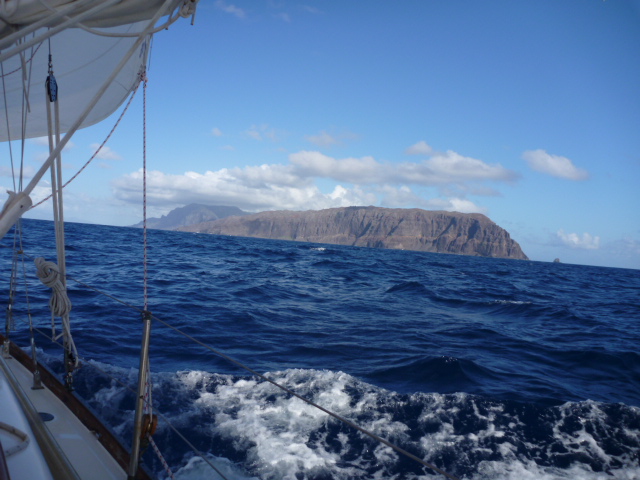
Hiva Oa comes up out of the sea
Slowly the silhouette grew into a scoured cliff, barren, hulking, volcano-black at its base. Races where waterfalls had been could be seen. Then beyond, high plateaus lushly green and topped with white cloud. Everywhere the island fell steeply into the sea and the waves crashed and crashed forming a string of pearls along the margins. Just past the cape, a line of alpine-like peaks, jagged and toothy. The canyons were a jungle of palm right down to the beach.
Slowly we sailed the coast in a lightening wind and a heavy chop until, at 1100, my impatience to see Atuona harbor forced the engine and we motored the last two hours into the crescent bay that defines the island’s southwestern edge. Past the loaf shaped rock of Hanake Island, past the breakwater, and we were in.
The small harbor was full. Twenty other sailboats were anchored bow and stern, facing the swell that wrapped the point and came rolling improbably in against a shore of volcanic rock. Their masts jumped and swung about in a way that suggested danger, as did their proximity to each other. Where I would put Murre was not obvious. I circled twice and dropped two anchors near the back of the pack, near the beach and in ten feet of water, stern anchor first, then riding forward to drop the main anchor and then settling back. Neatly done, I thought. It was 1300 hours.

Cloud over Mountain
Almost immediately a dingy put off for Murre from a nearby boat. A man, alone, gray hair, stylish glasses and tight swim trunks introduced himself as “Gerard from Paris”. He explained in halting English–far better than my French–that the day was unusually calm and sunny and that he had seen the swell breaking on previous days right here where had anchored. He suggested I move forward and offered to help.
So up came both anchors. At Gerard’s insisting, I inserted Murre between two boats that already seemed awkwardly close, dropped the main anchor, and then Gerard towed Murre back and into position and dropped the stern. And it was done. After twenty six days of ocean, suddenly Murre was at rest in a valley of green whose cool breeze smelled of flowers and wet, rich earth. I inhaled deeply and smiled and began to look around.
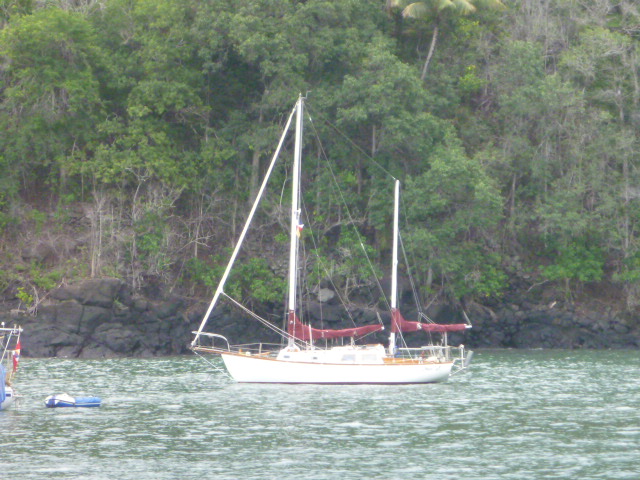
At Anchor in Atuona Harbor
Murre has Arrived Hiva Oa
Position: 09.48.16S 139.01.88W
Taa Huku Bay, Hiva Oa, Marquesas Islands
Wind: light and variable but beautifully cooling
Depth: 10 feet
Bottom: Heavy mud and rock (volcanic)
Anchors: bow and stern
Neighbors: ten other boats in this tiny bay
Language: decidedly French
Temperature: 82 degrees
Vista: Green and mountainous
Bar: 1012
Departed Cabo San Lucas: April 28, 0645
Arrived Hiva Oa, Marquesas: May 24, 1303
Days enroute: 26.5
Miles covered (noon to noon): 2775
Avg. miles per Day: 105
Hours motored: 6 (four in the doldrums and two to get into harbor)
Fresh food remaining: four oranges, eight onions, one squash (that I’ve had since January)
Water used: unsure at moment, but less than the forty gallons on the main tank, which continues to give. Washed dishes in fresh water today for first time since Cabo.
Looks like: Hawaii
Feels like: Hawaii
Smells like: Hawaii
Birds of: Hawaii
Sounds like: Paris
..and that’s just grand
It was a long passage, and I’m ready to stretch my legs.
All for now.
Pirates and a Shooting
Position: 08.23.78S 137.29.48W
Course: 230t
Speed: 6.2 knots
Wind: 10SE
Sky: 50%
Sea: 3 feet, SE
Temp: 80 degrees
Bar: 1012
156 Miles since yesterday. Wow. A little current in the right direction really helps!
Pirates and a Shooting
One gets use to first light revealing an open expanse of water, variously disturbed, cloud cover, variously dense and intricately shaped, a setting moon and the occasional bird. In fact, one gets so use to these being the only elements of the day that on a morning like this one, when a distant but unmistakable triangle of sail interrupts the western horizon, there is a brief moment of panic before curiosity sets in.
The panic is due to thinking one knows where all the boats are. Murre and I have been checking into the Pacific Puddle Jump network every day since departure and we’re down to the last few boats; actually we’re down to the last three. A boat named Chantey should have made port today. Then there’s Murre who is in shooting distance of Hiva Oa, and northeast of us by about two days is Columbine. And that’s it for the season because hurricanes will soon shut the door to other would be southbounders.
So if we are the only cruisers left, who was this chasing Murre’s tail in the early morning? Certainly this was not good. The ship was hull down but with binoculars I could see that she was a sloop and quite large. Her rig was immensely tall and the main looked massive, fully battened and powerful. The shallow cut jib barely filled. The boat was taking the wind deep on the quarter because her course was intended to intercept ours.
Immediately I thought of pirates. I was that fat Indiaman, sluggish and slow to realize the chase; and my pursuer a lithe Baltimore clipper who’d been chasing me even while I slept. Of course that was silly, but such is the result of many long evenings spent with Golden Age of Sail novels.
For two hours the chase was on. I did what I could to outrun her: I raised the mizzen. That gave me all plain sail applied to a beam wind of 12 knots and was all I could do. At seven knots over the ground I could not complain of Murre, but my opponent bore down anyway.
At hull up she became a contemporary pleasure yacht of some seventy feet, white hull, sweeping lines, rounded windows in the main salon–the current vogue for yachts. At half a mile I noticed motion on the foredeck, a man rigging something, probably a larger jib but it appeared to be bulky and orange. At less than a quarter mile the contraption appeared to be a boat, an orange boat, inflated, bow facing us and ready to be launched.
So we ARE to be boarded, I thought. How odd. I raced below to tidy up. As it was the day before we were to make port, tidying was the main agenda item anyway, but I thought I’d have more time. The dishes were done (what a relief), but the sink needed scrubbing and so did the stove top…too time consuming. My hurried attempts at neatening the bed only succeeded in making its single sheet and two pillows look more wrinkled and forlorn. I tossed my shirt into the dirty clothes bag instead of putting it on, and I shoved the deck boots into a corner. It was all I could do.
When I went back up on deck, the yacht was abeam and passing so quickly I barely had time for a wave and a photo. The four cleanly dressed people aboard waved back.
I could see the radio go the helmsman’s mouth…
“Sailboat. Where are you bound?”, he said.
We exchanged a quick conversation, may particulars and his. Yacht Oningara of New Zealand, out 12 days from Galapagos to Nuka Hiva, Murre only the third boat he’d seen. They’d only motored two days. Fast passage. Etc.
“And if you don’t mind my asking, what’s the orange thing on the bow?” I said.
“Oh, that’s a diesel bladder. Last time through here we ran out of fuel. Brought extra. Just trying to rig it up. Cheers mate. See you in the Tuamotos. We’ll buy you a beer.”
By this time he was a mile ahead. I could have chatted longer, but the diesel bladder maneuver was taking everyone’s attention.
And then they were gone.
This close brush with pirates reminds me of a recent shooting incident.
I ended a previous post (Frustration, May 11) with “a grand cloud cell approaches and I’m not sure Murre will be able to dodge this one. I should be on deck for this,” but I have failed to mention the remarkable occurrence that followed.
I went on deck. I was dressed only in shorts and my harness. As is the pattern, wind increased sharply at the leading edge of the squall, but died right away with the rain. Rain was torrential, a cooling blanket over the whole sea. A tickle on the skin that is refreshing and almost immediately too much sensation.
I had been on deck only a minute when just off Murre’s port quarter a big splash on the rain-coated water-top–a big fish in mad chase of quarry. I didn’t see the fish, only the splash. And then I was shot with bullets. Six bullets came flying from the water, aimed directly at Murre. Two hit me, one in the chest and one in the right leg, both leaving immediate black marks. Two thwacked the cabin side and two others flew past me over the cockpit, one tangling with the rigging and the other clearing the whole boat before splashing down into the ocean on Murre’s starboard side. Squid in flight.
The two on the deck were already bleeding black ink into the stream of water coursing toward the scuppers. Pastel pink animals with small purple spots. And oddly, though able to fly, were weak out of water, unable to lift their tentacles. I tried helping them over the side, but they were already dead, and the black spots on me had already washed away.
Tonight we race. I have reefed the main and the jib and still we race our last 70 miles to Hiva Oa. It’s important we make the islands in daylight, so I’ve got to slow Murre down even more. I need to be on deck, so must close for now.
And that’s my report.
Miles Made Good
Position: 06.20.93S 135.52.39W
Course: 217t
Speed: 6.7 (about .7 of that is a south setting current that’s helping us out) Wind: 13 gusting 16 SSE
Sky: 30% cloud
Temp: 80 degrees
Bar: 1012
143 miles noon to noon. That’s our best single day mileage yet!
Early in the passage our specific compass heading at any given moment wasn’t as important as ensuring each day we made as much south westing as wind allowed. But the Marquesas Islands are tiny, and we are approaching–now our compass heading is critical.
So, to get us back on course, I ran Murre close hauled all night in 15 to 18 knot winds from the SSE and a slop that caused her to pound terribly, even with a reef in the main and a double tuck in the working jib. Water over the bow was so common that it never fully drained from the windward decks or the aft near the captain’s seat where it puddled and stayed unless I scooped it out. And heavy spray over the cabin top was a frequent occurrence, making my favorite observation post–standing in the companion way hatch–a guaranteed dowsing.
Murre’s motion was such that I gave up on cooking and instead finished off, cold and right out of the pot, the cabbage and potatoes cooked the previous night. Sitting, knees to chest, below the closed companion way hatch I wondered how I would sleep without being ground into paste. I abandoned the idea of the sleeping berth, and instead stacked a number of pillows against the leeward settee and leaned back with my legs over the table in a position that looked like a drunk had collapsed there. It was workably comfortable.
But the noise I could not ameliorate. A boat’s cabin is like the inside of a guitar sound box. Every creak and clank on deck and swoosh of a wave below is magnified to ridiculous proportions inside the cabin. The working of the main sheet blocks, the jib sheet humming with tension, water over the bow, spray on the coach roof, that odd wave that slams Murre’s exposed bilge so hard it sounds like she’s hit something solid–all are alarmingly loud from below.
Luckily, the day of climbing in increasing wind had worn me out. I began the sleep cycle at nine o’clock, and didn’t finally give up my recliner until seven in the morning. (This did, however, include two longish episodes of sail/course work on deck during which I got drenched–so it wasn’t all roses).
By morning we had gained four weather miles on our rum line course. I gave a tentative look out the companionway hatch and saw that every exterior inch of Murre was soaked and still being soaked. And in addition to the usual casualties, a few flying fish and the odd squid, there were a number of Man-O-War jellyfish in the rigging and on the sails. Apparently Murre had flung an entire colony into the air at some dark moment of night, and not all had found their way back to the sea.
By noon we were ten miles to weather, at which point I began to feel more comfortable about our position. Late in the afternoon the wind began to ease and veer such that now we are under all plain sail, wind nearly on the beam, and making seven knots over the ground.
At this rate, if it holds, we could make Hiva Oa by noon on Monday. Atuona, the tiny bay inside of which is the village, is described as a terrible anchorage–open to the SE, rolly and buggy. But right now I don’t care because I know where the shower is and who I can ask to do my laundry. I also know there’s a cafe in town that serves ham and cheese croissants.
220 miles to go as I write.
That’s my report for today.
Mistakes
Position: 04.21.16S 134.33.91W
Course: 220t
Speed: 6 knots
Wind: 13 SSE
Sea: 4 SSE
Sky: 90%
Temp: 80 degrees
Bar: 1013
133 miles since yesterday. Moving now. Trades these must be.
Logistics note: my “noon” is 2000 gmt.
MISTAKES
Two.
One, I wasn’t paying attention and let Murre lose her weather gauge on Hiva Oa. For days we’ve been several miles east and upwind of our rum line course for the island. Being upwind gives us the advantage of easing into port without any fancy maneuvers–having to tack to it, for example. But over the last day the wind has backed more into the SSE and before I knew it we were five miles below our rum line. So now we’re close hauled in growing trades and seas. Murre is taking water over the bow every wave and over the cabin top with frequency. It’s uncomfortable for her and dizzying for me if I’m below. I’ve had to reef down: the mizzen is dowsed altogether and I have a reef in the main. We’re healed at about 30 degrees. Given that and the pounding, I’m surprised we’re still making better than five knots over the ground.
Two, I’ve been fighting a persistent leak of sea water into the head, i.e. into the toilet bowl. In rougher weather I’ve had to sponge out clear sea water once an hour or so and still plenty of it has got into the bilge, but not before soaking cans of paint and food, bottle of oil and other supplies as it passes. It’s a big mess down there. I haven’t used the head since Cabo, but instead have been practicing the ancient art of bucket-and-chuckit, which I must say is a complicated art in a seaway. (I find fitting that my bucket is an old container of bottom paint remover.) That I haven’t used the head has added to the mystery. The only hole without a valve is the vent line, which is on the banging, leeward side of the boat, but I’ve bunged it and still water comes in. Today I finally reasoned that one of the seacocks must be malfunctioning. I undid the water intake hose, but no water was dripped from its closed seacock. Then I looked in the head sink compartment where the head tank drain line and seacock live. I’d felt it closed many times over the last few weeks, but had never actually looked. IT WAS OPEN. I had misremembered the direction of the piping and so thought it was closed when it has actually been open since Cabo San Lucas.
I have dismantled the lock and latch to the head today. The latch has been sticking for some time and the big joke among cruisers who visited me in Mexico was that I would one day be found dead, locked in my own head, pants around my ankles, an unhappy look on my face. As seems to be the case with intricate things, its many pieces came apart with ease. It took half an hour of disassembly just to get to the latch, which sadly, is not fixable. It’s worn out.
Have run the engine twice today. In the morning it started roughly, but it started.
Slowly Murre is working to weather of her new course to Hiva Oa. I worry for her, but so far she is fine. Surely she is better than her crew who looks around wondering what’s for dinner that doesn’t require cooking.
Fewer than 400 miles to go.
That’s my report for today.
Hello all!
So I’m sure you’ve all noticed that a lot of Randall’s recent posts suddenly have the words “Updated!” added to the title. Well that’s because they are. Let me explain..
Last night, through the magic of ham radio, Randall and I were emailing back and forth around all the dull challenges of running a home with half the family somewhere in the middle of the ocean. As part of the chatter I asked him why some of his posts were so short when all he was doing was bobbing along. This kicked of a slew of emails which eventually lead to the understanding that formatting of Randall’s posts was cutting off all the good stuff.
Short story long – I’ve updated all his earlier posts we missed with the rest of their stories.
One other quick update. For those of you that don’t speak “Sailor” please note there is a new tab called “The Mother-In-Law’s Lexicon”. Some of you have commented that Randall uses all sorts of nautical terms and some of you have no idea what they mean. As I come from hearty sailing stock, we’ve recruited my Mum to act as translator. Please let us know if there are any other words you want the MIL to translate and we’ll keep updating the list.
Happy reading!
Mechanical Update, Part II
Position: 02.42.23S by 133.02.84W
Course: 218t
Speed: 5 knots
Wind: 10, SE
Sea: 3 feet, SE
Sky: 25%
Temp: 82 degrees
Bar: 1012
114 miles noon to noon. Back in the groove.
Wind was up and down in the morning, fresh on the front side of a squall, squalid as it departed. But in the afternoon the SE winds, may we call them Trades now?, filled in and as I type we average 6.2 nots in 12 knots from the SE gusting 15. I took in the mizzen at sundown without any apparent reduction in speed.
MECHANICAL ISSUES, PART II
-Three days ago: I changed the oil and filter. No water in the crank case. Oil beautiful and black and consistent. Engine started right up after oil change. Ran under load for three hours in doldrums. No colored smoke; ran well and as per normal. Shut down. Hours later, no water evident on dip stick or from samples taken from oil drain.
-Yesterday: attempted to start engine and blew fuse on start battery positive terminal (200amp fuse). Only got a click. Put in new fuse–attempted start. Same result (duh!)
-This morning:
-Checked all electrical; is fine.
-Attempted to hand turn engine with wrench on crank-shaft pulley. Got only 1/4 turn and then crank shaft would spring back to original position. (Yikes.)
-In my snooping around engine, found salt water in underside of air intake cup; about a spoonful and a few drops in the canal leading to the engine. I cannot think of any way this got there except via the engine, but that makes no sense either as it’s an intake port.
-Took apart and examined washer and spring in siphon break connected to aft of heat exchanger and water injection point in exhaust. Mechanism did not seem clogged. (Valve has been replaced with a length of hose that leads to bilge.)
-Took sample of oil from crank case: clean, no water. Dip stick: clean, no water.
-Took fuse out of start circuit and attempted to start engine. The first three times it only clicked; then turned over once; then cranked sluggishly–one piston clearly stuck. After five seconds it started and in another five it was running smoothly–all pistons firing. Ran for an hour under load. All normal. Shut down.
-Three hours later: oil cap covered in water droplets; they taste fresh (no salt/no coolant taste). Dip stick has water droplets up and down it; they also taste fresh. At base of dipstick is grayish substance with the consistency of thin face cream. It has no non oil taste (not salt; not coolant). I take a sample from crank case drain: it is black and thin (still hot from engine run) and not grey or thick. NO evidence of water in crank case.
So I’m WAY confused.
I’ve examined my exhaust install and DO think it easy to take on backflush sea water. Lousy install. Will fix if can in Hiva Oa, but it sounds like there may be damage to the engine already.
Plan to run the engine every day until port and mechanic.
That’s my report for today.
A Trade Wind Life – Updated!
Position: 01.08.22S by 131.58.44W
Course: 220t
Speed: 4.5 knots (over last 24 hours: we are bucking a one knot current) Wind: 7 gusting 10, SE
Wave: 2 – 4 SE
Sky: 30%
Temp: 78 degrees
Bar: 1013
88 miles since yesterday–our speed is returning; hope the wind holds. Would like to keep our average over 100 miles a day–current daily average, 104 miles per day.
A ship on the move is a happy ship, and the wind that came up yesterday evening has held at between 6 and 10 knots SE. Murre is under all plain sail taking the breeze on the beam or sometimes a bit forward. It’s too early to call this the SE trades, but that’s what they feel like.
A course of 218 true will carry us directly to Hiva Oa, and I fiddle and fiddle with the the wind vane, correcting a pinch here and a pinch there until Molly must think me demented.
But beyond the fiddling, I am unnecessary crew. Murre has it, and if the wind remains even, she will quickly grind out our remaining 645 miles to the Marquesas.
So, with nothing better to do, I spent the morning studying the birds. We’re in a new hemisphere for sure and a new avisphere for some. Albatross, for example, don’t typically cross the windless doldrums. Given the absence of what was once numerous–the Mottled Petral–I’d guess they don’t either. But this morning’s bird, the Storm Petrel, is the one I’m working. I’m now fairly certain I’m seeing a different species. Above the equator, this tiny bird flew like a bat or a pigeon–acrobatic, erratic, three dimensional flight. Leaches Storm Petrel. This morning’s petrel is similar in color–black with tan carpal bars and a white rump–but the rump is more white and the flight is noticeably even with brief moments of straight soaring at water top. Of the twenty species, I’ve got it down to two: Wedge Rumped or Wilson’s. It’s all in the legs–do they stick out beyond the tail or not. But no bird has got that close yet.
That was over coffee.
After a breakfast of cheesy eggs with the last of the wrinkled poblanos, I dived into Cunliffe’s CELESTIAL NAVIGATION. It’s time to learn this again, and if Murre is in the trades, I’ll have time. But either the eggs and cheese were past their prime or deducing a body’s Local Hour Angle from Greenwich Hour Angle and an imagined longitude–four times quickly, east and west–is the brain twister it seems. Either way I got a bit queasy. It’s sentences like this–“The declination of his zenith is the same as his latitude”–that convince one it’s time to take a turn on deck.
—
There are four of us, four other known boats wending their way slowly south as wind will allow–the last of the season’s much larger fleet. We check in each evening on a Single Sideband channel 8 Alpha at 0130 gmt and into a loose organization called the Puddle Jump Net(work). The net is hosted by a boat named Don Quixote and a woman named Toast. I didn’t ask, another boat did.
I thought at first she was being clever or self deprecating or maybe it was a name of a different nationality, like the woman I once met whose name was TeaPie–how lovely and exotic, I thought, except that she was Korean and it was spelled TiPai (still lovely). But no, it’s Toast, and she anticipated our confusion by saying, “I spell–Tango-Oscar-Alpha-Stingray-Tango, Toast.” I’m very excited to meet this person. I’ve heard of a boy named Sue, but never a woman named Toast.
Leading the pack down at 06 south is a boat named QA. Aboard QA is a cruising couple who departed Cabo San Lucas for their third run to the South Pacific and home to Australia, but off the Revillagigedo Islands, 300 miles southwest of Baja, QA ran into a storm whose lightening knocked out the electrical system. No batteries, no engine. And this is one of the lightest wind years on record. QA has been on passage 44 days as of today. Nearly half of those days have been drift days.
Next is a boat named Chantey, about 80 miles southwest of Murre, and behind us another 100 miles is a boat named Columbine. Columbine will cross the line tonight. Murre is the smallest and Columbine has been eating up the miles that separate us since her departure.
I may well win the dubious distinction of being the last boat in, but not if I can help it.
Tonight – Updated!
May 17, 2011
Marina life is city life and it’s difficult to keep track of the night sky. Lights and masts and society crowd it out. So it wasn’t until my first night on passage that I saw the moon and was happy. The moon was a thin fingernail then, so dim the stars obscured it, and my pleasure came not from its present state but from knowing I would see it wax as we made our southing.
So week after week we have made southing and now the moon is full.
But I am not expecting it tonight. The day has been relaxed–we had crossed the line earlier–and I am letting myself steep in the satisfaction. I stand in the companionway hatch intently finishing the champagne opened at the line and sipped slowly all day, and I watch the night come on.
Then the moon.
I turn, still thick with the richness of the setting sun and there it is, volcano-orange and grotesque. Torn into ragged, dangerous edges by distant black clouds, it is first a fiery car wreck on the horizon, then, as it takes some of its natural shape, a death mask. Slowly, ceremoniously it rises between two theatrically placed, uneven columns of cloud that twist and distort its shape as it angrily burns its way into the night, where, once born, it is immediately wrapped into the darkness of a passing rain squall. It emerges ten minutes later–the squall having thinned and pulled away like multiple layers of curtain–renewed, smaller, ivory, and casts a cool, regal glow onto the obsidian water below.
What an awesome show.
—
It’s on nights like this that I wish I could write, really write. Like your favorite author whose pages are taken in like breathing. Whose words, sentences, paragraphs become together more than anyone thought words, sentences, and paragraphs could be. Whose characters are as good as real. Whose fictions become, in your world, history. Like that!
—
Orion reclines on the horizon, his lower elbow and knee resting gently on the pillows of two small clouds that, bored of their task or finding the night air too cool for their liking, slowly dissolve, and Orion, abandoned, sinks, legs first into the abyss.
—
I once sat down with a favorite book intent on understanding what made it tick. Previously I’d been content to gorge on it again and again without any desire to have the recipe.
I looked up the words I had never thought it important to know. I studied the sentences to see how the images and thoughts linked up. I contemplated the book’s organization.
I learned a few new words and that the author of my favorite book knew nothing about punctuation.
That’s pretty much it.
The mystery of the book’s genius was not revealed in dissection. Its powerful voice pounded through parts whose sum didn’t seem to add up to much. How could that be?
I returned, with some relief, to regularly, thoughtlessly inhaling the book.
—
The North star is sunk. For days now I have been trying to get a last glimpse before the ocean takes it. But the moon is too bright for its distance to pierce or there is cloud on the horizon or I, distracted by the myriad other night entertainments, forget. The big dipper rotates, filling and emptying each night and now, as we approach our second degree of south latitude, it still declines at least thirty degrees above the horizon. But I fear the North star is drowned for good.
Murre Crosses the Equator – Updated!
Date: May 17, 2011
Time:
-1953 GMT
-1153 Marquesas
Position: 00.00N by 131.01W
Course: 215t
Speed: 3.5 knots (4.5 over water)
Wind: 7 knots, SE
Sea: 3 feet NW, 1 foot SE
Sky: 25% cloud, two big thunderheads and a few cumulus
Temp: 80 degrees
Bar: 1013
—
Please congratulate us! Murre and Randall have crossed the line. Murre now cuts the water of the Southern Ocean and Randall is officially a SHELLBACK, a term used in the days of the square rigged ships to describe a sailor whose ship had passed over the equator. I like this title better than any I can think of.
How did we celebrate?
With champagne. Upon departing OpenTable.com I received a gift of champagne from two colleagues, Melissa Rinke and Charlie Burns–two bottles, one of Moet and Chandon for drinking and the other, Cook’s, for christening Murre prior to her departure from San Francisco. But I couldn’t bare to mar Murre’s new hull paint, and departure was a rush job anyway, so I buried both in a damp (if the mold now decorating the labels is any indication) locker and forgot about them.
Several hours ago I unearthed one of the bottles, put it in a sack attached to a line and tossed tossed it over the side to cool–a futile gesture as the water temperatures here is but a few degrees below that of the air. I am celebrating with the Cook’s. Champagne is a social beverage and Murre is abstemious, so I’m saving the fine stuff for a later celebration with friends. And besides, I take this bottle as a fitting way to toast the great navigator himself, whose voyages I admire and whose wake I am following–sort of.
Thank you to Melissa and Charlie!
The wind comes fair on our port beam; the water has that dimpling that sailors like and even a white cap here and there. We have made good 1983 miles and Hiva Oa is 760 miles south west.
Mechanical Update from the Doldrums – Update!
Position: 00.50N by 130.46W
Course: 225t
Speed: 1 knot
Wind: 3 knots, South
Sea: 4 feet, NW
Sky: 50% cloud
Temp: 82 degrees
Bar: 1013
28 miles, noon to noon. Compared to 18, it feels like a big jump.
—
My second night “camping” in the doldrums, sails furled and becalmed, rated far lower down the scale of idyllic sleeps. A deep swell set in from … well, from everywhere … and rolled Murre so hard I thought her masts might come unstuck. Things flew off shelves; noises previously hunted down and killed revived, and I had to wedge myself in my bunk, knees pressing one side and hips another, so as not to be churned into butter. I slept little.
But with the sun, hope, and yes there was a small wind. An odd wind, not a uniform flow. From the top of the larger swells I could see it blotching the surface of the smooth sea like spots on a cow. No matter, I set sail immediately and stayed on the wheel for two hours before remembering I hadn’t had coffee. The wind gave us two knots and suggested more might be coming. I made coffee and had breakfast but stayed close. Unfortunately the wind was from the south, our desired course, and its promise was a sham. The water looked windier as the morning progressed but in fact wind velocity did not increase. Just so, our speed. I lost interest and set about the day’s main event–getting into the engine.
The committee had set forth the tasks and their order and I followed them:
1. Change the oil and oil filter without running the engine first.
2. When draining the oil, pay special attention to the first liquid out. Water will have settled to the bottom and if there in quantity will be the first to drain.
3. Report back on consistency and quality of drained oil. What is its texture and weight–is it smooth like shampoo or honey or olive oil? Is it clumpy? What is the color and quality of the clumps?
4. Remove the filter and pry it open. Look for non oil items, metal shavings, inside the filter. Their presence or absence will help indicate the size of the problem.
5. Add new oil and filter, start and run engine under load for several hours. Watch temperature and oil pressure like a hawk. Squeeze coolant hoses to ascertain presence of vapor lock.
6. Upon terminating engine run, back coolant cap off just a hair so as to keep pressurized coolant from seeping back into the engine.
7. Report back findings. Pay special attention to accuracy and provide ample detail.
Changing oil while underway is a trick. Imagine performing the operation on your car from inside the cab and while the car is being driven down an uneven dirt road. I had just begun the operation–had gloves on, pumps ready, oil draining–when the wind died entirely. Sails began to bark and that familiar roll set in. But nothing spilled, the filter did not drop into the bilge never to be recovered, and I did not run out of paper towels.
Best of all, there was no obvious water in the oil. What came out of the crank case was smooth and fine and only black.
The engine started right up and ran flawlessly until dark.
I typed my report and sent it to the committee for approval, but even before hearing back, I feel relieved. We don’t yet know exactly the problem, but if it’s a coolant leak, it looks like it’s minor, and if it’s sea water coming back in through the exhaust in rough seas, I can fix this in Tahiti.
A good day…
And just as the sun set, a real wind. Light but effective and from the east. So, as I write we run off our last 25 miles to the line (the equator) under sail. I had wanted to cross the equator during the day to see the famous dotted line and maybe to have a cold one at one of the numerous Tecate Sixes* set afloat along 0N for weary seafarers. But if a fare wind directs me to become a shellback under a full moon, I will not complain.
—
*Tecate Six is a convenience store chain in La Paz that, for your convenience, sells nothing but Tecate Beer and chips. Why confuse things with choice.
More News from the Doldrums – Updated!
Position: 01.14.360N by 131.02.131W
Course: 140t
Speed: 1.5 knots
Wind: 3 knots, WSW
Sea: 3 feet, all directions
Sky: 15% cloud
Temp: 82 degrees
Bar: 1015
18 miles since yesterday. Yep, one eight miles. Wind is essential to sailing, I find.
—
I woke to the sound of the heavy breathing of a mammal that was not me. It was an hour before first light and on deck the sky was so low I could see mist in the flashlight beam though the decks were dry. Pitch black. The breathing was too deep and resonant to be a dolphin yet too frequent to be a large whale unless it was several in a pod. The sound was strong, the animal or animals close. I shined the flashlight out into the haze and saw a splash. But the light was not the invitation I had hoped and after that I heard no more.
There was a gentle breeze, however, and so I made sail in the dark and was soon heading south at less than two knots. It wasn’t much of a breeze.
I had slept unusually well, following the same cycle as always. Sleeping on a boat underway is similar to sleeping on a plane–perfectly doable, often refreshing, but not at all like real sleep. Sleeping on a boat stopped, bobbing on the ocean, and all wrapped up for lack of wind is quite different. It’s quiet. There’s a sense of stillness and location and the serenity that comes from an evening at a good camp site.
The day brought with it wind, extremely light and from the south southwest, requiring I put Murre close hauled on starboard tack heading south east. I had to hand steer much of the day as Molly simply could not get a read. Later when wind increased enough for Molly to function, I took a much needed, multi-bucket bath, and was surprised at the warmth of the ocean water.
We had made twelve miles by noon and twenty four by sun down. Progress, though not it great quantity.
Much more progress was made stateside where a number of people worked hard to ascertain the sudden appearance and safe removal of water from Murre’s engine oil. In the olden days a man would solve his own problems himself or die trying. Now one has the privilege of tapping a committee, and I tapped that privilege something fierce. Emails shot back and forth all day, theories raised, blasted, reformed and raised again until now I have for tomorrow a clear course of action.
And a special note of thanks to Reed and the mechanics on Garage Journal who’ve been helping with advice.
Tonight is the same as last night except we are now at 00.58N. Fifty eight miles to the equator. Murre rolls, as is her want, upon a glassy sea the color of mercury under a near full moon. Her sails are wrapped tight upon their booms and both anchor and running lights are on–might as well look festive. Billowing cumulus overhead and in the distance a dark squall.
The water below us is not just dark. Lights like those of fireflies wink on and off, big, suggesting animals three to six inches long. I try to find them with the flashlight, but they deftly move just outside the beam. The beam goes down and down and down into clear water miles deep.
Short Conversation with the Doldrums – Updated!
Position: 01.32.3767N by 131.02.337W
Course: 200t
Speed: 3.5 knots
Winds: 5 knots, SE
Sea: 3 feet, SE
Sky: 90% cloud
Temp: 82 degrees
Bar: 1013
112 miles since yesterday–rolling along, but wind already subsiding by noon.
—
A Short Conversation with the Doldrums–
Doldrums: Greetings and welcome to you…
Randall: YOU SON OF A BITCH!
Doldrums: Pardon?
Randall: The wind, what have you done with the wind?
Doldrums: Have you just arrived?
Randall: Apparently so–we were making great time until mid afternoon when the wind vanished, evaporated into thin air, and now this…flat calm…
Doldrums: I know, isn’t it lovely? No wind to muss your hair, pull the newspaper from your hands, upset the potted plants–just warm sunshine, relaxing calm. Feel free to stay and enjoy…
Randall: I don’t wish to stay…I didn’t even wish to arrive.
Doldrums: I mean, don’t you find that one of the most disagreeable things about the wind, the way it rattles in your ears–that incessant gurgling sound, almost but not quite a conversation, a vulgar conversation I’m sure if anyone could understand it. What a relief to be rid of it, don’t you agree?
Randall: I do not. Have you noticed my conveyance?
Doldrums: Ah yes, a sailboat. Not our fault. You were warned. But now that you are here, we invite you to enjoy your calm, warm, relaxing surroundings. There might be music later…
Randall: What would it take to bring the wind back? I have some cash, a sack of oranges, seven bottles of Mexican wine, red, and a nice reading copy of Marjorie Petersen’s RED SKY AT NIGHT. I’ll trade these for two days of wind, no, three. Agreed?
Doldrums: First you must understand what a great feat it is to have moved the wind elsewhere so completely, the deals we had to make with the sun, the cajoling, the compromises. Do you think we wanted this lazy, rolling swell? No, we wanted the sea flat. Well, you can’t have everything.
Randall: But it’s terrible here. There aren’t even any birds!
Doldrums: Fine, if you can’t enjoy what we have worked so hard to create, then leave.
Randall: I’m trying to.
—
The lovely southeast wind that has carried us these three days down to 01.22N, a mere 82 miles from the line (the equator) and quick escape into the trades abandoned the scene in the early afternoon. It softened and softened and softened until after a time it simply was not there. It was too good to be true anyway–no one sails the doldrums in one go. I went below to get the engine ready for work, and when dipping for the oil level, found sludge in the crank case. Water in the oil. From where I do not know. Already I have exchanged several emails with my good friend Kelton who is helping me (bless him) track down a diagnosis, if not also a solution. But it is Saturday and the shop is closed. Don’t things like this always happen on a weekend, he says. I had no idea it was Saturday.
—
Evening. A herringbone sky. To the far west the setting sun shines through this morse code of cloud and onto three tiny, cottony cumulus below, its rays falling from these to the sea like the tentacles of jelly fish. Sinister animals, I think, sucking up the wind.
We have made 7 miles of southing in as many hours.
Night. The herringbone sky begins a march to the west, under orders from the three quarter moon above. And the zephyr of wind that has kept Murre moving at a knot or so and her sails almost quiet if not also happy dies altogether. In the roll of swell the sails beat like angry drums; it’s their wind dance song, and the wind does not listen.
—
We have not not moved in weeks, and I do not know what to do. I mean practically. Do I turn on the running lights or the anchor light? Do I take in sail or leave it up in case a breath develops overnight? Do I stand watch as normal or pretend I am snug behind some headland?
—
Tomorrow is another day–tonight we swallow the disappointment of this one with a glass of wine.
Life on the Tilt
Position: 03.18.990N by 130.28.187W
Course: 180t
Speed: 5 knots
Wind, 7 knots SE
Sea: 2 feet, SE
Cloud: 50% to 10%
Bar: 1010
101 miles again…not fast, but steady.
Wind softened last evening or I fancied it did and just as the sun was setting I swapped out the large genoa for the working jib. A messy job–sail canvas everywhere and I spend the majority of my time attempting to untangle myself from my own safety harness. But once done, the difference is immediately felt–a steadier, effortless pulling and we point higher with more speed.
We remain on the tilt, close hauled, as I write and have been so now for the better part of two days, heading as close to due south as wind will allow. Wind is steady from the SE at between 5 and 10 knots depending on the time of day or our position relative to an approaching rain squall or other reasons I do not comprehend.
And it doesn’t matter because we have wind. I am now well below the stormy north edge of the ITCZ; I am now well into the area where the doldrums should be, and they are not here. They have been blown away.
These trade-like winds are not the SE trades, however. My weather files show that those lie at 0N, have more east in them and are another 10 knots stronger. These are not the trades, which means they could vanish as quickly as they’ve arisen, but for the moment we are driving them for what they are worth.
There is almost no bird life here. A shearwater, chocolate brown all over except for a white underbody, that my book fails to note. One tropic bird, first in days. One pair of storm petrels. Could it be that birds instinctively avoid the doldrums?
And flying fish have returned. After seeing so many so consistently for so many days, it was a surprise to note no flying fish whatever two days ago. Murre’s decks were clean in the morning and not a single fish was seen all day. I assumed the water temperature had warmed too much for their liking. But yesterday they returned–they are fewer in number by half and their flying skill is terrible. They jump from the water and immediately take a nose dive or flip over and fall back or fail to leave the surface at all. It’s comic. Am I sailing through the flying fish nursery or is this another species still evolving into flight?
***
HEALTH AND WELFARE REPORT–END WEEK TWO
We have been at sea two weeks as of yesterday. During this time we have covered 1700 miles of ocean under sail and are averaging 118 miles a day. Hiva Oa is approximately 900 miles south west.
Food: It is now easier to name the fresh foods that have survived rather than those I’m out of. Several pablano chilies remain–I’ve purposefully left them for last because unlike bell peppers, pablanos don’t rot, they wizen. Two apples. One cabbage–hairy, but it will be fine a few leaves down–am saving it to go with the bag of potatoes at some later date. Amazingly a couple tomatoes are still edible. And I have a bag of onions and a bag of oranges and nearly all the eggs–almost three dozen. Canned and dried foods have become my main source, but I’ve barely made a dent in the first locker. Cooking continues to a least desirable chore, especially of late as the whole boat is on the tilt, requiring one hold on with three hands and chop onions with one. Turn away for one minute and everything is on the floor. And the pressure cooker continues to be the most valuable purchase; am on my third pot of lentils and savoring them.
Water: Have increased intake to three liters a day because of an increase in temperature, especially in the cabin, which is poorly ventilated. The cabin is 80 degrees now, always, and I sweat profusely.
Physical Health: The little toe is still swollen and pink and soar but less so on all counts. The shoulder has not been a problem since last writing, not because its healed but because I’ve somehow learned not to pull it in the wrong way. I’ve not been counting my sleep hours, but am getting plenty: I usually start my sleep cycle at 9 in the evening and end with dawn.
Attitude: I am weary of the constant motion and the pace–the need to keep moving–and think fondly now of that afternoon Murre and I were becalmed. Can we throw the anchor over and relax for a bit? And I tend to get frustrated at little things: Molly can’t hold a course today or the onions keep rolling off the counter and onto the floor or… Beyond that I’m pleased with or progress and am still finding my surroundings beautiful to behold.
“Sailboat Sailboat!”
MAY 12, THURSDAY
Days at Sea: 14
Position: 04.53N by 129.52W
Course: 190t
Speed: 4.5 knots
Wind: 6 SSE
Swell: 2 SSE
Sky: 50%
Temp: 80 degrees
Bar: 1012
101 miles made good since yesterday.
Sleep comes with difficulty, the difficulty of finding time for it. The ship is as likely to need sail changes, course corrections and other care at night as during the day, so for the singlehander who is ever on call, cat-napping through a twenty-four hour cycle is the way to go.
But I am not a nap taker on land and forcing myself into that routine at sea has thus far met with little success; either I can’t fall asleep or something happens that needs my attention.
Take today, for example. It was late afternoon and I had been in my bunk for twenty minutes when I heard a helicopter pass over the boat.
One hears all kinds of things at sea: finch songs in the rigging, bits of human conversation just the other side of a near bulkhead, a sailor’s throaty belch, sails flapping noisily when they are not. But the whir of helicopter blades had not yet made my at-sea repertoire.
So I rose to the companionway hatch, and there it was, a small orange helicopter hovering right above Murre.
How does one grok the appearance of a physical object that has no right to be there? My first thoughts were: one, I must be close to land. Each time I encounter a fishing trawler I think the same thing–my position must be way out and I am in fact sailing large circles just off the coast of Honduras; and two, something must have happened while I slept that has put me in need of rescue. My first feeling was one of relief. I have chosen this occupation and would do so again, but one of its accoutrements is consistent, low-grade stress that part of me would like to be shot of. I wouldn’t mind a rescue if that meant being whisked away to the nearest Four Seasons Hotel with its triple-head hot shower and five-star restaurant.
I noticed a Mexican flag painted on the helicopter’s tail. I waved. The pilot waved. But he didn’t immediately fly off. He must be wrestling with his own reality check, I thought. First he encounters the oddity of an abandoned boat at sea–then the oddity of its tenant, a hairy, sunburned man dressed in nothing but boxer shorts, waving casually from the cockpit as if his world were the very definition of normal.
I sought to clarify matters by making the international sign for “I’m OK.” I tapped the top of my head with my right hand while ensuring my right arm was out to my side in a nice, round arc. I also waved the radio microphone in the air by way of invitation to conversation, but the pilot declined by flying away.
A moment later the VHF radio began to speak, in Spanish at first and then, getting no response, in what sounded like English. I could just make out the muffled words, “Sailboat Sailboat.” For a brief moment I wondered if the voice could be referring to me. Then, remembering where I was, I answered back “Sailboat Sailboat here” sleepily before I’d had a chance to think. Then, more professionally, “This is sailing vessel Murre. How copy?”
“My pilot wants to know if you are OK,” said a Mexican voice on the radio. “Do you need help?”
“I am OK. I am OK. All well aboard,” I replied. “Did there appear to be something wrong?”
“My pilot said you made a strange sign with your arm and then you pointed at your radio. Do you need to relay a message?”
“No. All well aboard,” I repeated.
“OK, out,” said the voice.
Out? That’s it?
But before I had a chance to object the voice came back with “Sailboat Sailboat. What is your port of origin and where are you headed. Just curious.”
“I am departed Cabo San Lucas and am inbound Marquesas Islands,” I replied.
“Ok. Out.”
The voice’s curiosity was easily satisfied.
Mine not so much. “Hailing vessel, what is your location?” I asked.
“We are at 04.35N and 129.53W,” said the voice. “Ten miles east of your position. Out.”
“And what type of vessel are you?” I asked.
“We are the purse seiner Ma Atun of Mazatlan Sinaloa. Out.”
It is my experience that commercial seamen are not much prone to radio conversation with pleasure boaters, so I left it at that.
I could see the boat on the horizon only by its towers at first, then, as it steamed west, the hull came up ocean blue and of that distinctive shape of Mexican tuna fishing boats. For half an hour the helicopter zoomed from one horizon to another looking for game, then it finally returned and landed on the tuna boat’s house, where it looked like a small bird perched on the back of an elephant.
***
For a day and half we sailed inside a cloud, a low, wet, horizonless drizzle punctuated occasionally by heavier cloud and heavy rain and inside of which wind refused to be consistent or from a favorable quarter. Finally, last night, I gave up on sail changes and let Murre run downwind all night due west. At this point we want southing, but I couldn’t unrig the jib pole yet again only to have the wind turn moments later into a direction that required it.
Then this morning, clear skies. We are sailing in a valley of sunshine. Behind is the grey, many-armed monster of a cell that we have just escaped, and ahead as much as forty miles, another mountain of cloud with multiple, snow-capped, stratospheric peaks. But in the middle, a fine easterly breeze and a much needed sense of openness. Emotions follow the weather. Emotions are the weather, and in this bright valley our emotions are happy ones.
The wind veers southeast and makes a due southerly course tough for Murre whose fat, old genoa I have left up.
At eleven o’clock we are at the base of the nether mountain range where wind increases briefly to 15 knots at the edge of the cell and immediately softens once we are inside. Rain is torrential for half an hour: no lightning, and then we are through only to face another range of cloud ten miles on.
The wind backs to east-southeast, which takes our heading to about 210 true. Molly struggles to maintain a close hauled course: the headsail is too big and is muscling her around, but there is too much wind for a sail change now. Stupid. I should have put the working jib up this morning. Yet the fact of it, the fact of a steady wind this far into the ITCZ, for in it we must be, is itself remarkable. Aren’t the doldrums close by?
Low and Gray
Position: 06.29.098N by 129.16.894W
Course: 190t
Speed: 6 knots
Wind: 10 knots ESE
Sea: 3 – 4 feet NE
Temp: 75 degrees
Bar: 1010
123 miles yesterday. But I set ships clocks back two hours to Marquesas time–so that was a 26 hour period.
Tough times. Drizzle, low ceiling all day. But lumpy mixed swell such that Murre refuses to allow a full set of sail unless I’m OK with those sails, especially the main, beating themselves to death. Have tried everything. Am tired, and all I have to show for it is 15 miles since noon and now just a jib and mizzen up.
Heading south.
Batteries low. More later.
Frustration
Position: 08.01.534N by 127.55.878W
Course: 200t
Speed: 4 knots (best over last few hours)
Wind: 5 knots
Sea: 3 feet
Sky: 80% cloud
Temp: 80 degrees
Bar: 1012
109 miles since yesterday. Our screaming easterly wind steadily fell with the night.
There it was again, a glow on the horizon at about three in the morning. Murre has an incredible knack for finding the only other vessel in this quadrant, and once found, she goes straight at it. Every trawler we’ve encountered so far has required a course change. For Murre, “ships passing in the night” is cause for a chase.
Fortunately, I’ve learned that these trawlers are usually parked; probably they are sleeping, and the glow of lights is seen when the ship is well over the horizon, which allows me to continue my sleep cycle. It was day before we were in binocular range of our find, and what a find. A ship entirely rusted out. Some paint remained amidships and on the house so that one could tell she had at one time been white. She listed to port. If I hadn’t seen her by her lights first, I’d have said she was abandoned.
She moved slowly away as we approached.
(I find it odd that all four trawlers we’ve happened on in the last two weeks have all been directly ahead.)
Today has been long and the work as frustrating as it has been fruitless. The beautiful wind of yesterday was a frail whisper by morning and no amount of sail fiddling, course changing, pleading, swearing, has convinced Murre to go more than a few knots in the right direction, even as the wind has built into the afternoon. She wants to head due south and will happily give me four knots there. But we need some westing first–Murre won’t listen. On a southwest course I get two and three knots and a wallowing sow, no matter how much canvas I hang in the sky.
So now we are running at about 190 degrees true under poled out genoe and mizzen staysail and Murre purrs along at four knots. At least one of us is happy.
We are so close to the ITCZ and yet we are so far. This is one of sailing’s great lessons: your eta cannot be estimated because the wind cannot be guaranteed; it can barley be predicted.
The sky has not been what I expected. Several great thunderheads rising slowly from the east, brilliant white above, steely grey below and full of rain, but Murre has managed to thread her way through all these so far. Only one near miss left water on the decks–drops were few and they evaporated immediately.
Other cloud cover is typical tropical cumulus–leaning towers marching west. Quite beautiful. So the batteries are getting a good charge today after all.
And today we’ve encountered our first swell from the south, round and irregular, remnants of the southeasterly trade winds. Strange to think that a whole new world lies just beyond the horizon.
A grand cloud cell approaches and I’m not sure Murre will be able to dodge this one. I should be on deck for this.
Transition Zone
Position: 09.30N by 126.51W
Course: 225t
Speed: 5.4 knots
Wind: 12 NE
Sea: 6 feet
Sky: 100% occluded
Temp: 76 degrees
Bar: 1013
129 miles yesterday. Another solid day’s progress southwest.
We are now fully below 10N, and things are changing rapidly. Murre has been under full cloud cover since last evening, and there was even a little lightening at altitude around five in the morning.
At noon today I took Murre off wing and wing, off her dead downwind track and moved to a course with wind on the port quarter. In fact it’s the wind that’s changed, now east at 15 and building. We’re flying along at 6.5 knots and healed way over. After nearly a week of rolly, downwind, cruise-ship Murre, I will now have to get used to leant over, hang-on-by-your-fingernails Murre. I will have to relearn how to walk in the cabin.
We are approaching the Intertropical Convergence Zone, commonly called the ITCZ and known by most folks as the doldrums. Currently the ITCZ’s north edge is at 5 north latitude, which is less than three hundred miles for us on current heading, and our cloudy, humid, oppressive weather, 15 knots out of the east not withstanding, is a precursor. It will be worse when we get there. I will likely experience what weather guys call “convection”, fancy talk for enormous thunder clouds that can build to 22,000 feet and dissipate in the same day, but not before shaking things up first.
Currently the ITCZ is 300 miles wide at my probable entry point. Inside of it there is no predictable wind whatever. Squalls from the convection cells can create short, intense bursts of wind, but for sailboats, its tough going.
So, I intend to motor.
Which leads to a logistical note. Our cloud cover has made it difficult for my solar panels to keep the batteries full of charge, and today I had to run the engine for two hours to top them off. If I want to have the fuel necessary to get through the ITCZ, I need to conserve, and that may mean not spending so much time on the computer. As it is, my range in neutral conditions is about 300 miles, so I’m already at the edge. Who knows, it may be sunny tomorrow. But I doubt it.
I will try to keep up the blog as we progress, but if my posts become erratic and short, you will know it is because I need to conserve energy.
Rain
Position: 11.03.125N by 125.19.513W
Course: 230t
Speed: 5.8 knots
Wind: 13 gusting 15 knots, NE
Sea: 8 – 10 feet
Sky: 70%
Temp: 75 degrees
Bar: 1012
139 miles yesterday. A very solid day indeed!
We had already logged 100 miles by early morning, so I woke happy at first light to find the sky so heavy with cloud that first light could barely get through. It took an hour for there to be any definition to the seascape. Astern was a set of cloud as dense as lead and low; in other parts the sky was towering thunder clouds, white and roiling; here and there was peak-a-boo blue that revealed thin cirrus at high altitude. But the overall effect was one of layering: cloud was stacked upon cloud until you wondered there could be that much room in the sky. And then back in one tiny corner toward the east and near the horizon, rays of orange cloud and sun striking the sea. It was a holy moment.
Then there was rain. Not much. The heat and humidity seemed to intensify with the density of cloud, and I went about fine tuning sails, tidying lines in nothing but shorts and rubber boots.
Wind speeds were about the same but the wave sets were certainly bigger and steeper and breaking. Nothing came aboard; in fact Murre has yet to take any wave on board this passage. But today’s waves and the rain reminded me it was time to put in the waterproof cockpit hatches. So that was the morning’s task.
Nothing happens quickly on Murre. It took me the better part of three days to finish installing the cheek blocks, eyes, and line for the mainsail’s second reef, not because the task was challenging, but because the sea needed watching. I would find myself seated on the coach roof with screwdriver in one hand and screw in the other staring out to sea for I did not know how long. But now I have learned. When scheduling the day’s tasks, I think in terms of one job in the morning and one job in the afternoon. Putting in the cockpit hatches should have taken half an hour, but I wasn’t done till noon.
At three, Murre was overtaken from the east by another cloud made of lead. (Wind is from the north east, but weather approaches from the east.) Wind softened as the cloud moved over us and then the rain began, light at first, but heavier and heavier until the sea was nothing but a festival of tiny splashes. The rain squashed the swell–there were no white caps for the first time in days. Instead the sea, so dark now it was almost black, appeared to be dusted in sugar. The loud hiss sounded like applause. Rain flowed in a thick stream from the tuck of sail that was the reef in the main; it poured off the cabin top and filled the scuppers with more than they could handle. Rain gushed around the deck looking for something to do. Baja dirt, flying fish parts, boobie guano, salt scum, all flowed off the boat until Murre looked brighter than I can remember.
Rain fell this hard for an hour, and for an hour I stood in the cockpit in the buff getting the best shower I’ve ever had.
Ten minutes after it stopped, the wind filled back in with its eager swell and white caps and Murre is once again wing and wing and wending her way quickly southwest.
We have averaged 120 miles a day in the first ten days of passage, quite good I think.
I made pasta last night with the last red bell pepper, and in the morning I finished the bananas. With all this cloud, my solar panels can’t keep up with the refrigerator’s energy demands and I’ve had to switch it off, so I forced myself to finish the yogurt. Sadly, the flan custard had to go over the side.
This is the Beautiful Ocean
Position: 12.38.269N by 123.35.464W
Course: 230t
Speed: 5.3kn
Wind: 12NE
Sea: 5 feet
Sky: 10% Cloud
Temp: 78 degrees
Bar: 1011
117 miles. We are in the trades and could have put on more miles, but I ran all night with jib only–the wind was freshening at sunset and I did not know how are it would go.
“Isn’t it monotonous, seeing the same ocean every day?” I was recently asked when describing a long passage. I don’t know how it could not be. The view is, after all, just water and sky peppered with the occasional bird, but it is not. Today is as different from yesterday as can be imagined. The oppressive cloud has lifted, and now in the powdery blue above us, young, cotton-ball cumulus begin life and move west. The sea has darkened without losing any of its sparkle. It is still sapphire, but deeper, more royal. The happy trades that have finally arrived are chugging along at just under 15 knots and stack up steep, effervescent seas that tumble in on themselves. Their whitecaps evokes feelings of infinite refreshment. Just before these seas crash, the water at the apex of the wave becomes translucent; it loses its darker hues and glints greeny aqua-marine.
For the last several days, flying fishes have been our constant companions. Or to be more specific, every few minutes a school of fishes bursts in unison into the air, fleeing any companionship whatever with what they must assume is Murre’s hungry, black maw. These repeated observations require I revise some previous comments upon flying fishes. They do not, for example, fly with their elongated lower fin constantly in the water. Rather, if after having soared some distance completely airborne, the fish feels the need to fly further, it only then dips in its lower fin. The lower lobe acts like an outboard motor. Over and over I’ve seen a fish soar toward an approaching wave, power up and over the wave front while remaining airborne, and so continue on. Typically fish stay in the air no more than five to ten seconds, and typically they pursue a straight line from take off to ungraceful splash down. But the fish must have some in-air control because sometimes a fish will catch the wind and soar, arcing up and slantwise over waves like the shearwaters do, and several times now I’ve seen an entire school of fishes turn together as if they were a flock of birds.
Are there several species? How do they see when above water–do they have eye lenses like seals? What do they eat? Who eats them? I have no books on the flying fish.
Murre usually catches two or three flying fishes a night in her scuppers. Last night I was just climbing into my bunk after a turn on deck and had just switched off the light when I heard a wet slap followed by flapping. A flying fish had flown into the cabin via the open hatch and landed flat-out on the sole. Immediately the pungent odor of flying fish filled the space–a salty, putrid, quintessentially fishy smell. I picked up the shocked fish with a dish towel and lobbed it over the side and then regretted my choice of implements. I find I did not bring enough dish towels, only four, and because I am unwilling to spare the fresh water to wash them they are all putrid in their own way. Among many other smells, this one now carries the strong odor of fish and more than a few scales. Back in his own world, I wonder if the fish is not having a similar reaction–gagging at having been handled by a filthy, brown dish towel.
In these steady winds my sailing duties today have included the following: shake a reef out of the main. That’s it. We are still wing and wing as we have been for days, and we are still dead downwind. The working jib is poled out to port; the main to starboard. I haven’t even adjusted course on the wind vane.
So, having plenty of time and warm sunshine, today I took a bath. There is a famous shot of Sir Francis Chichester, the first man to singlehand around the world via the three capes, standing in the cockpit of his boat in some distant ocean and lobbing a bucket of salt water over his head. I followed suit in all but the photograph and found it amusing that as I climbed out of my pants, I glanced around to see if anyone was looking.
Setbacks
Position: 13.54.171N by 122.03.403W
Course: 230t
Speed: 4.5kn
Wind: 9 knots, NE
Sky: 4% occluded
Temp: 75 degrees
Bar: 1013
122 miles in last 24 hours–average 5 knots per hour. Great!
The wind picked up considerably around sunset, up toward 12 to 15 knots, so I changed out the large genoa for the working jib before it got dark. I am now believe firmly that roller furling for the singlehander who has multiple sets of headsails and a good windvane is a waste. Hank on sails would be easier. Getting the working jib on in a nice breeze required raising the mizzen so the bow would point into the wind, and sitting out near the end of the bow sprit, feeding the sail into its track while pulling very hard on the halyard. It was one of the few times I appreciated wearing a harness.
Accomplishing that and getting it poled out, etc. required twenty minutes. But when I went to reset the main, I noticed something dangling from near the spreaders. The port side lazy jack swage had let go; the line was all over the deck and the upper wire was swinging in the wind. Apart from finding lazy jacks useful, having a free swinging piece of wire up in the rigging that could foul the main halyard, for example, is dangerous, and I found the thought that I will have to climb the mast while at sea deflating.
I am afraid of heights. I learned this in a profound way one afternoon a few years back while three hundred feet up the cliff face of a beautiful mountain in Hemmet, California. Without warning it occurred to me that my life was being held in the air by a tiny wire and a clamp squeezed into a crevice of rock, and that all of us on the climb assumed that it was a matter of fact that the wire and the clamp, not to mention the rock crevice, would hold. Faith in technology is for the young–I remember it well. But somewhere along the way you learn that things break, even when well built, and in the case of climbing gear, the guarantee is of little consequence. Somehow none of this had occurred to me before the third pitch of the climb, and my friend, an experienced mountaineer who had abandoned me and my tiny umbilical chord to set the rope for the next pitch looked down and with obvious glee said, “Dude, you look spooked!”
Ascending the mast presents the same problem. It is a mountain climber’s adage that “you have to trust your gear”, and I don’t. The climbing gear I use is new and robust, the line I use to ascend is new, but it’s attached to a wire halyard whose eye was swaged by me. So was the one that let go last night.* You see where this is going.
Yesterday’s wind did not hold. By noon it had softened to 7 knots and the sails slatted terribly. Moreover the sky was gloomy and low and foreboding. Humidity has invaded everything below. The cabin sole is damp and will not dry and my clothes are perpetually soggy.
The low sky and failing wind are not a good sign. This (above 9 degrees north latitude) is a dangerous place in summer, and the north east Pacific’s summer is eight days away.
We’re back to running with jib and mizzen staysail and are making four knots.
***
*To be accurate, the one that let go last night was swaged over plastic coated wire. The plastic had squeezed through the swage.
On the Move Again
Position: 15.15.515N by 120.30.004W
Course: 235t
Speed: 5 knots
Wind: 8 knots, NNE
Sky: 0% occluded
Sea: Swell, 2 feet
Temp: 75%
Bar: 1014
98 miles since yesterday
Wind held at 8 knots out of the northeast all afternoon and Murre sailed with power under big genoa and billowing mizzen staysail until dark, when I pulled in the staysail and put us directly downwind, due southwest. I often run Murre a little more conservatively at night, this so I don’t have to worry about a jibe or other on-deck problems as I try to get some rest. But last night my tactic failed. Dead downwind under just the big headsail, Murre rolled beyond all imagining, and I barely slept at all.
I should not be surprised. Many a sailing author has commented how sweetly his craft wends her way downwind and under headsails alone–and how much she rolls for it. But must Murre attempt to take the prize in this category?
When lying on my back, I was flopped from one side of my single-wide bunk to the other. I tried wedging myself in with knees and shoulders, and while successful at stopping my own movement, it was too uncomfortable to allow sleep. I tried propping myself up with extra pillows, but this only moved my gyrations from a completely horizontal to a somewhat vertical position. Finally I lay back with one leg over the lee cloth and across the table the other against the bulkhead. I don’t know why, but this worked to secure my position in the bunk.
That was only one issue solved, however. When a boat rolls so extremely, everything inside that is not absolutely glued or screwed down shifts. The old cigar boxes in which I store fasteners slammed from one side of their shelf to the other; the dishes raced around the three inches clearance they have in their cubby, crashing about with childish glee. Worst if smallest was a tiny, metallic whirring inches from my head which finally resolved to be the metal ball inside a can of generic spray varnish–in my wrath, almost thrown overboard.
And then there was the deep thunking aft that sounded as if the engine was attempting an escape into the sea through the hull. A quick peak in the engine room showed this was not the case but revealed nothing else. Imagine, if you will, a grown man kneeling before his engine compartment in the dark and with both hands on the panels. His eyes are closed; his head is bent. He could be praying. In fact, he’s trying to see deep into the bowels of his ship through his palms. What’s happening down there? It didn’t work.
Finally I lifted the lid on the cockpit hatch and immediately saw that my two, five gallon jugs of spare diesel were knocking up against the hull on each roll.
Fixed that today.
***
HEALTH AND WELFARE REPORT, WEEK ONE
Today at noon Murre and I passed our first week at sea. During this time we have covered over 800 miles of ocean, but are only 750 miles closer to our goal (our course has been far from straight). In miles, not necessarily in time, we have completed about one quarter of the passage.
Food: to date I have eaten almost none of the 90,000 calories in canned goods buried in various of Murre’s lockers. Aside from one can of lentils and another of beans and two of condensed milk, food consumed has been fresh, caught, or dried (one serving of rice and another of lentils in the pressure cooker). But fresh foods are running low. Fresh meats are gone, as are bananas and avocados. The bell peppers are looking ragged and a few of the tomatoes are black.
Water: My fresh water consumption rate has been low. Murre carries around 70 gallons of water distributed into two large tanks and several smaller ones. Of this each day I use two liters of clear water for drinking, another few cups for coffee, and that’s about it. All other water needs are handled via a saltwater tap into the galley, including water for cooking and cleaning (of dishes and me).
Health: Health is good, I think. The cold symptoms of the first two days are gone and appetite has mostly returned, though I am still eating quite a bit less than usual. My right little toe continues to heal from a very bad stubbing a few days prior to departure and it remains twice the size of its nearest neighbor and painful, but both skin wounds are now normal flesh. My right shoulder hurts terribly when my arm is bent back or above me; these symptoms were first noticed the day I left…of course.
Attitude: Also good. It is still too early in the passage to feel boredom–the newness of pretty much every experience cancels it out. And anything like loneliness is deferred by email contact with my wife and friends and these articles, and my radio conversations with Mexico based cruiser’s nets into which I check daily. In particular I’ve spoken with Rani and Chris on LADYBUG twice now (they are sailing in the northern Sea of Cortez) and have found that verbal contact quite pleasurable. It is easy to see, however, that the lack of quality sleep, being constantly on call, and the energy required to go about daily tasks in a tiny space that bucks like a wild horse will wear over time. I still frequently feel what H.W. Tilman calls the “salutary and humbling emotion of fear” especially as it relates to getting across the line safely and, much longer term, getting both Murre and myself home.
***
Wind has built to 10 knots out of the northeast this afternoon and we continue wing and wing, a delicate business on a wind vane and in a running sea, but beautiful and birdlike.
We saw our first Black-Footed Albatross today–magnificent animal and unmistakable as anything else given its 87 inch wingspan. But no tropic bird came calling, for which I am sad.
Becalmed
Position: 16.35.834N by 119.31.521W
Course: 210
Speed: 2 knots
Wind: 3 knots, NE
Sea: 3 foot swells
Sky: 77% cloud
Bar: 1014
We sailed on genoa and mizzen staysail all night and through to the next day. But wind softened near daybreak, and by 8 o’clock, we were becalmed. An absolute flat calm, and this as we approach the magical 120 degree west longitude line where the trades are said to run freely like great herds of stampeding buffalo.
They are not here.
I took in all sail and Murre, as is her want, rolled while I looked around and wondered what one does in a calm. I spent some time examining the two flying fish that had come aboard the night before. They had leapt onto Murre’s deck at different times, but oddly, ended up on top of each other near the same starboard scupper. One was quite large, 6 inches, and I noticed in the night that its parasites, which looked like common sand flees, were abandoning ship in search of water in which to breath. They too were scattered over the deck and dead by morning.
Blunt head, big eyes and a body whose side-to-side cross section is the shape of an inverted triangle. The sweeping pectoral fins have the curvature of a wing when opened and extend almost all the way back to the tail. The forked tail also aids in flying. The lower lobe is twice as long as the upper, and the fish dips this lower part in the water while in flight to add propulsion. A well thought out animal. I tried to feed it to a passing boobie, but the bird would have nothing to do with it.
Soon after a large school of fish passed below Murre. One’s appreciation of the ocean on a boat under sail is all about surfaces, the shape and size of waves, their white caps, the reflection of sky, one’s attitude on these waves relative to the wind, etc., but drifting as we were, I could begin to appreciate depth. I did not recognize the fish that were scattered below us, some quite deep, so I brought in the trailing lure to see if they could be tempted.
My fishing rig is 300 yards of 150 pound test line on a plastic spool, at the end of which is a lure intended to imitate a wounded herring, or some such. No fancy rod and reel. While trolling the line is simply looped around a stern cleat. My catch, when I am so lucky, is brought in hand over hand.
I undid a length of line from the spool and, Mexican panguero style, I twirled the lure above my head like a lasso and let fly. The lure went out, the line went out, and the spool leapt from my hand and into the water.
I screamed and almost jumped after it. This is my only set–losing it would be disaster. I ran for the boat hook and lunged for the floating spool just as the now sunken lure was grabbed by a fish. All, including a small Dorado, were brought aboard safely.
I regretted tossing back my Dorado catch from a few days ago. Mercy, it occurred to me, is not a concept the sea or its creatures have much use for. In fact, in a fanciful conversation with a passing tropic bird, I was instructed that it’s an idea much reviled by folks in these parts. Opportunities are not limitless. You must catch fish when you can.
So I did. I lowered the lure into the school and jigged, and the Dorado went mad. I had three aboard within ten minutes. The second of these bled profusely while still in the water, and suddenly there was a large, olive colored shark moving slowly through the school. Nothing happened. The Dorado did not spook; the shark did go for my bleeder and did not loop back. But on deck there was a sudden chill. I had thought Murre and I alone out here–in fact we were becalmed in somebody’s back yard.
The bleeder also fought for a long time after coming aboard and made the entirety of the white cockpit look like a blood speckled Easter egg.
I cleaned the fish immediately. Then, more from a sense of duty than desire, ate the smaller one raw. I cut off only a small piece at first, but it tasted so delicious–fresh and soft and sweet and delicately of ocean–that I quickly devoured the whole thing.
Also on the surface of the water was a kind of water skimmer insect. Tiny–the size of a mosquito and white. Two of them. 700 miles from nowhere, water skimmers.
By early afternoon the wind had returned. During the calm I had shifted our rig–the poled out genoa and the mizzen staysail–from starboard to port tack so that we could begin to put some southing into our westing, but sadly the 8 knots we now sail on is out of the north, and our course nearly due south. Such is my luck this passage.
The water is a deep electric sapphire blue; the sky, pale with powdery cumulus, and the easy swell lolls me. I could camp here for weeks, but the Pacific is not a park–we must press on, we must get south. We are in a hurry.
Fighting Light Wind
Position: 16.45.63W by 118.07.06W
Course: 250t
Speed: 3 knots
Wind: 5 knots, NE
Sea: 4 foot swell
Sky: 70% cloud cover. Lowe cumulus and high haze.
Temp: 73
Bar: 1012
91 miles, noon to noon
Winds became very light overnight and by eight o’clock this morning were no more than 5 knots out of the NE.
Spent much of the morning making adjustments to sail, but there seemed almost too little wind to move us. Finally dropped the main sail so it wouldn’t flog itself to death (I worry for its long term health) and left Murre to puddle along under large genoa and mizzen.
The genoa could have done it, but Murre has a tendency to roll and roll happily even at the thought of rolling and the light swell allowed her to wallow like a pig. This had the effect of spilling all the little bits of wind the genoa had worked so hard to gather up. It barked and snapped in complaint as Murre tossed it from side to side, and then our speed would drop to nothing. After a time the wallowing would stop, the sail would fill, and just as we gathered something resembling way, the pattern repeated.
It is impossible to overstate the frustration this caused. I would pound Murre’s flank and yell at the top of my lungs for her to just hold still already. Neither of us could get to our destination without the other, and I’d appreciate if she would concentrate at the task at hand. After the yelling, I would cough for five minutes. My voice box is unused to any work at all.
Final experiment was to raise the mizzen staysail (a spinnaker weight sail) behind the large, light wind genoa. At first not much happened. It’s just not possible to make much speed downwind out of a five breeze, but as the afternoon has progressed, the wind has filled in an is now almost 10 knots from the NE. Now both the genoa and mizzen staysail billow out beautifully and move with a sense of urgency, almost like that lovely painting by Marin-Marie.
Made up a cup of rice in the new pressure cooker last night. It’s a Mexican made device that spits and drools and explodes into a hissing fit every few minutes, but beyond that does a nice job of rice. Sautd bell peppers and onions and the last of the fresh chicken, which was beginning to look a little grey and furry, but tasted fine with a heavy dusting of curry powder.
And just as the night before, as I sat in the companionway to eat and watch the night, a dim light on the horizon and exactly in the same position. Again, it took several hours to resolve into another ship-sized fishing trawler that, this time, showed its red and green and scared me out of my wits. We ran away under power and it was midnight before I began my sleep cycle.
Each day these last three we have been visited by a tropic bird and a boobie. Both circle as if they’d land if I weren’t already on board. Leaches Storm Petrals swoop like bats over the water nearby but take no notice of us at all.
Slow day sailing but hard work
Position: 17.32.320N by 116.45.676W
Course: 230t
Speed: 4 knots
Wind: 11 knots NE
Sea: 4 feet
Sky: 80% cloud
Temp: 70 degrees
Bar: 1011
We’ve made 122 miles in the last 24 hours, not bad considering that overnight wind came more out of the NE and made my heading of 230 untenable with current sail configuration. I ran off west to keep the sails full and quite and by morning was 25 miles north of my rum line to 10N and 124W. Wind stayed in the NE all day, so I took the opportunity to raise the big genoa on the spinnaker pole and I lowered the main so I could add the second reef point.
The simplest jobs on a pitching, rolling platform are challenging. Getting the spinnaker pole down from its storage place up on the mast without putting it or you over the side, for example, or putting a screw driver into its slot in the screw before the screw leaps to a completely different, unanticipated location on the boom.
Wind slacked off considerably in the afternoon giving us four knots over the ground running dead down, but it’s come back up to 10 knots now (4pm), and with it our speed has resumed to nearly 6 knots. With the easing of the wind, the swell diminished too. Now Murre carries the big genoa with main and mizzen and with a minimum of slating. Feels like a smooth ride as I write, too smooth, actually–I keep popping my head out the hatch to see what’s the matter.
Caught a juvenile Dorado (12 inches) within thirty minutes of dropping the hook. Threw him back but not before he’d vomited a pungent paste the color of mercury onto the cockpit. Stunning, magical animal. I’d happily eat an adult, but a young one should get to play in the yard some before dinner.
Wrestles night. Was very tired and anticipated an early start to my sleep cycle, but saw a glow on the horizon as I finished dinner. We were going slowly at that point and it took three hours for the glow to become a large, stationary fishing trawler and for it to be safely astern. Then the banging of blocks and crashing of sails before I put Murre out to the west.
Finished the last of the Avocados today. No matter how one buys them, they all seem to ripen at once. Had to eat two or discard one.
Pleased with our progress. The NE trades are at 120W, less than 300 miles away. Baby steps.
 Murre and the Pacific