Departing Clarion
Position: 18.29.50N by 114.51.785W
Course: 230
Speed: 6.2 kn
Wind 12 to 15 NNE
Waves: 8 to 10 feet
Sky: no cloud
temp: 69*
Bar: 1012
132 miles made good since last noon.
We departed Clarion Island at 1330 hours, taking it 10 miles to port, a smoky silhouette that was much larger than I expected. Strange to see land after three days. Stranger to think that is the last of it we will see for the next 2000 miles or more.
Spent the morning fine tuning Murre’s sails and the vane so that we can take a course of 230 degrees true in what is now a northeasterly. Am under full jib pulled in as if we are on a beam’s reach, reefed main and reefed mizzen, the former to keep it from popping as Murre slides off the wave’s backside and the latter to keep it from overpowering the vane. Better balance now, but I’m amazed we can achieve balance at all in such boisterous seas. The scene is beautiful on deck, great, happy sapphire beasts with white beards people the ocean; they splash aboard now and then to say hello. Waves are much less shy than birds. But below is like a rodeo. Hang on every second or be gored by the table and thrown into the galley.
And watch out for those coffee grounds. Two mornings in a row now I’ve spilled wet coffee grounds all over the counter top as the boat upset itself to port. Once I can forgive, but twice? Where’s the instant coffee?
Strange fish in the water earlier. I could see it a mere foot below and surfing the waves in our general direction, but what was it? It appeared to be bigger than a dolphin, and at first I thought it was a very large tuna on its side, but think maybe it was a beaked whale of some sort. I hoped it would surf into Murre’s wake, but it did not.
And numerous birds. Whole gatherings of Shearwaters (Bullars or Mottled or Cook’s Petrel, I can’t tell), bat winged Leache’s Storm Petrel, Masked Boobies, even a Red Billed Tropic Bird that circled Murre a few times, screeched once and flew away, and one Common Tern.
Raised Rani and Chris of LADYBUG last night on the radio. They are anchored in the extreme north of the Sea of Cortez and hunkered down as a storm blows over. Each night I check into one of the local Single Sideband Networks with my position, course, and speed. Rani and Chris had been monitoring and hailed me soon after. Such a pleasure to talk to them, and yet somehow it heightened the sense of isolation.
Murre is Flying
Position: 19.46.462N by 112.57.399W
Course: 225t
Speed: 6 knots
Wind: 12 -15 NNW
Waves: 2 (wind) 6 (swell)
Sky: 25% (occluded)
Temperature: 72*
Bar: 1013, rising slowly
Weve made good 118 miles since noon yesterday, much more if you count our meandering course to what has been a fickle, meandering wind since our departure. And I am pleased with this progress.
Winds during the first two days were light and from the W to WSW. This means weve been close hauled, and without much wind pressure, its tough to make a boat climb. Weve been pushed much further south than Id like for this stage of the passage (due south out of Cabo the percentage of calms goes way up). But during the night, the wind has increased and backed into its more usual quarter, NW. On both nights, this has allowed us to gain back some of the westing the day denied. Ive been impressed with Murres light wind speeds, her ability to ghost along at better than 4 knots in what seems a wind that is itself barely that strong.
But today, today a glorious NW wind has filled in, and we are sloshing along at 6 knots or better with the wind between beam and quarter. Except that the trade winds are another 400 miles west, this feels like true trade wind sailing: steady, fast, boisterous; happy, splash-aboard waves. And a water color beyond my ability to describe. When not working the ship this morning, Ive tried to figure it out, but all I can say at moment is that the water is what the blue sky would look like if it were made of liquid glass and given over to wearing whitecaps. But that doesnt capture both the lightness and the depth of the specific hue of blue allowed only to oceans.
Yesterday, two visitors: a hawk and a boobie. The hawk, probably a Merlin, was desperate for a place to rest. Clearly lost. It tried for fifteen minutes to land on the leach of sails or the stays, but couldnt get what it counted to be a good hold. Circle, circle, circle. Finally it flew off while I wasnt looking. Sad to think it is now drowned somewhere. We were 150 miles offshore when it found us. The other was a Masked Boobie, also looking for a place to catch its breath. Boobies are divers with webbed feet, but I dont think they’re in the habit of sitting water top, at least this one wasnt. Unlike the Merlin, this bird showed no fear of me, even as I yelled and shook the sails to keep it from landing on top of the wind indicator, which I need and which the Boobie, a heavy bird, would surely crush. Using all the avian politeness I could muster, I invited it to use the spreaders; they are purpose built for webbed feet–for crying out loud! But it chose the mizzen top and looked like a monkey hanging on, half flying, and attempting to preen all at the same time.
Am beginning to settle in, slowly. Still doing odd jobs: stowing, restowing stuff that wont stay put; getting the anchor off the bow and lashed below (now theres a fun job in a sea way); installing the storm windows built in La Paz (this mostly to clear out the locker for other things that need a more secure location), vainly attempting to seal the leaking forepeak hatch that drips on the rougher nights onto Joannas side of the bunk. And sailing: setting the big genoa in light winds or replacing it with the working jib and reefing down when it blows. There is plenty to do.
And I still feel like I have a bit of a cold–stress probably–and not enough to eat. Especially underway, I find it difficult to stay fed, mostly because I dont feel like cooking. Above me is an enormous basked of fresh vegetables, much of which, I fear will be either eaten or ignored by fishes.
And nights are still difficult so far. Am sleeping in 30 minute intervals even though the last two ships spotted (by the AIS) were spotted yesterday and were 45 and 90 miles astern respectively.
We are now 250 miles south west of Cabo San Lucas and 130 to Isla Clarion, my first waypoint.
All well.
Murre is away!
Time: 0236 GMT (7pm Pacific)
Position: 22.10.868N by 110.25.123W
Wind: West at 8 to 10 knots
Speed: 4.5 knots
Course: 200t (true)
Temp: 70 degrees
We are close hauled and sliding easily over a gently lolling sea. Cloud has filled in from the west, cumulus cloud, ocean cloud unlike any I’ve seen these last six months of desert cruising, and already there is a heavy dew on the sails. Directly overhead, stars. No moon and to the east the night is so dark I cannot make out where sea ends and sky begins. Dark and quite. Water tinkles along Murre’s side. Her propeller makes a low whirring sound as it turns (I can’t figure out how to stop it). One of my food hammocks bangs softly against a bulkhead slowly pulverizing my three bags of tortilla chips. But other than that, a deep stillness.
I have a reef in the mizzen only to keep its wind from interfering with Molly, the wind vane, and have been on this course and with this set of sail since taking leave of Cabo Falso, since pouring out into an empty sea, at ten o’clock this morning. Behind Baja’s hills, flat calm, and the moment we came out from the lee, this west wind to sweep us away. We are already more than 50 miles offshore.
First night at sea. The thought of it makes me queasy.
Wind is freshening. I will take in the mizzen.
Preparing for Sea–Sea Trials
I’ve made a number of changes to Murre over the last few weeks: rebuilt the wind vane, added an inner forestay for a storm jib, re-rigged the genoa pole, re-“thunk” spinnaker deployment, added chain and a new, BRUCE-type anchor to the bow, installed lee cloths for a sleeping berth in the main cabin, etc. What’s more, none of my radio communications equipment works when in a marina (the close proximity of other sailboat masts create too much interference). Thus, since it’s important all these systems work, better to test them in Bahia de La Paz than on the big blue. So we departed Marina Palmira yesterday for a two day, very local cruise.
I can report that the rebuilt vane works and works wonderfully. Besides remaining afloat and mobile, wind-driven directional stability is of prime importance to our cruising success, and a test on all points of sail, including straight downwind, wing and wing (light wind, no swell at all) showed the device in good working order. It still squeaks though.
 That was yesterday. Today I redid the lee cloth install in the morning (small jobs can take forever) and then in the afternoon and just as the lovely Coromuel died right away I raised the spinnaker. Just my luck, I thought. I had wanted to raise the spinnaker in light wind, not NO wind. But true to form, within ten minutes the southerly had become a northerly and soon Murre was making two knots in a five knot breeze. What joy to be slipping through the water on a zephyr barely qualified to lift a daisy seed. What joy, except our heading was the beach. So I also learned that my 40 year old, symmetrical, “racing” spinnaker being flown as if it were an asymmetrical, cruising spinnaker will allow points of sail just shy of the beam.
And the radio. Many of the boats already on the way to the Marquesas are in radio contact. They’ve formed a loose network and meet at regular times. I am one of the last boats to leave, so the prospect of contacting front runners for weather is appealing. At anchor last night I could only faintly make out net control (the boat that moderates the larger conversation) but I heard DON QUIXOTE, a catamaran that recently departed Mexico, discuss twenty knot winds and large seas from the northwest. “The bar is dropping and we have cloud cover, but we’re hoping for a quiet night,” he said in a tone of voice suggesting he knew his hope was futile. Tonight net control is still faint, as are many of the reporters, until a woman’s voice booms in. She is on a boat at 11 degrees north and 122 degrees west, roughly 1000 miles southwest of Cabo San Lucas. No wind: six foot swell from the south. So its a mixed bag.
And I wanted to test this, this post. Most of my communications over the next several months will be over single sideband radio, including blog posts. What you are reading right now was sent from the middle of the bay. Did it work? I don’t have internet access, so you tell me.
A Coromuel whines in the rigging as I write. The night sky is without a moon, but the stars are no brighter for it. Orion is setting in the west, a proud warrior severed by a horizon I cannot see and pierced by the bright strobe from the local power plant. We depart in four days. It gives one pause.
Preparing for Sea, Part II
Among cruisers, strategies for taking on voyage-quantity stores differ widely. At one end of the spectrum are the aggressively organized sailors who create recipe books of meals and stock to that. If the boat is happy enough to contain a freezer, those in this group may pack away pre-prepared meals, labeled neatly for easy access when the going gets rough. At the other end are captains who send a crew member to the grocery store with orders to fill a large shopping cart with whatever and be back within the hour. One man’s advice to me was to fill the boat with as much food and as many tools as she could hold; then on the week before departure throw away the food and buy more tools.
In such a field finding useful information can be difficult.
I had the opportunity to stock up on non-perishables items two weeks ago and while I had a rental car but before I’d given the approach much thought. I filled a shopping cart with as much canned food as it would hold, neatly ordered with like-items stacked together–vegetables in the front, meats in the back, coveted fruits in the baby seat–so that I could keep an eye on proportion and so that later categorization would be easier. I took great care to stack these items on the checker’s belt in like manner, but I failed to inform the bagger of my method.
In Mexico, grocery baggers are awkwardly young or totteringly old, and in neither case are they paid a wage by the store. Their salary is a coin tip handed over as customers retrieve their purchases. The effects of this gratuity system are counter-intuitive, as the care baggers exercise in packing your goods is nearly non-existent. Many times I’ve returned to the boat to find my bananas under a cans of beans or a six-pack of beer on top of a carton of now damaged eggs–a service for which I paid handsomely. So I knew better, but by the time I realized my error it was too late; my carefully organized foods sat in their lumpish bags at the end of the checker’s belt and gave an impression of order similar to cans in a food drive barrel. With a much diminished feeling of gratefulness I placed my customary ten peso coin (lavish) into the upturned palm of a smiling, toothless, and very old woman.
In keeping with order destroyed, back at the boat I threw these food bags into a corner of the cockpit, covered them with a towel and went on with other jobs.
Until last week, when it became time to tackle the food problem.
Typically one takes on stores for the number of days the voyage is anticipated to take and half again more. Based on a study of 2000 cruising yachts of various sizes and in various years, the 2605 mile passage from Cabo San Lucas to Nuku Hiva Island in the Marquesas requires between 19 and 23 days sailing (two-thirds of yachts fell within this passage time range). Murre is not speedy. At a waterline of 25 feet, she tends to be smaller and thus slower than most boats that cross, and this appears to be a light wind year, so I budgeted a month for the passage and thus required stores for 45 days.
Lacking any great skill in the galley, I abandoned the idea of compiling a recipe book. I had bought items I liked and that could be sautéed or boiled into an edible, if not recognizable, dish. I just needed to know if there were enough items. I reasoned that if the typical diet required 2000 calories a day, Murre would need to hold 90,000 calories in order to meet the 45 day requirement.*
 So out came the cans I’d bought and all the cans that already lived in various lockers and after taking a deep breath, I began to tot up how many calories I owned. The drudgery of this task was immediately forestalled by the problem of understanding nutritional information in absurdly fine-print Spanish. Converting grams to ounces and figuring portion sizes (porciones por envase) resolved quickly enough, but the calorie counting itself was tougher. Mexico gives the totter-up options: the kilojoule (kj) and the kilocalorie (kcal). The kilojoule was frighteningly exotic and sounded like it could deliver an electric shock. I didn’t even explore it. But some digging online revealed that the single American calorie is in fact 1000 caloric units of energy. Kcal equals one calorie.
Result: Murre contains 230 cans of food product equal to approximately 87,000 American calories. Dried goods (pasta, rice, beans etc.) add about another 10,000 calories. And when fresh foods not yet purchased are taken on we should easily top 100,000 calories aboard.
That ought to be enough to charge our batteries for a while.
—
*This logic is flawed. One, I doubt I typically consume 2000 calories a day; two, calories are not meals and if I don’t get the balances right I may end up on day 27 with a boat full of dried pasta and instant coffee. For those interested in the math, I’ve attached the spreadsheet.
Preparing for Sea, Part I
The following exchange has become a refrain between Joanna and me. “I’m working on boat jobs this week in preparation for departure,” I say. To which my wife replies, “You’ve worked so much on that boat you should have two boats by now. What on earth could there be left to do?”
Left to do?
Maybe my long association with this old boat has allowed me to forget that not everyone lives this way. Not everyone has a hobby that requires more upkeep than a house, two cars and a lawn mower combined. Not everyone takes on a project that can never be completed.
And by way of providing some context to the ocean crossing to-do list, the following summary with commentary:
 Rebuilt the wind vane. The vane is strong and has served well, but its bushings have worn away over the years and need refreshing. Easy job, except the central hinge pin is seized and simply will not budge. Panicked calls to the manufacturer in San Francisco whose advice is not reassuring: “Push the pin out with a hydraulic press and pray you don’t bend the frame.” Praying is the easy part. Finding the press takes two days. The pin pops out with a terrifying crash and next day the vane is back on Murre and looking smart.
Patch the main sail. The main is not as new as one could wish, her full battens have too often barked against the lower shrouds, and all of her luff grommets have popped. Luckily La Paz has a loft with a northeast sounding name, Snug Harbor Sails, and a resident sea dog of great skill. After two visits and a little courting, the sea dog, Doug, is coerced into making a house call and now the main is “all patched up”. After he departs, I find a large roll of sail tape and a wad of webbing I did not previously own tucked into a corner of the cockpit.
Rerig jib/spinnaker pole; test fly the spinnaker at dock. I perform the latter of these on a nearly calm day accompanied by a gust five minutes after the spinnaker is launched. The boat lays over 20 degrees and the spinnaker comes down with a three-foot tear at the head. Back to Snug Harbor Sails I go and return with a re-enforced spinnaker and a newly sewn French flag.
 Acquire charts of French Polynesia. Sounds easy, isn’t. None can be found for sale in La Paz nor are any stashed in the lockers of any resident cruisers. The boat departing for the Marquesas before me has only Pilot Charts of the southern hemisphere and a South Pacific chart whose scale is so small it includes Australia. I admire their guts but want real charts. Finally I order a set from San Diego for an exorbitant fee. The vendor warns me that Thailand and the Baja Peninsula have the worst mail delivery record in the world. Things take months or don’t arrive at all. To everyone‘s shock, the charts arrive…on time. The extra duty I have to pay, 20% of the value, including the deliver charge, is worth every penny.
Build storm windows; reinforce companionway and forward hatch with plexiglass; install pad eyes so captain’s seat lid can be lashed down. Where we are headed is famous for easy weather, but better to be prepared.
Replace starboard running light with LED. Bought new, LED running lights in San Francisco and installed in La Paz, but starboard light fails to function. A second has to be ordered and smuggled into the county in Joanna’s suitcase.
Install new solar panel charge controller. Old one fails; new one enters country in same way as LED light along with more rechargeable batteries, two new flashlights, ferrite beads to keep the single sideband radio from crashing the laptop, new mast climbing gear, and two collectible books, Ernie Bradford’s Wind Off the Island and George Millar’s White Boat from England, both recommended by Don, the classically minded owner of a classic yacht next to me and neither having anything to do with the Pacific. Joanna’s suitcase is quite large.
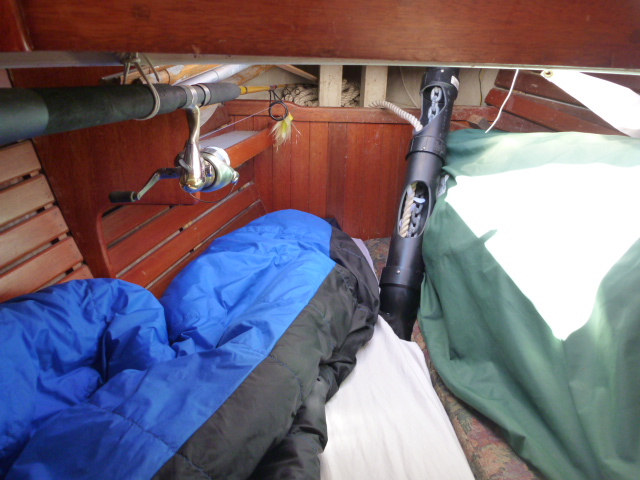 Secure anchor chain locker (again). By now Murre has almost 200 feet (220 pounds) of 5/16ths chain attached to her 35 pound CQR anchor–way more chain than can fit into the purpose-built forward locker. So, I route the chain to the space below the V-berth using standard housing water pipe. First install (done while at anchor at Isla San Francisco) is too far forward and there’s not enough space below for the chain. Redone in La Paz.
Grease the wheel; change the oil; re-caulk the scuppers; fix the engine blower hose that had somehow wrapped itself around the wheel and burst; paint the mast where chaffing has chipped it these last months; renew lashings for main sheet block, build a shelf for the VHF unit so that it is held in place by more than one screw. Etc. Etc.
A rare domestic item–install a trash can. It is said that a boat won’t feel like a home until it has a trash can installed. Murre’s is now behind the engine access hatch, and, true to the saying I feel amazingly better for it.
And lastly, get the writing up to date…

Where is Murre?
Good Bye SPOT, Hello YOTREPS
Family and a few friends were kind enough to gift me a tracking device, SPOT, for my cruise south, a device that has allowed me to send ad hoc position reports to important people (the wife, the mother, the sister) and to attach photos and stories to these reports on the SPOT ADVENTURES site.
But SPOT’s coverage is not global. Even when Murre was bound from Mexico to Hawaii, there was likely going to be a middle period during which position reports were not possible. Now that the heading is decidedly south, SPOT will fail even sooner.
SPOT is not a passage maker’s solution.
Luckily there is an alternative, which goes by the acronym YOTREPS (I presume this means Yacht Offshore Transit Reports, but the site chooses not to explain). YOTREPS is a free service that displays participating yacht positions in a familiar map format in exchange for regular wind, sea, sky, barometric and temperature data from the yacht, data that is used to help verify and refine oceanic weather forecasting.
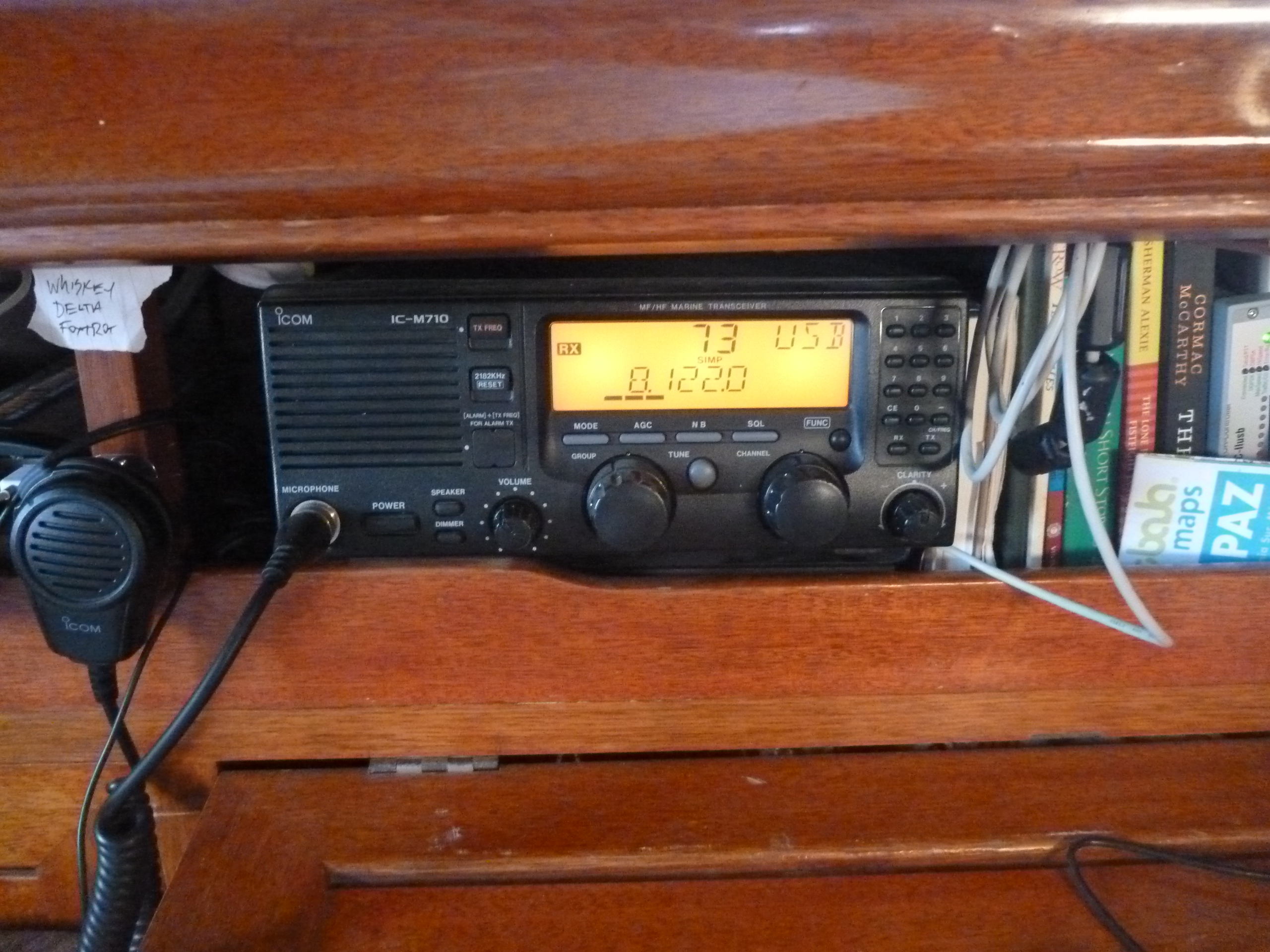 When not in a marina and thus beyond the reach of WIFI, Murre uses single sideband radio to communicate with shore. This technology allows voice communication with stations at great distance. Murre has heard news from China, game shows from Australia and has spoken with Oregon and El Salvador. When connected to a very slow and very loud modem on board, a modem I’ve attempted to quiet by sandwiching it on the bookshelf between Shakespeare’s Much Ado about Nothing and Pablo Martinez’s “only true and accurate” History of Lower California, the radio allows me to send and receive simple, all-text emails via a network of global receiver stations managed by Sailmail. And this is how I will tell YOTREPS, and you, where Murre is today.
The menu tab of this blog contains a header entitled Where is Murre? that links directly to Murre’s most recent position report. Feel free to visit here as often as you like.
For those interested in exploring Yotreps or finding other boats in transit, start with the YOTREPS Reporting Boat List. Boats are recorded here by name and YOTREPS ID number but are sorted by the ID number. Murre’s YOTREPS ID (her single sideband call sign) is WDF6383, so she‘s near the bottom of the list. Click on the hyperlinked word “track” to be taken to position maps. If you’d like more information, you can download the YOTREPS Reporter, which allows you to plot Murre’s position on a chart with the wind and sea state data I report.
Though this is all new to me too, getting reports appears to be straightforward, more so, at least, than my reporting of them, which requires that I divide the sky into oktas (eighths) in order to “count” cloud density, convert Fahrenheit to Celsius and think of wave height in meters.
Other Ways of Staying in Contact
Again, using the single sideband radio to transmit email and with a little luck I should be able to continue posting to this blog during passages. So be sure to sign up for the feed.
Important Disclaimer
For your own peace of mind DO NOT assume that my failure to post positions during a passage means that Murre or Randall are in trouble. A number of things could be preventing me from reaching out: the computer fails, the radio fails, the sun is in the wrong position, land based stations aren’t taking my traffic, my batteries are dead, I’m too busy managing the ship, etc. Though important, this communication mechanism is a luxury and will always be secondary to keeping Murre safe and on course.
A Change of Plans
Murre launched on her current adventure from San Francisco in November of 2010. She was headed south, to Mexico, down the Pacific coast of the Baja Peninsula, up into the Sea of Cortez, and into a rich cruising ground of indigo waters and tan desert islands that had captured my imagination for years. So complete was this incarceration that all of the articles I’ve posted to date on SPOT ADVENTURES have been under the title Murre in Mexico and none have discussed how boat and skipper would return home.
So let me catch you up.
From the Sea of Cortez there are two common routes north. One is affectionately called the “Baja Bash” by west coast cruisers; that is, switch on the motor and plow up the ragged coast against strong and stronger winds and seas supported by thousands of miles of fetch. Imagine, for example, walking from Los Angeles to San Francisco on the I5 freeway, against traffic; now delete from this image lane dividers and make the ground jump up and down. The ride is reported to be wet, rough, ridiculously unpleasant.
The other way home is via the historic “Great Circle” route, the track used by sailing ships of trade for thousands of years before the invention of that snotty upstart, the motor. Compared to the “Baja Bash” this passage is as leisurely as it is long. Take what wind there is out of Cabo San Lucas and follow it west, picking up the northeast trades to Hawaii in a week or so. From Hawaii shoot straight north on trades that soften as latitude increases; continue climbing up and up and around this ocean’s main weather feature, the North Pacific High, where northwesterlies eventually prevail and can be ridden to one’s destination.
While neither choice is fast in a modern sense, the “Baja Bash” passage is around 1600 miles and can be thought of in terms of weeks. To achieve the “Great Circle” route one must think in months: total distance traveled is at least 5000 miles and could easily require 50 days sailing, this without any dallying in Hawaii, a place that invites dallying. Murre’s way home has always been via Hawaii.
But, in fact, there is a third route.
A few weeks ago I was sitting by the pool of a nice hotel in San Jose del Cabo with my lovely wife, Joanna. I put down my book, took an extra long pull on my margarita and ever so casually remarked that I’d been thinking of heading to Hawaii via French Polynesia. To which my wife immediately replied “why not!”.
Current occupation to one side, I am actually the timid one in this relationship. I could think of a thousand reasons why not (too far, too long away, too expensive, not part of the agreement, too damned scary, etc.) and had been rehearsing answers to her objections for days, so I was entirely unprepared for no objection at all. I hadn’t imagined I’d see the gauntlet lying there at the foot of my chaise lounge smiling sweetly and purring like a kitten. All I had to do was pick it up.
So I did.
The nearest approach to French Polynesia is via a small group of islands called the Marquesas. These lie 2600 miles southwest of the southern tip of Baja at about 10 degrees south latitude and on the other side of the Intertropical Convergence Zone (ITCZ), more commonly known as the Doldrums. From here one carefully makes way through the fringed reef islands of the Tuamotus and into the famous Society Island chain at whose center is Tahiti. Of course, one can continue trending west–the choices are nearly infinite–to the Cook Islands, Samoa, Fiji, Tonga, the New Hebrides and find, eventually, New Zealand or Australia as did the explorers of old. But too much westing makes Hawaii a difficult destination, and Murre dearly wishes to see Hawaii this season, so we will launch north from Tahiti.

This change of plans will add 2500 miles and about six months to the itinerary. The northern and southern hurricane seasons typically dovetail, and when, in October, cruising boats are required (by law) to depart French Polynesia in order to avoid their late year storms, hurricane season in the north has wound down, making passage to Hawaii safe. Once there, one must wait until late spring before a passage over the high and through the wintery northern latitudes is tenable.
So, Murre will depart south in a week or two, wander among the Polynesians until fall, plan to arrive in Hawaii in early November, and from there launch for home in May of 2012.
It all sounds so easy.
 Murre and the Pacific