Tahiti Revisited
August 25, Tahiti
A habit of procrastination and laziness has the advantage of ensuring one is always on the cusp of surprise and wonder. Without a plan you never know what interesting thing is just around the corner.
One month you may be sailing to Hawaii and the next may find you in French Polynesia with the intention of slumming around until hurricanes have stopped booming above the equator. But just as you finally make that jewel, Tahiti, and a mere week before you are to celebrate the passing of three months in the superlative island group, your agent delivers news that a visa extension is not in the cards. It’s something to do with the new Customs Deputy in the capital city, Papeete, who thinks ninety days in the company of an American is ninety days too many. If only you had followed the rules; if only you had applied for an extension six months before departing for the islands, in which case your application would have been routed through Paris, where inexplicably, official feeling flows in a different direction.
But six months before departing for French Polynesia the idea of sailing there hadn’t even occurred, you explain. You’d never even heard of the northern islands until other cruisers in Mexico set their courses south, waving their good byes and shouting “see you in the Marquesas!”
The what? Wait, how’s that spelled?
Helga’s cell phone rings and she takes the call. The two of you are seated at a picnic table in the shade of a banyan just up from the dinghy dock at the Tahiti Yacht Club. “Yes, I have the passport,” she says into the phone. “No, the papers won’t be ready until tomorrow.” And you stop listening.
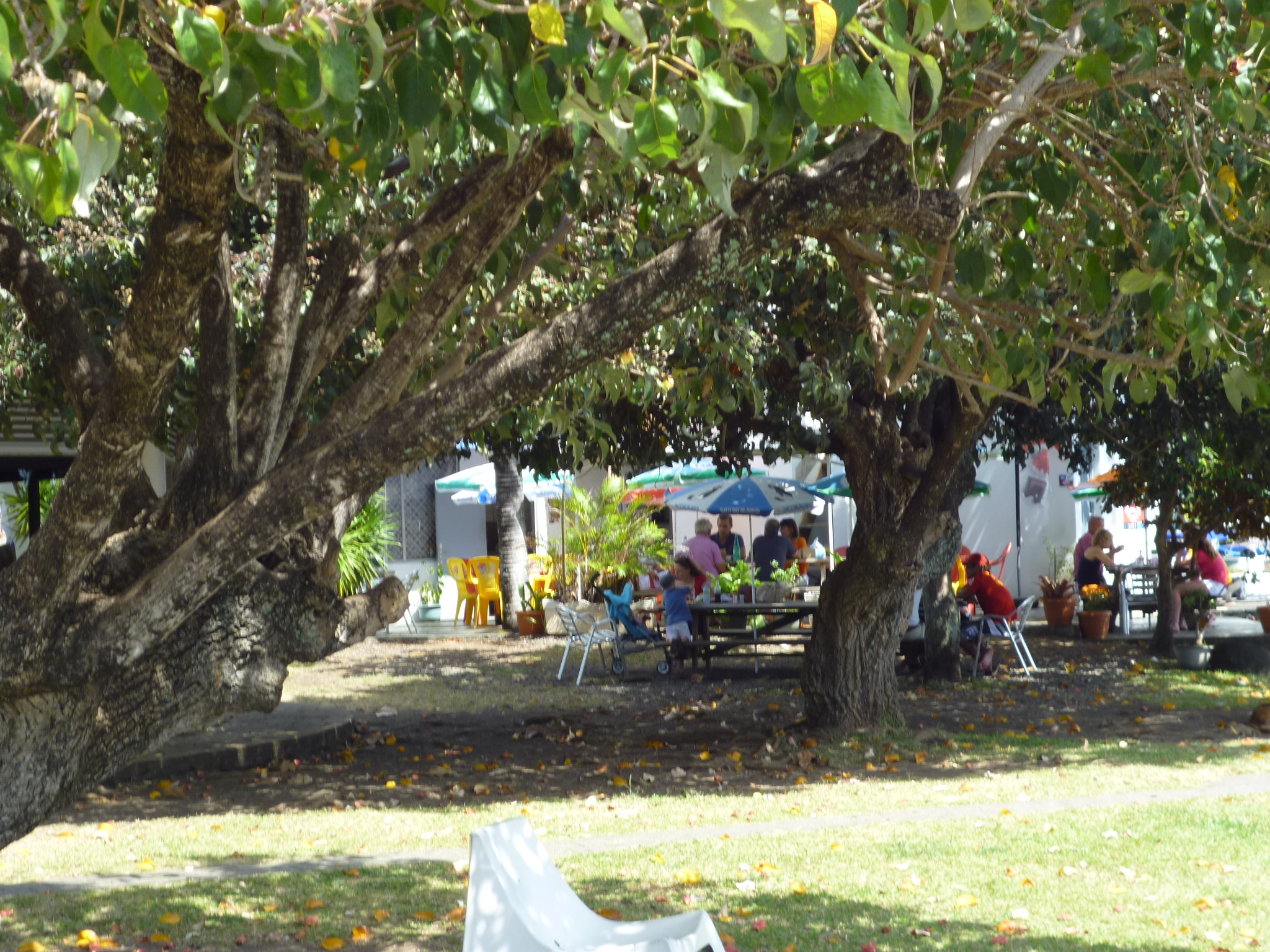
The Meeting Place
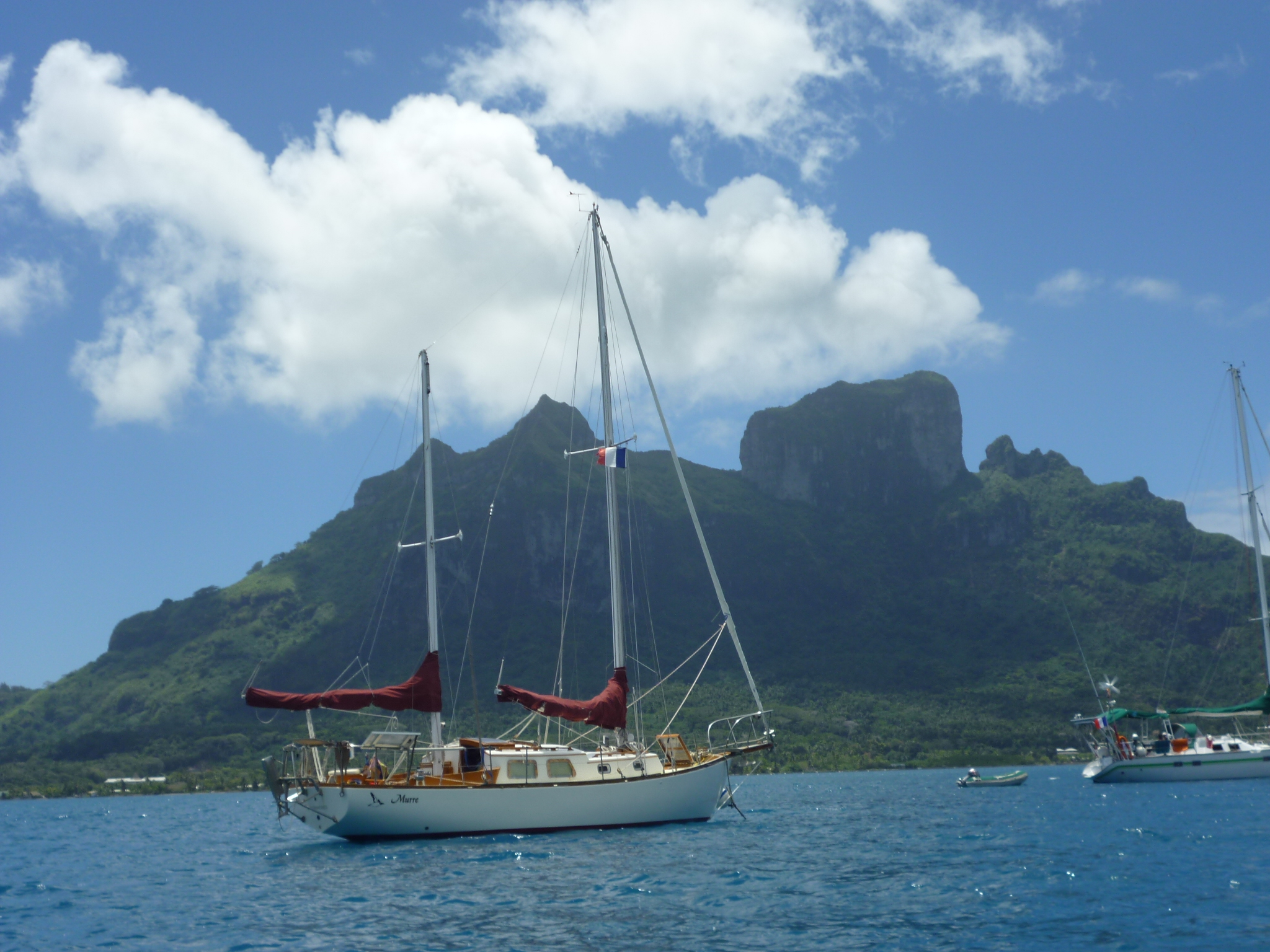
By American standards the marina is small. In fact, with thirty boats docked med-style near the wall and another ten on moorings out in the bay (of which Murre was one) it hardly rates as a marina at all. But the private showers have large nozzles that deliver a torrent of hot water and there are two tiny restaurants on property. Each serves Italian espresso and Tahitian beer and French wine and Poisson Cru de Coco and Steak Frites and Creme Brule from seven in the morning until well after sunset. One is fancy and one is not, but in each case the employees are locals who appear always to be laughing, telling stories in a blend of French and Tahitian that makes you smile even though you know nothing of the content.
And the neighborhood is comfortable, in an urban way. The yacht club is located in the commune of Arue on the eastern outskirts of Papeete where the hills are covered with homes and apartments, some fancy and grouped behind steel gates, others ragged and without paint. A large cemetery sits on a promontory overlooking the ocean where each grave is covered with a white roof protecting its resident against the harsh tropical sun. The boulevard rushes with Peugeos and Citroens and Renaults and Fiats and scooters of all kinds and smells strongly of exhaust. In the mornings it is jammed with work-bound, Papeete-bound drivers, all of whom signal lane changes through the roundabouts, none of whom honk. They politely stop for pedestrians yards back of the intersection–so far back, in fact, that you are unsure your first time crossing that they have stopped for you. Only blocks away is a grocery as large as Walmart and similarly stocked, except that an entire isle is dedicated to cheese, another to bread, and there is a pate counter behind which stands a toothless woman in a blue smock waiting to slice off half a pound of any paste you desire.
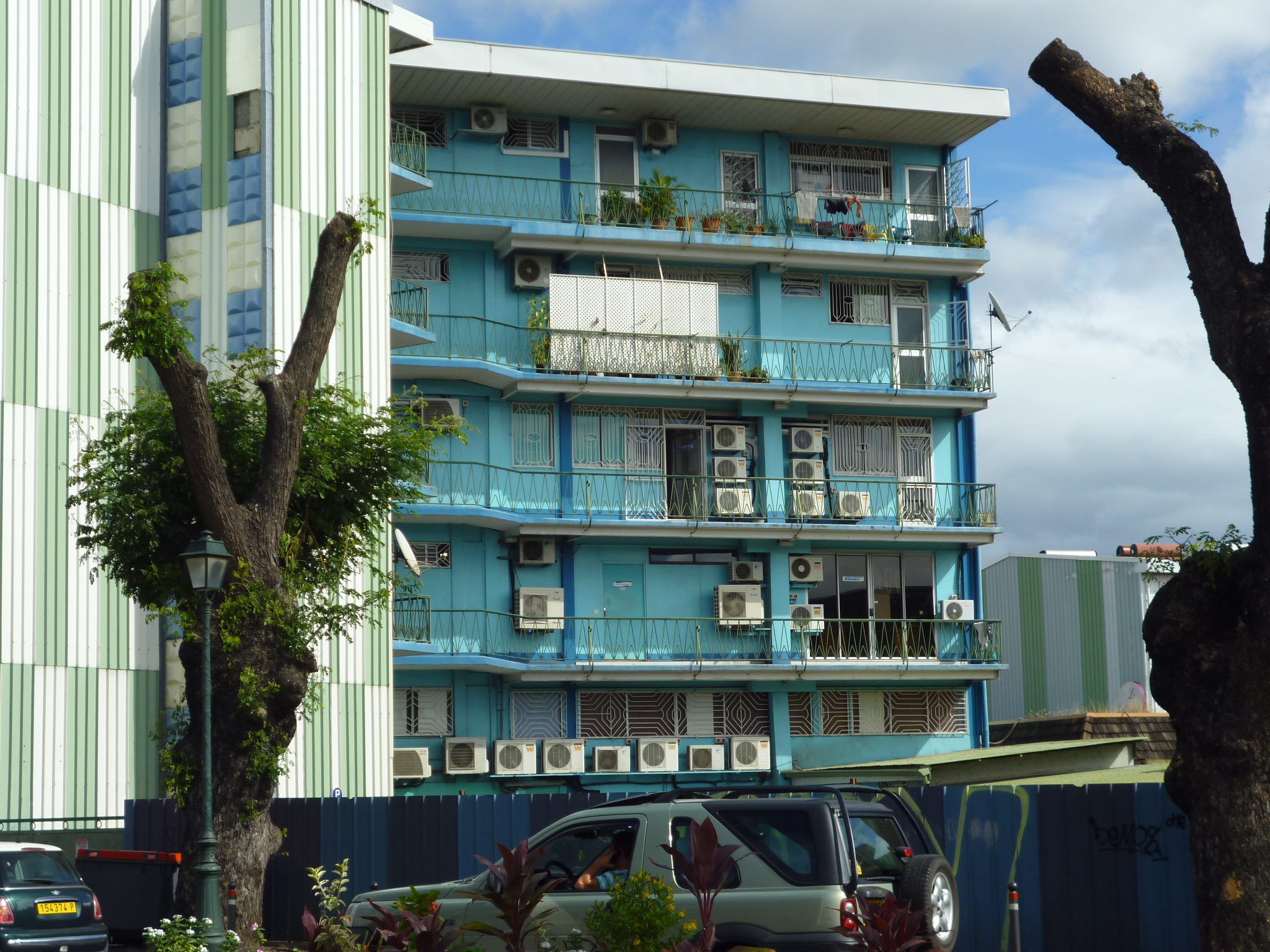
Apartments in Papeete
Across from where Murre lays is a large, rundown apartment complex full of families, both Tahitian and French, that flow out into the large yard in the evenings as the day cools. Each afternoon the bay fills with children learning to sail Optimists in twenty knot trades and they are reefed down hard. They only turtle occasionally; often they are upright before the instructor’s speed boat can race to their rescue. That is a thing to respect, you think. And the harbor master has given you a map of Papeete, only four kilometers up the road, and has offered to print some documents you need. His nose is big and red and his ashtray is full of butts before noon, but his smile is genuine and quick to invade his face. And a French couple on RANTAPLAN has given you an electronic chart plotting program to replace the one you lost in the Tuamotus. They sailed here from France sixteen years ago, and stayed. And why not, you think. This is where the real people live. There isn’t another tourist for miles.
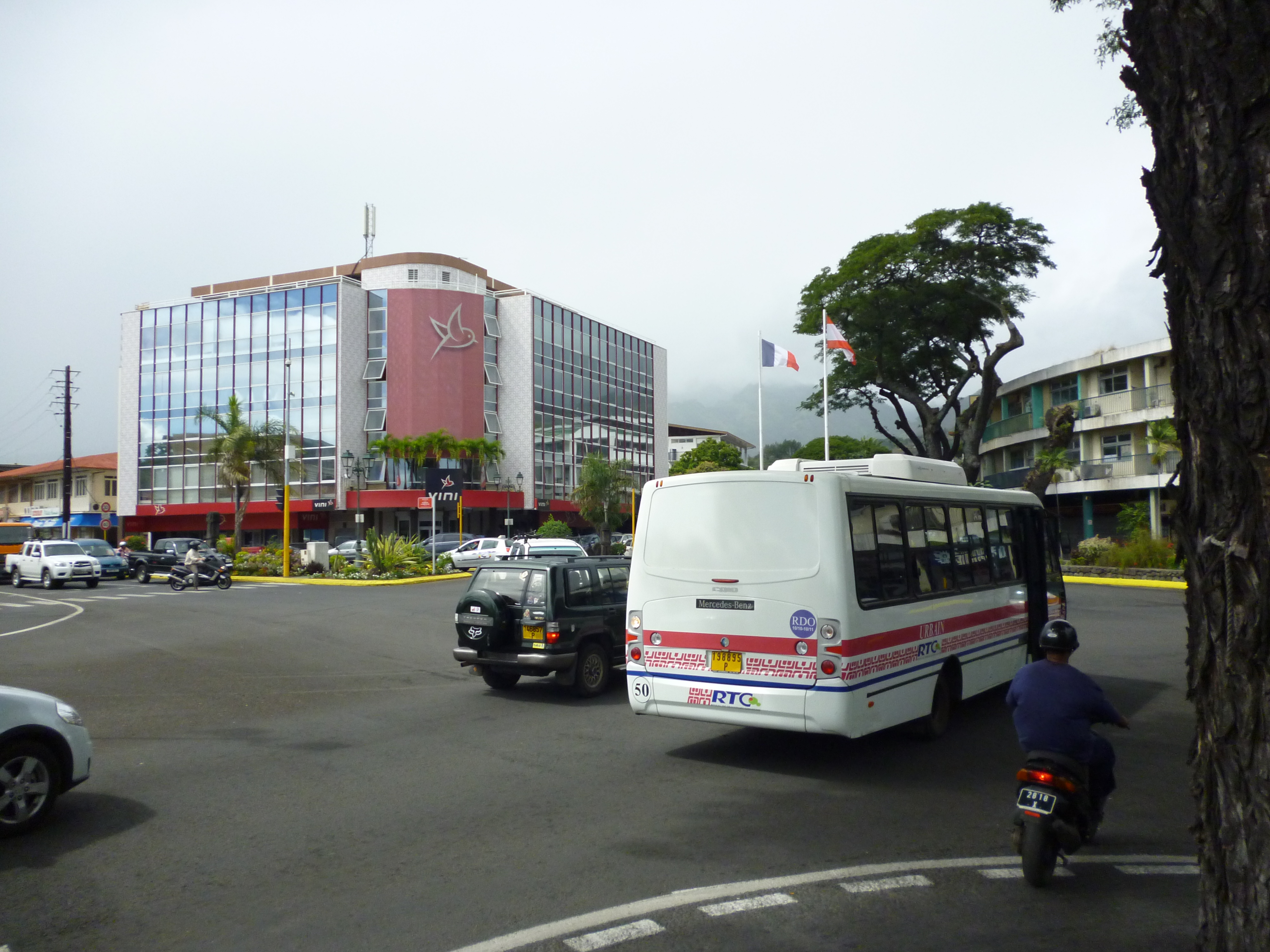
Busy Downtown Papeete
You walk to downtown Papeete and it is a mash-up of shops and restaurants, people and cars. Busses exhale dirtily onto sidewalk cafes filled with patrons concluding lunch with cigarettes and espresso. Bars blare American rock and roll. Ferries to Moorea clank in the surge of their docks as they fill with passengers. One cargo ship departs the harbor with a blast of its horn as another makes an approach. The main market, stall after stall of fresh fish, vegetables, bread and pastries, shells, beads and floral-patterned pareas by the bolt, is as large as a trains station and almost as busy. Near the edge of the shopping district is a grimy night club called MANHATTAN, and you almost believe it. Papeete is gritty and electric and you like it.
Helga closes her phone conversation and turns, and I am snapped back to reality.
“Have you decided where you are going to go?” she asks, jumping to a conclusion I still wished to argue. Helga is my customs agent, a German who in her past has worked cruise ships all over the tropics. Her business focuses primarily on handling the customs paperwork for Tahiti’s commercial traffic, only last year taking on the task of passing cruising boats through the system. When I inquire why she’s still here in Tahiti, she responds with “Typical story. Met a man. Had a baby. Now I am every day in paradise.” She hands me a pen with which to sign papers laid out on the table. I put it down.
“Seriously, Helga,” I say. “I planned this trip based on information from an older guidebook that said visa extensions in French Polynesia were not a big deal.”
“Ah, those old guide books,” she says, indicating this approach is as novel and surprising as “the dog ate my homework.”
“And now that I’m here,” I continue, undaunted, “I’m stuck. I can’t go back to Hawaii now because its hurricane season above the line. I can’t leave now; its unsafe to do so. I could die.” I say slowly, emphasizing the words “now” and then “die” in a way I hope is meaningful. “And I can’t go west and still get north to Hawaii later. Hawaii is my home; I have to go there. Surely your Customs Director would understand that!”
“No he would not” says Helga flatly, “he’d say you should have planned better.”
There is truth in that, I think, but it’s hardly the point.
“Please allow me to remind you,” I say, “that these are the Society Islands. You’re country isn’t being very sociable, Helga.” But my jab misses.”
They’re called that because they are close together,” says Helga sternly, “Not because we are friendly.” But then she laughs. “I’ll clear you out to the Cooks,” she says. “It’s just a quick hop.”
We move on to other topics, I sign the papers and Helga leaves with my passport, promising to return the next day.
—
Later that day my wife, Joanna, arrives from San Francisco for a week’s visit. I haven’t seen her since Mexico, since April, and I hold her hand so tightly on the way into town she can barely shift the gears of the rental car.
She is the logical one, the planner. So over our first romantic dinner in months we talk options.
“I have three,” I say. “One is to fly home with you now and return after the northern hurricane season but before the southern.”
“Length of time?” she asks.
“Three months,” I say.
She scowls. “Miss you as I do, that’s kind of a long time to have you moping around the house, besides which it’s not very adventurous. What are my other choices.”
“The second is that I continue west through the Cooks, Tonga and Somoa to Fiji, which has one, maybe two good hurricane refuges.”
“I’m all good with Fiji,” says Jo. “Very pretty. I’ll come visit.”
“Yes, I will admit continuing on is attractive, but Fiji is another sixteen hundred miles west, and I doubt I could return to San Francisco in one season. It’s just too far. Summering in Fiji would extent the cruise into 2013. That would make it three years since I left home.”
“That’s not the deal,” says Jo. “A one year cruise that becomes a two-year cruise is one thing, but a one year cruise that extends to three is quite another. Who’s to say you wouldn’t…
“I know,” I say. “Fiji is close to New Zealand, which is just a short hop to Australia, which puts me in the Indian Ocean from which I can almost see South Africa. Pretty soon you’ve retired and moved to the south of France and I’m still not home. I get it…”
“I’m not trying to be evil,” says Jo.
“No cruiser I’ve ever met believes I have a wife at home who’s OK with any of this. Forget about it,” I say.
“So what’s the third option?” she asks.
The waiter delivers our entrees. Joanna is having Mahi Mahi dressed in fresh limes and mango. I am having the lamb.
“Well,” I say slowly, “there are still several islands in French Polynesia Murre and I haven’t visited.” Looking at my dinner I say, “I could go on the…”
“You mean…” says Jo following my eyes. “No way. Go … rogue?”
“Shhh.” I say.
“But what’s the risk?” she whispers.
—
Helga arrives next day early to deliver my passport, and I hitch a ride with her into Papeete. I have been practicing my questions all morning.
“So, how do you like working with the cruising class?” I begin.
“There’s no money in it and you people are irresponsible,” she says quickly but with a smile. Helga is as naturally friendly as she is blunt. “For example, most cruisers make me wait at the dock. I even have to call them to come in their dinghies sometimes. You I like. You are prompt.”
“That’s it? You don’t like us because we aren’t timely?
“And you don’t care about the rules, especially you Americans.” she replies. “I know a man over in Marina Taina who is a week past his visa. Each time I say he needs to leave he shrugs me off–‘next week’, he says. And there’s another man–this man has no boat or money–who is two weeks overdue. He can’t find anyone who wants crew. Do you need crew?” asks Helga.
“I’m singlehanding,” I say. She looks at me quizzically. “I prefer to sail alone–it’s a small boat.”
“Two months ago a father and son sailed through.” she continues. “The son’s visa expired while they were in Tahiti and the father said the boy had flown home, but they found him on Hiva Oa in the Marquesas last week. In the Marquesas!”
“They?” I ask.
“The Gendarmes.” says Helga.
“And then what happens?”
“I have to fly him home, immediately, and at my expense. This boy lived in Seattle so I routed him through Los Angeles and Chicago in a middle seat. He wasn’t happy with me, but from him I get a police record. The Gendarmes blame me.”
“But do the Gendarmes actively search out people who over stay their welcome–I mean hypothetically?” I ask. The question is unfortunate, says too much.
Helga gives me a stern look. “Every Wednesday they do a sweep of Tahiti marinas, but you”, she says with emphasis, “are leaving French Polynesia for the Cook Islands.”
“I know that,” I say.
“When?” she asks.
“When does my visa expire?”
“August 23,” she says.
“Then,” I say.
“I’ll meet you the day before with papers,” she says.
—
On August 22, Helga and I meet under the banyan tree of the yacht club and I clear out to the Cook Islands via Moorea.
“Here is your passport, and this is your customs paperwork,” says Helga. “Note here it says ‘Cooks via Moorea’. You can show this to the Gendarmes on Moorea if you want, but,” she pauses and says meaningfully, “I don’t think they care.”
—
September 28, Bora Bora
One looks for omens, signs that this is the right time to depart. This isn’t superstition so much as an acknowledgement that the imminent undertaking is arduous and one needs all the favor one can get. Yesterday I was to weigh for Hawaii. In the morning the sky was low and grey and it rained heavily. I had a blog to finish. It had been five days since I’d taken on water. There was a knot in the pit of my stomach. It didn’t feel right.
The afternoon broke sunny and I rowed ashore with my water jugs looking for a spigot. At Bloody Mary’s restaurant I popped into the office, said I’d noticed a hose at the back of the building and could I take water from it. “I’ll go you one better,” said the owner in clear, American English. “At the end of our pier near your dinghy is a lock box with a hose in it. Here’s the key. And you can dump your trash out back. Do you need ice?” That was the first sign.
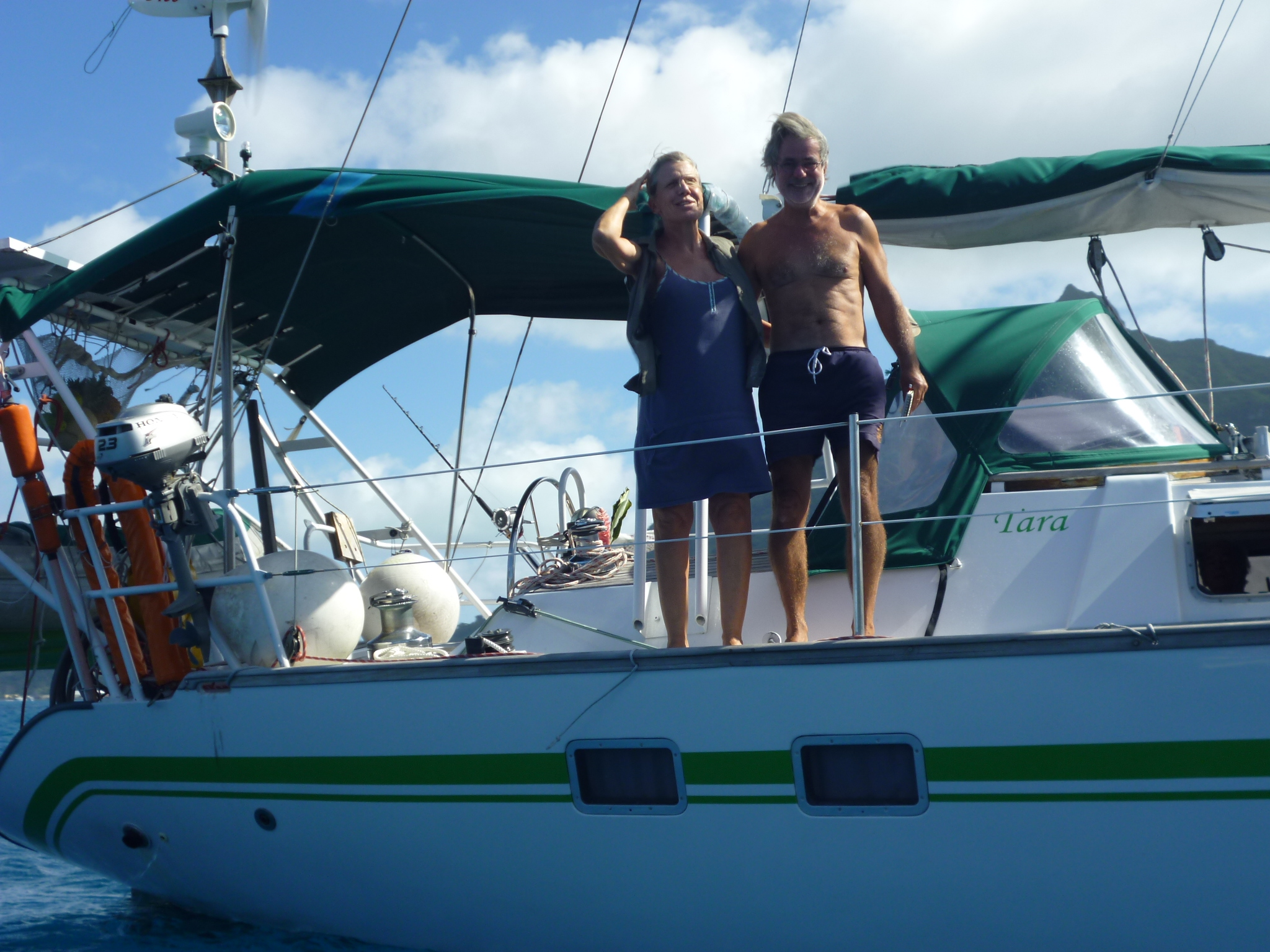
Gerard and Michele of TARA in Bora Bora
Then in the afternoon TARA of Paris, a lovely aluminum cruiser with a green stripe, pulled in and moored next to me. Gerard waved. I waved back. Gerard was the first man I met in French Polynesia. I had just anchored in Atuona, Hiva Oa, after a twenty-six day crossing from Cabo San Lucas, and, looking up from my exercise, noticed a lovely aluminum cruiser next to me, its owner putting off in his dinghy for Murre. Gerard explained that clean as my bow-and-stern, singlehanded anchoring maneuver had been, I had chosen my location poorly. It was too shallow. Ground swell would fill in if the wind picked up and I’d likely touch if not pound. He pointed to a better spot and spent an hour helping me get there. I was tired; the harbor, tiny and crowded. And his kindness more appreciated than he knew. We have not met since then, so this morning I rowed over and thanked him again. It was fitting that TARA and Gerard would be my last meeting before departing French Polynesia. That was the second sign.
The day is clear, wind brisk. All the other boats that were moored here overnight have departed; even the cruise ship, Paul Gauguin, looks to be raising its anchor. There are no more signs to be had and looking is just delay. Time to go.
Huahine, Raiatea, Tahaa, Bora Bora PHOTOGRAPHS
Click here for are a few pictures of the last four islands Murre visited in the Society Island group.
Battery Issues at Opunohu
Lest it be thought that Murre is the only cruising yacht in the Pacific to experience technical difficulties, the following:
Sailing vessel QWave departed Mexico for the Marquesas in early April. Three days later she was passing to the north of the Revillagigedo Islands under a heavy, grey sky when a lightning storm overtook her. One bolt struck her main mast, knocking out her electrical system, including her ability to start the engine. Her owners, a retired couple, decided to continue on instead of turning back to Cabo San Lucas and repair: winds were contrary and the climb could take over a week. Murre departed Cabo for the Marquesas almost a month later and began checking into one of the several marine radio networks in the evenings. By this time QWave had managed to jury rig an undamaged solar panel for light-duty charging and so had limited radio access and daily GPS position fixes. The radio conversions with QWave were always the same:
“Network Moderator calling QWave, QWave QWave how copy?
A drawling male voice as though from ten miles up a Louisiana bayou would respond with, “Oh, we copy you jess fine, honey. Ya’ll comin in loud and clear tonight.”
“Then come ahead with your report, QWave,” the moderator would invite.
“Ok, honey, let me jess lean over and turn on the GPS.”
It was late in the season, but the Pacific still held at least ten boats making their southing from Mexico or the US to French Polynesia, and they were spread over a thousand miles of ocean. Most were new to marine radio nets but quickly got use to delivering evening reports succinctly and in a certain format for a moderator, also a cruiser somewhere in the loose pack, who was taking careful notes in case of emergency. Position, course, and speed, wind, waves, barometer and temperature, in that order and with specific attention to the calling of the numbers: 09 degrees 37 minutes north latitude, for example, was spoken as “Zero niner three seven north”. Not so with QWave.
“Weeull honey, the GPS is slow tonight, but I tell ya what, we’re still in the doldrums,” would say the man. “We had some wind for a couple a hours, mostly from the south, but it’s gone again. We’re jess rollin.”
“All well aboard?” came the moderator’s automatic question.
“We had our last can of tuna for dinner. This is day forty-two, honey. We’re gettin a bit tired. Would like to make the equator soon.”
“Is there anything you need?”
“Well, we could use a leetl watah. If anyone can spare it, we’d be very appreciative. We’re down to five gallons.”
Typically there was another boat within a day or two of QWave’s position that was willing to heave-to while QWave caught up.
Their passage to Nuku Hiva took fifty-five days. Compare Murre’s at twenty-six.
That was a more spectacular example of a cruiser with technical issues, but I’ve encountered many others in the last few months. At Kauehi atoll in the Tuamotus we met MABUHAY, stuck there for two weeks awaiting delivery of a new, less leaky hydraulic steering hose. The day after we departed Kauehi, TUTIN arrived there, and as she motored into the small harbor, her transmission clanked loudly and quit. ODIN’s water maker seized one week west of the Galapagos Islands. COLUMBINE’s auto helm failed on her crossing to the Marquesas. PUKIRI had to replace batteries in Raiatea. PUKURI’s batteries died old age, however. Murre’s succumbed to a different phenomenon.
Murre carries three large wet-cell, deep cycle, maintenance free house batteries bought new for this cruise. I’ve been particularly pleased with them: they pack a lot of power, and because they are maintenance free, I don’t have to worry about refilling the cells periodically. I have bragged of these batteries to other cruisers, and each has looked at me skeptically. “Do your maintenance free batteries have water fill caps?” they always asked. I would affirm this but say they were flush caps that shouldn’t be opened. “Are you sure they are maintenance free?” I was very sure, I would say. I remembered the packaging. I remembered.
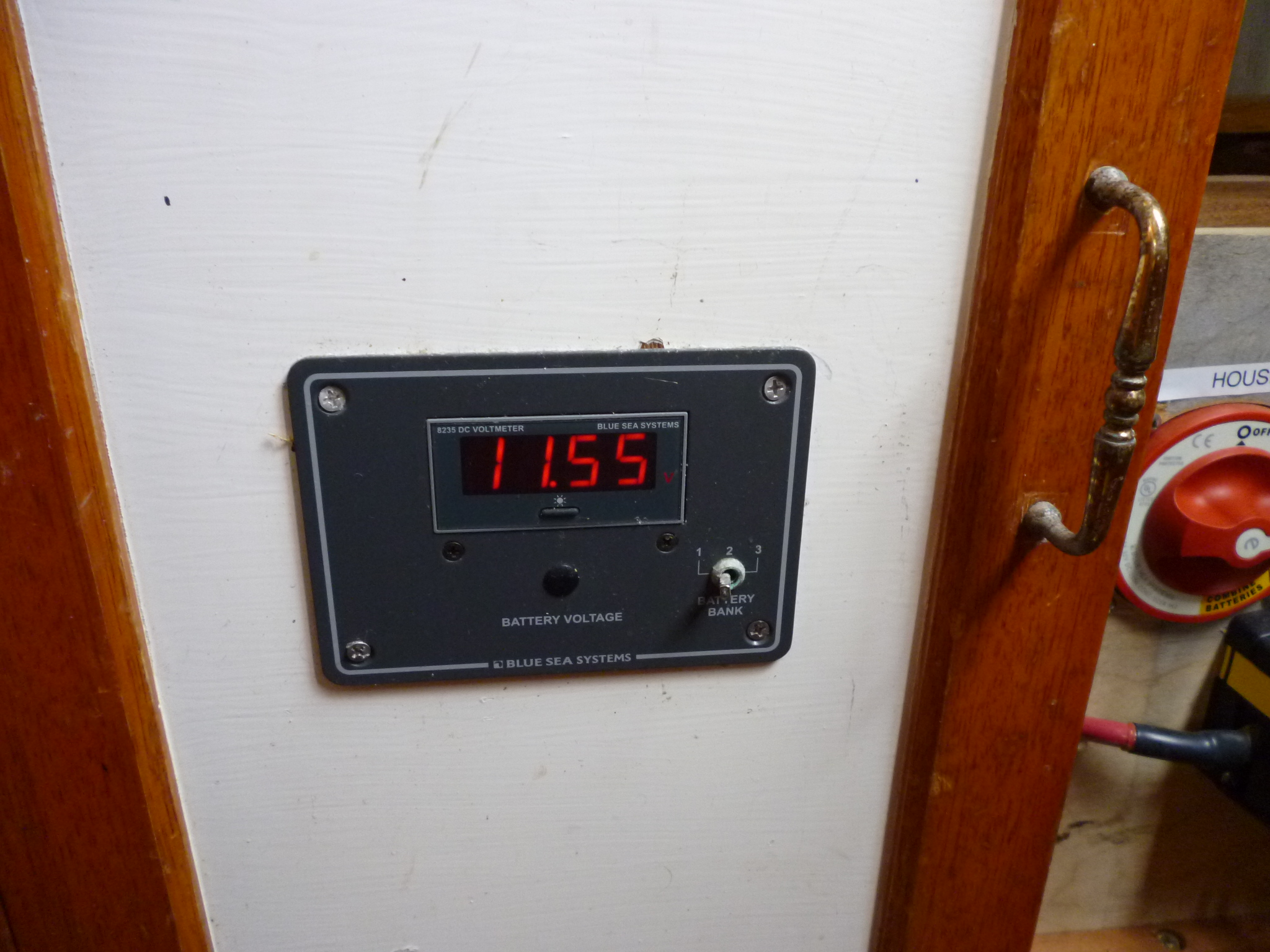
Low number. Bad omen.
During our long stay at Opunohu, I noticed that morning battery voltage showed lower and lower readings even though charge and usage patterns remained constant. As we were just days away from launching for Hawaii, this was an issue that needed exploring. I spent an afternoon ensuring the solar panels were operating properly. I opened the battery compartment and examined all the post connections, cleaning several, though they still had the shine of newness about them. I tested for voltage leaks–there were none. I even tested the automatic voltage meter with a hand-held. There simply weren’t any problems. As an afterthought I popped one of the flush fill lids on one of the batteries. The cell was half dry and the lead exposed. I immediately opened the other seventeen compartments. Each was the same: dry below the lead.
“How could this happen?” asked Hannes of PUKURI when I explained my problem, but I could find no answer that didn’t make Murre’s captain into a fool. How, indeed, could I so clearly remember a feature of my batteries that did not exist? Did I make it up? If so, how? And why? After having spent so many hours designing and installing Murre’s electrical system, why would I sabotage its effectiveness in this way and on the eve of a major passage? Was my false memory sabotage, ill-timed senility, or just really bad luck? It was a situation that deserved considerable soul-searching, but there was no time for that now.
The thirst-crazed batteries took almost two gallons of distilled water, most of my supply. After a full charge, I set about assessing the damage. “Never allow a battery’s lead plates to become exposed to air. Damage is irreversible,” said the manual. But a load test was inconclusive–the house batteries in question seemed to be as strong as the starting battery. Next came a full capacity test, an exercise during which batteries are drained slowly over a long period of time. “During a capacity test,” said the manual, “healthy batteries should last for twenty hours.” I started at six in the morning, and they were dead by noon. I looked over at the manual. “They’re weak beyond revival and might fail utterly at any moment,” it replied.
What would a mid-passage battery failure mean on a boat where most systems have at least one backup? I made a list:
1. Engine starting/operation–seperate battery system not compromised by house battery failure.
2. Electric Bilge Pumps–Murre has two manual pumps and a number of buckets in the starboard settee.
3. Water pump–we only use manual foot pumps for galley water.
4. Cooking fuel–there are no electrical elements in this system.
5. Refrigeration–not used during a passage anyway.
6. Navigation–if used once a day for position fixes, the chart plotter battery could last the voyage. Or use handheld GPS, also failing. Or navigate by sextant. Back up chart plotter and USB GPS on laptop vulnerable to below.
7. Navigation lights–could hang paraffin anchor light in rigging. Otherwise not backup.
8. Automatic Ship Location Device–no backup.
9. VHF radio power–no backup.
10. Marine Radio power–no backup.
11. Laptop computer battery charging–no backup.
Bottom line, it could be done, but departing with fresh batteries would be better. Surely this would require a return to Tahiti (an idea I loathed), or could I have them sent to Moorea by ferry? I would need to make some calls, so moved Murre to Cook’s Bay to be nearer the village cell tower. Ashore I asked for a hardware store where I could replace my supply of distilled water. “Ou est le quincaillarie?” got me nothing but funny looks until I found a man who spoke English. “You should go to the bicycle shop,” he said. “They have car parts too but we call it ‘the bicycle shop’. You see them out front. The bicycles. Inside is the shop. I don’t think they have water.”
But the owner of the bicycle shop said he did have distilled water by the litre and by the gallon. And he had an entire shelf of batteries on display. I explained my situation. “These are all car batteries, but I know a battery guy for boats. I will call. Come back tomorrow,” said Moana, a big man with a big smile who walked his store in bare feet. I returned the next day to find that the batteries I needed were, in fact, available and could be delivered to his shop in a single day. I ran through the specifications with Moana one more time to be sure–voltage, amperage, dimensions. Price: $23,000 Pacific Francs each, competitive, even for the US. “And the delivery fee?” I asked. “For me there is no fee. I know the man who loads the boat,” said Moana.
I couldn’t believe my good fortune. Nothing is that easy in French Polynesia. “And they can be here tomorrow! Fantastic!” I said and reached into my pocket for the cash.
“No, not tomorrow,” said Moana. “I think maybe a week.”
“From Tahiti? It’s only twenty miles. You said delivery would take one day.” I replied.
“My man in Tahiti is all out. These batteries come from Raiatea–a different man, different island. The boat only takes one day, but there is only one boat a week, and it arrived yesterday. I can order next Wednesday for delivery on Thursday, so if you come back next Tuesday, we can order Wednesday for Thursday delivery. You understand?”
I wasn’t sure I could take another week on Moorea, and I’d heard too many stories about important parts ordered properly that failed to make the boat. I got the name and number of the battery shop in Raiatea and thanked Moana for his help. “You come back next week when you decide, OK?”, he insisted. I said I would, and by way of ending on a positive note, complimented him on his name. “It means …” and I spread my arms wide.
“NO!” said Moana. “Not big. Moana means deep ocean,” and he waved a meaty hand, pointing beyond the parking lot, beyond the road and the beach and the reef. “Out there: that’s my name,” he said, in case I’d forgotten in which direction lay the big ocean onto which Murre and I cast ourselves Friday evening, bound overnight the seventy miles to Huahine island, beyond which Raiatea was but a short jump of twenty.
We sailed off anchor under jib alone, and just beyond the reef I set the wind vane. Where the goal is to arrive at a new port of call in the broad of day, sailing overnight on short runs is a fairly common tactic, but I find it a bit unnerving at first. Other boats at anchor are cooking dinner or watching the sunset from the cockpit as you head off into a night of slogging and sloshing; that and the slow sinking of the island’s lights and an inability to see the waves you are not yet used to adds to early feelings of discomfort. I spent the first hour tuning Molly to our course of 300 degrees true, and once she found her groove, she stayed more or less on course till morning. As dawn came on I shot six stars with the sextant, only three of which worked up to a meaningful position. A small boat on the move is a galloping animal, and the heavens above, much less fixed than in the ease of a quite harbor, where I was fortunate to have practiced.

Village on west side of Huahine
We spent two days and nights anchored on a sandy shelf out on the fringed reef of Huahines’s village, during which time it blew so hard over the pine covered hills that I was unable to leave the boat except for a short hike on a Sunday afternoon. The town was shut tight. Kids played in the surf. An old man sat on the pier for hours looking out at nothing in particular.
We departed early Monday morning, leaving most of Huahine unexplored, and were shooting Teavapiti pass into Raiatea’s lagoon by two in the afternoon. Raiatea is second in size and population only to Tahiti, and with smaller Tahaa but a few miles to the north and within the same reef, she feels even bigger. We worked our way between these two islands, racing before twenty knot winds from the east on water flat as a lake, to Raiatea’s west side where are located the island’s one boat yard and one marina, and the town of Uturoa (or so my chart suggested), dropping anchor outside the boat yard, Chantier Naval des Isles, by early evening. I called the battery shop while the anchor growled unhappily across the coral hard-pan. To my relief, the owner, Emanuel, picked up immediately and even responded in English, but he couldn’t figure out where I was on the island (note: one marina, one boat yard). His directions, however, led me to believe I’d come to the wrong side. It was too late in day to go back, and the anchor wasn’t holding here, so I moved a mile further down the channel and dropped the hook in sand where the bottom went from fifty feet to five in a heart beat. I slept poorly all night for worry of dragging into the nearby coral heads.
Just after sunup on Tuesday, we motored back to the windward side of island where, sure enough, there was the town center. How could I have missed it? But the anchorages were far too deep for Murre and all were a lee shore. After feeling around for an hour, I returned to the west side and the boat yard and took a mooring, the cost of which I had wanted to avoid, but when I rowed ashore the receptionist, Patrice, informed me I could not stay. “The buoys they are all reserved; it is very difficult,” she said. The day was getting on: what to do? A call to the posh marina at Apooiti was answered and moorings available for $220 Pacific Francs per meter of boat per night. Murre was snugged into the tiny bay by noon.

Fleet of charter catamarans with Murre behind
The harbor master, Jean Micel, sat behind a large desk in a second floor office that looked out onto a fleet of white and yellow charter boats. He was a thick-set man with a shy smile who introduced his two dogs, one big and black and muscular and the other small and tan, as PUFF and POUCE POUCE, respectively.
“POOF?”, I asked, almost innocently, while handing over payment for the night.
“No, PUFF,” said Jean Micel with an expression that suggested Americans who speak no French ought not to engage in French wordplay with Frenchmen who speak no English. That was a lot to pack into one expression, but the message was clear. POUCE POUCE, which translated to “itchy”, was less controversial.
The walk into town took less than an hour, and one o’clock found me outside Rapid Auto Service where I was greeted by Emanuel, still brushing his teeth after lunch. “Moana of Moorea sent me,” I said, and the rest was easy. Emanuel was pale and French and slick in an island sort of way, hair combed back, the requisite surf shorts new instead of grungy, a crisp button down shirt opened part way to reveal a small, gold cross hanging from his neck. He pointed to his battery selection–pallet upon pallet, every size, shape and kind.

New batteries in and under load
In fact, the car batteries to one side were the only thing automotive about the place. The lift was covered over; tool racks were empty of tools; stacks of batteries filled work benches and every other available space.
“Fresh shipment,” said Emanuel, pointing to a pallet of deep cycle batteries of the power and size I needed. I handed over the cash for my three batteries and was, to my surprise, handed a printed receipt on which was handwritten “six month guarantee”. “We can take you back to your boat–there is no extra charge for this service,” said Emanuel. And by the evening of Tuesday, the batteries had been installed, two days earlier than if I’d stayed in Moorea.
By way of miraculous vindication, I had noticed in one corner of the Rapid Auto Service shop a set of batteries of the same size and shape as the ones I had come to replace–wet cells, made in Italy, with flush fill caps, the sticker on the side announced in English, “Maintenance Free”.
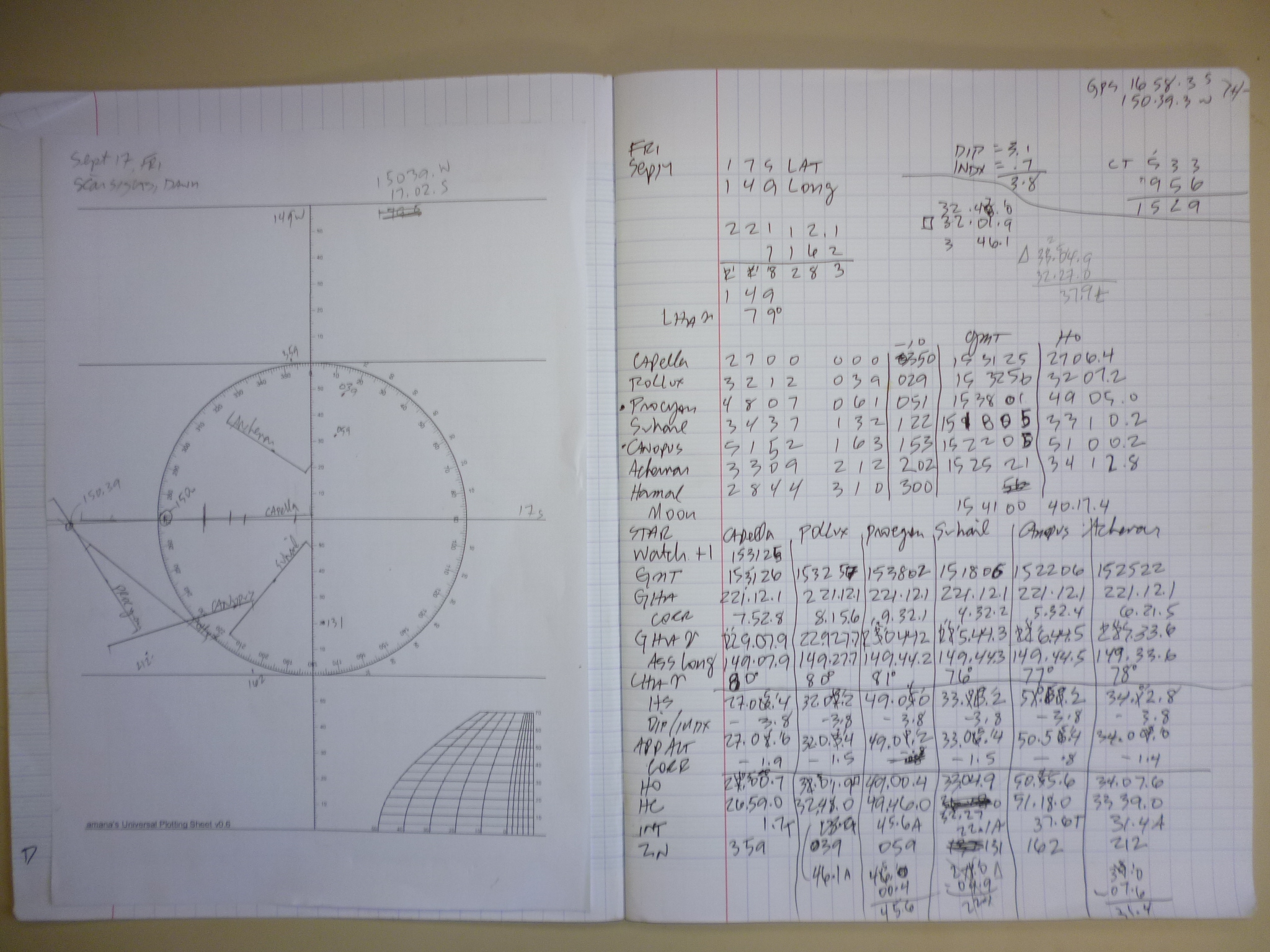
First at-sea star sight work-up
- Beautiful Teavapiti Pass on the east side of Raiatea

Shark Man has a Birthday
My nephew, Thomas Bates, an avid follower of this blog, is unusually interested in animals. He likes all kingdoms, all kinds, anything with a heartbeat and eyes, but he is especially fond of the wild animals, and of those, especially the ugly or the fast or the dangerous. I remember in previous years a particular fascination with frogs. His bedroom was hung with frog art, and any frog found in the yard became a closely held companion, at least until supper time. On a catamaran tour of Kauai’s Na Pali coast in 2010, Thomas stayed on the bow longer than any other passenger, and way into the ocean’s growing roughness, because he had earlier seen spinner dolphins shooting out of the water like slick, grey rockets, and below the hulls whole families cavorted in the boat’s wave just beyond arm’s reach. The captain finally required we real him in for fear he’d be washed overboard. Thomas, by this time a prune of a boy and shivering, had a look about him that I recognized. It was the look of enchantment, like being washed overboard into the company of dolphins would have been just fine.
More recently Thomas’s interest, I am told, has turned to sharks. Sharks in the river behind his rural Texas home are few to none–he knows; he has looked–and fewer still swim in the pretty pool of the back yard. So, for purely objective reasons, for the simple pleasure of observing and reporting back to science the strong swimming characteristics typical of the species, Thomas requested a remote-controlled shark for his birthday.
Today Thomas turns eleven.
This morning I was musing about Thomas as I sat in the cockpit looking down into the clear water of yet another Moorea lagoon. Murre and I have moved since our last post, but barely; we’re just outside the eastern arm of Cook’s Bay and a scant two miles by crow from our last spot. The channel behind this reef is deep, the water, inscrutably blue, but to the north the sandy bottom shelves quickly to a shallow plateau of a light, crystalline green. Murre’s anchor is visible from the bow, tossed out onto this plateau of eight foot water, but the boat rides back on her chain to the cliff edge, and from the cockpit I can see into the deep.
It’s just sand, so the reef creatures are few. A pair of angel fish large as dinner plates swim up toward me when I gaze over the side. Large grey rays and the smaller black and speckled eagle rays feed in the shallows. Jacks and spiny cow fish follow them for scraps, and further on and down a school of unicorn fishes jostles. Further still and further down, I see sharks.
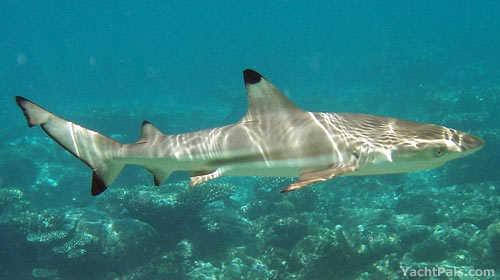 The interior of the reef is dominated by Black Tip Reef sharks–the deeper the reef, the bigger they get. I’ve seen them to six feet long just below us this morning, gliding with a slow grace that suggests their reserves of power are infinite. And swimming with them takes some getting use to. Your first few sightings freeze the heart; the flight reflex slams into your head like a freight train; you reach for the bowie-knife strapped to your thigh. It’s not there; you never bought it. You just know you are toast. Then after a time you realize these sharks only show you their backside. They see you first, and they are always fleeing. So, lately, I’ve taken to chasing Black Tip Reef sharks, not for purposes of harassment, but just so I can get a better look.
I wonder if Thomas would like swimming with reef sharks. It’s quite the sport. Polynesian children often chase the smaller of these sharks in the wading pools. If they catch one, they take a ride. I’ve seen photographs of men riding the larger sharks too, a hand around each ventral fin, but here the challenge is not the riding but the capture. In Hawaii shark riding was a time-honored tradition on some islands, and the act granted status to the successful just as bull riding does now.
When Joanna visited Moorea with me, we swam with grey rays and sharks at a famous tourist spot not three miles away. The rays glided right up for their tidbits of fish, allowing all comers to caress their silky, flowing skin. But the sharks kept their distance, patrolling a stretch of blue too deep for us to reach on tippy toe. If we swam too them, they vanished.
Outside the reef, the number and type of sharks increases dramatically. Just outside the pass to Opunohu Bay is a large school of circling Lemon Sharks. To eight feet, this shark appears thuggish and thick. Its teeth stick out at odd angles, and in the right light its skin is perceptibly jaundice. But it too is wary and may retreat if approached, unless you happen to be spear fishing. And here, I am told, Hammerheads can sometimes be found in large schools soaring near the reef wall like great fleshy hawks on a gyre.
 And what an amazing fish for a young man to admire. Sharks can smell food sources, like blood, from as much as a quarter-mile away or hear the thrashing of a wounded animal from up to a mile. Proximity allows them to sense an organism’s weak electrical field. They lack the altitude regulating gas bladders of other fishes, and so, in most species, if they are not swimming, they sink. This suits the bottom dwelling sharks, and some can even fan their own gills with water as they rest in the sand or in rock caves, while most sharks must keep a move on or they suffocate. Sharks that hang out in middle levels use oil glands for buoyancy. This means that sharks can rise in the water column much faster than other swimming animals–they can attack from below. This hunting tactic featured prominently in a particularly compelling movie, the name of which escapes me.
Shark skin is rough and can be used as sand paper; the Japanese fasten it to cutting boards for the grating of fresh wasabi root. The roughness is due to embedded “dermal denticles”, essentially tiny teeth, that are aerodynamically grooved and allow the fish to move faster through the water than if its skin were smooth. A shark’s teeth are simply enlarged and modified dermal denticles that grow out of the shark’s mouth skin rather than its jaw cartilage. This strategy allows the teeth to be replaced easily, conveyor-belt fashion from the inside, and as often as every eight days in some species.
 Many sharks are live-born. Gestation periods can be as much as twelve months, and if the mother carries more than one pup, the larger of the two will sometimes eat the other while they are still in the womb. All sharks are carnivores, but many engage in experimental eating. The Tiger Shark, for example, likes garbage. “The stomach of a ten foot specimen harpooned in Pearl Harbor in 1931 contained the hind leg of a mule, two bathing suits, a belt buckle, a pint of buttons, two horseshoes, the corner of a wooden soapbox, two small anchors, anchor chain and assorted bolts, nails, and copper fittings.” [1] Whitetip sharks are so strong that they can shove boulder-sized coral out of the way while digging around for octopus. Many have small, tightly defined territories but some travel widely. A Great White tagged off the coast of California in 2000 was tracked by satellite all the way to Hawaii, 2,280 miles away, where it hung out for four months before the sensor died.
One could do worse than be interested in sharks.
Thomas is a talker. Never have I met a young man for whom the first amendment protected more. For him talking is less a right than a physical necessity. Subtract talking from the picture and you might as well subtract Thomas. And so I imagine that Thomas talks to animals, knowing they could talk back if they wanted to or if he could somehow figure out their language. I share this imagining. I wish the wild animals I encounter would allow a closer approach, would offer up some clue to what they’re about without so much chasing. Sometimes the more curious fishes in this reef will swing up,turn and give me the eye, and it is then that I feel again the familiar enchantment. For that moment it seems knowing them is within arms reach.
Which is to say, I wish Shark Man a happy birthday. I laud his interest in the wild kingdom and will be looking for his full report on the natural history of battery operated Carcharhinus Thomasi.
—
[1] The quote and shark facts culled from HAWAIIAN REEF FISHES, John P. Hoover, Mutual Publishing, 2008.
Opunohu Bay, Moorea: PHOTOGRAPHS
I am a poor photographer. But lovely Moorea doesn’t mind. She shines through beautifully.
Click here to explore Opunohu Bay, Moorea.
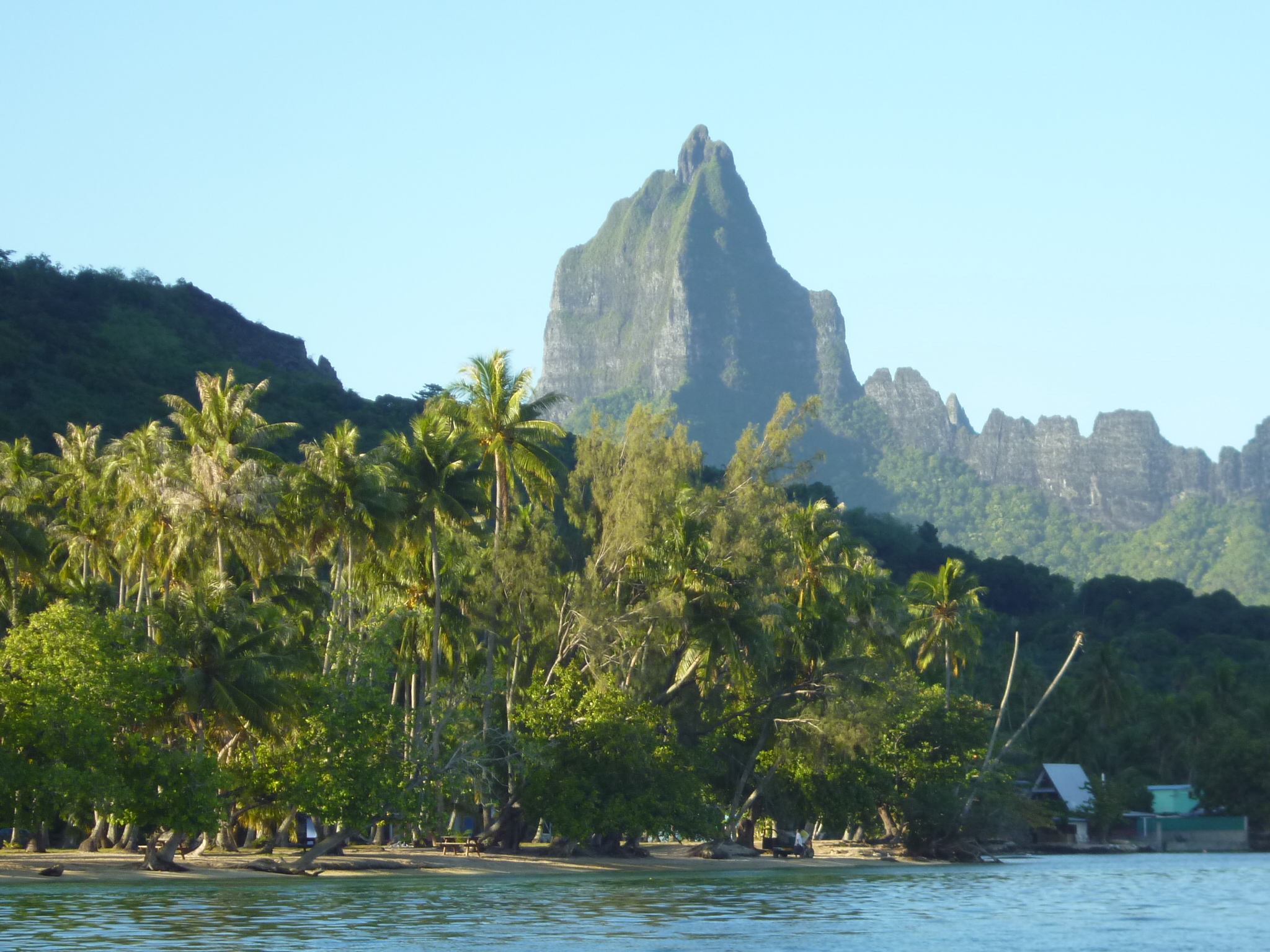
View of beach and mountain from Murre at anchor
Opunohu Beach Bum
“Son, we haven’t heard from you in so long; where are you; what’s happening?” Thus began–and ended–a recent communication from my mother. Answers are easy, if a little embarrassing. Except for a gentle tug at the anchor chain on a shift of wind or current, Murre’s position has remained gloriously constant for long enough that I must consult the log to recall our arrival. And as to happenings, they only lightly populate the slowing line of time. Now a row ashore to dig one’s toes in the warm sand of the near beach or enjoy ice cream at the local market or watch a sunset from under a coconut palm (only to be warned by a local that falling coconuts kill) all count as major events. Each day begins with coffee in the cockpit and ends with a jump into clear, warm water where below the boat gentle grey rays feed, attended by jacks and puffers.
I fault my surroundings for this recent lack of adventuring. I accuse them of a stunning, a rare beauty that takes so little effort to enjoy, thoughts of better islands, better anchorages, fail to organize. My surroundings accept this accusation without resentment and quietly continue in their beauty.
Opunohu Bay, on the island of Moorea, is less than twenty miles northwest of Tahiti’s minor metropolis, Papeete, but is so secluded it could be hundreds. From a chart, it has the look of an inverted triangle with the exception of two bays, deep as fjords, that cut into its northern line. The more eastern is named after Captain Cook, though he never entered there, choosing instead the western most Opunohu for RESOLUTION’s landing in 1776. And I can do no better than Cook’s best biographer for a description of our current berth:
“… [Cook] anchored so close to the shore that he could moor the ship to the hibiscus trees, with the pure water of several rivulets flowing into the bay near by. He looked on this place with a severely practical eye, as ‘not inferior to any harbour I have met with in any of the islands’ for security ‘and the goodness of the bottom’–which hardly conveys an idea of the immensity of the backdrop to the calm sheet of water; for in this dead volcano [that is Moorea] strange peaks and buttresses, fire-blasted walls of rock, reach into the sky as if here the world had blown up, and the world’s greenness were forever to fall back defeated. But below the heights the green grows thick enough, peaks sink into slopes, the curve of the bay reaches gently to the outer lagoon.” (1)
And not that much has changed in the intervening years. A paved road runs the island around; small houses are here and there gathered along its perimeter; three major hotel brands have built palm-roofed bungalows out into the crystal lagoons, but for all this, the island continues to feel timeless. Which is to say Opunohu and its surroundings are both dramatic and comfortable–a seductive combination to any mariner.
Just above Murre’s anchorage on Opunohu’s outer lip is Moorea’s second highest peak, Mount Rotui, nine hundred meters to the summit and climbable. The trail is difficult to locate, requiring the jumping of fences, the invasion of backyards and a brief scramble through rocky scree and acacia scrub before one encounters an obvious path. Per recommendation, I took an afternoon to find it, marked my way with cairns, and returned early the next morning. As advertised, the way was all up. Within twenty minutes I was on hands and knees, pulling myself along with the aid of loose rock and roots; at ten more minutes I’d crested the first rise where stood a shock of Ironwoods on a ledge and howling in the wind. Here I spooked. It was all too vertical. I admired the view only briefly and descended. Later, from the cockpit, I could see where I’d been and it seemed like nothing.
So I returned a few days later with reinforcements, two, younger acquaintances from a catamaran named PUKURI, Christine and Hannes of Austria, noted in several anchorages since Tahuata but met for the first time here at a beach barbecue. That’s Opunohu’s other attraction–I’ve made some friends. Our conversation over fire roasted sausages and red wine indicated these two were not afraid to use their legs, a rarity among cruisers. I extended the invitation and next morning we met on the beach for what was to be my third attempt at Rotui.
“Is it a real trail?” Christine had asked the night before, “We seem always to be hacking our way through jungle.” I assured her it was, but now regretted not mentioning its ruggedness, for the first thing I noted as they secured the dingy was a shoe problem. Christine wore only flip flops and Hannes’ rubber sandals looked unlikely to last the rough rocks of the climb. “Our shoes have just moulded away,” said Christine. PUKURI, a forty foot, strip-plank and epoxy, racing catamaran, forces a rustic lifestyle upon its crew of two. Her main cabin is tiny and low and entirely open aft, and her narrow hulls are only accessible from the outside. “If it rains, we get wet,” said Hannes, “and if it blows the wrong way–it usually blows the wrong way–we get wet, but we can go fast.” He smiled, suggesting that the sacrifices were well worth the gain.
The trail had not repented since my first visits and went vertical immediately. I led the way, but in my excitement, kept losing both my guests. When we stopped to rest, they leaned over their knees gasping and exhausted, and we had yet to reach the Ironwoods. At the first big boulder, I showed Hannes the easy path to one side, but Christine, to my surprise, tossed her flip flops ahead and went straight over the top.
Having two companions shot me with unusual courage. I climbed the precipitous Ironwood section as if it were in a child’s playground and was some way along the knife-edge of ridge, leaning into the wind with arms out like wings when Christine and Hannes caught up. “I am usually afraid of heights,” I remarked by way of explaining my evident glee. Days earlier all in the anchorage had witnessed as I ascended Murre’s main mast for some much needed patch and paint. It’s only thirty five feet to her truck, but I was shaking when I got there and almost needed help getting down. “Hannes is too,” said Christine, “He’s not so sure footed.”
Hannes affirmed this only two ridges later by calling from down trail, “So, guys! Hello! What’s the goal here?” By this time he was a bit wild-eyed and spent more time on hands and knees than the going required. The path, but a few feet wide, occasionally provided nothing to walk on save the compressed roots of ferns clinging to the cliff edge. The view fell away hundreds of feet. Rain approached from the mountains to the east and our summit was in cloud. “You’ve had enough, haven’t you, Hannes,” said Christine in a way suggesting she too was satisfied. I was not.
I asked if they wouldn’t mind pausing for lunch here while I made for at least the next ridge, and before all was quite resolved, I was off. Where the energy came from I do not know. I bounded up like a deer; I jumped boulders and swung around trees with a fleetness previously unknown. I had barely been at the top five minutes when I noticed Christine’s orange hat moving along the section just below, and I was still panting when she joined me. She hadn’t stayed with Hannes, and she hadn’t broken a sweat.
Here the view took in both Cook’s and Opunohu bays (oddly, both bays contained a single super-sloop with blue hull), and the ancient, toothy jag of the far ridge was now at eye level. Finally we had escaped the sound of cars. The song of bulbuls came to the fore. Tropic birds swooped their circles near the black cliffs. Cloud just overhead whispered as it passed. And here I noticed a type of Ohia Lehua (2); on this often arid slope, its leaves were yellowing, and only a few red bottle brushes remained.
Christine had admitted to the roughness of that last stretch by wearing her flip flops. “It’s nice that the trail is dry,” she said. “When I was in Thailand, the jungle was always so wet and difficult to pass. On one hike I was trapped on a beach for a week and only eating coconuts while I waited for the rain to stop. Two coconuts a day for a week.” She scowled. She had, I learned, walked much of Thailand alone. On the descent I learned more.
She worked six years as a baggage handler for an Austrian airline because it gave her ready access to cheap flights and a schedule so flexible she often traveled more in any give year than she worked. “But then,” she said, “the company was purchased by a bigger airline that made the women wear skirts, so I quit and moved to Asia.” Christine lead the way as we climb off the mountain, and here I noticed her certain grace. Where I grasped at passing rocks with a will, Christine took her cues for balance by touching finger tip to twig end, and always she was talking. “I never wore shoes much when I was young. My parents toured all over America by car. We lived in that car and there wasn’t always room for shoes. Sometimes there wasn’t room for me. You should go to Thailand. The food is so inexpensive and tasty, and you can rent a bungalow for $5 a night. I like travel. I like seeing new places. I could travel forever. We can go a few more years, Hannes and I. Then the money runs out.”
I attempted a contribution. “That’s the first Ohia Lehua I’ve seen in all of French Polynesia,” I said. “It’s an endemic plant in Hawaii, one of the flowers most loved by the now extinct Honeycreepers.” This went nowhere.
“It’s why we always look for free food,” said Christine. “Make the money last.”
We found Hannes back at the Ironwoods facing into the wind and grasping a limb with a straight and petrified arm. He still looked worried.
That night, another fire on the beach. We are joined by Bertal and Uta from ODIN for the grilling of chicken wings and the requisite sausages. The two couples, friends since a common anchorage in the Caribbean three years past, could not be more different. Whereas Christine and Hannes are essentially back-packing aboard PUKURI, often living off the free coconuts, papaya, and breadfruit they find on frequent hikes, Bertal and Uta live in such style on ODIN that they rarely go ashore. Bertal worked in radio, was a DJ, had a show in Munich “like Jerry Springer”; Uta had a career in marketing and drove a Porche. Both are fit and coiffed and clean. Neither is over fifty. ODIN reflects their style–a 40 foot mono-hull whose sheets and halyards are worked by electric winches in white casings and stainless steel chain rolls over the automated anchor windlass. “It’s an Amel,” explains Bertal. “The designer was partially blind, and the knobs of the buttons in the cockpit all have different shapes so they can be recognized by touch–handy when it’s dark.” Everything aboard ODIN is custom, from the generator that clamps to here spinning propeller shaft all the way down to her white awnings and white bucket. The couples tease each other’s boats. Hannes can’t believe that Bertal paid $60 for a custom Amel wash bucket when PUKURI’s blue one cost $2 at the hardware store. Bertal can’t believe that Hannes and Christine choose to remain on a boat that has no toilet.
At her taff rail ODIN flies a large German flag, and when I remark the oddity of putting a black stripe on top of the red and gold, Bertal explains, “It’s so that we first remember with sadness those lost in the war.”
“You mean the holocaust?” I ask.
“NO!”, says Bertal with a kind of shock, “the wars of independence.” Germany is even younger than the United States, he says, and the flag’s stripes commemorate the struggles to unify middle Europe’s various fiefdoms.
But Bertal has followed my remark. “That little man with the Charlie Chaplain mustache was no German,” he says later, “He was Austrian!” Neither Hannes nor Christine so much as flinch, and it is clear that none of my companions identifies seriously with the great war. I had thought that being a contemporary German national would carry with it an obvious shame, that the people of an entire country would somehow heave with a subtle hang-doggedness resulting from such a profound defeat and the world’s rebuke. But on consideration, why would this be so? Images of holocaust and a specifically American victory, a perennial theme of western entertainment, are unlikely to get such play at home. Germany is again prosperous and at least ostensibly unified. So fast is the pace of current events and the seduction of denial that dissociation is a reflex. A profitable reflex. A universal reflex. For example: the tortures at Guantanamo were not perpetrated by my people; the responsibility for those acts, not mine.
I am not, however, afforded the same dissociative privilege. “I lost so much money in the stock market because of **your** Bush!” says Bertal. “Such a stupid man. All of Europe was ashamed when you elected him, and twice!” Uta roles her eyes at the approach of a not infrequent diatribe, which I move to divert by explaining that Mr. Bush’s I.Q. was, in truth, quite high even if he lacked the ability to communicate it and that he has not been the president for some years now. But facts are anathema and the conversation quickly moves on to more congenial topics–like why cruising Austrians usually choose catamarans and Germans, the mono-hull.
Or this. “Take your Austrian,” says Bertal pointing at Hannes with a chicken wing. “Your Austrian is not a fighter. Have you seen the Austrian war flag?” he asks me. I have not. “It’s a white dragon on a white background.” He waves the imaginary flag above his head and cowers, grinning. “Austrians don’t fight; they marry; their motto, ‘Not war but weddings!'” Hannes smiles thinly but does not argue. In his former life he was a computer programmer; he’s thoughtful and patient and knows better than to engage a German on a soap box. “But Germans,” continues Bertal, “are fighters and we have lost two world wars proving it. Stupid wars, but at least we show we have courage. Your French, your Italian, he is always running away. But Germans have courage–Americans too. I suppose…”
Uta shoves a sausage in Bertal’s mouth, creating a brief moment of silence which Hannes fills with, “So, what do you think of your little ketch? Is the rig really as inefficient as they say?”
The oddity of this kind of talk around a bon fire on the beach of a small island two thousand miles from anywhere strikes none of us, and we continue till midnight.
Next day I rejoin boat projects in progress and am discouraged that, again, none have advanced in my absence. That I am currently a beach bum is a bit of a fiction: in fact, Murre is making me ready her for our next big jump. Jobs are minor but important: patch the wooden main mast where the baton hardware has worn through the paint, patch the main sail where the mast and rigging have worn through the cloth; tune standing rigging that has relaxed this last five thousand miles; check the running rigging for chafe and swap where necessary; grease the wheel to ease the working of the wind vane; test-install the emergency rudder my wife brought from the states; change the oil; scrub the bum; replace the zincs. Under normal circumstances these jobs would take but a few days–at Opunohu, and surrounded by such perfect conditions, I’ve successfully spread the work over two whole weeks. But available tasks are dwindling. Deciding where to go next is really all that remains.
(1) THE LIFE OF CAPTAIN JAMES COOK, J.C. Beaglehole, Stanford University Press, 1974, P. 557. (2) Hawaiian common name; similar, New Zealand Christmas Tree.
Quiet Kauehi
July 25 – 30
Down Makemo’s lagoon the way we had come, though sailing this time. Wind fifteen knots out of the east and the full sun of midday on the cobalt water. The jib flying alone so that the loom of coral heads would approach slowly. As before, reefs were widely dispersed and easily seen by the white teeth of their breakers or the lightening of the water. Then out on a sucking ebb, great sheets of water pouring into the pass from either side and frothing overfalls of five knots at the entrance. I started the engine in case one of the numerous whirl pools pushed us toward the coral, but we raced clean out, and I barley touched the wheel.
Then a course WNW under poled-out jib and jigger. In the late afternoon, Katui’s palms brushed the horizon some nine miles to port, and two hours later orange lights winked on. I dowsed the mizzen and gained half a knot. Wind was ESE, Murre on a dead run and rolling and rolling her way along.
By midnight Raraka was ten miles to port. It was here, I would later learn, that KAYAK (see Everyone Has a Story) was lost on a reef. Brian and Kelly had struggled to find the pass in daylight, failing which, they decided to lie off and await the next day. But the charts were out by over a mile, and they drifted onto the reef in the night. One touch and it was over, one bump was a bite straight through the steel of hull. Brian and Kelly were unhurt; things were salvaged, but the boat was dead as was their cruise.
Here we began to make a turn east and through the channel between Raraka and Kauehi. It was one o’clock and dark; random lights shown from both atolls, occasionally tufts of palm would define the land. Raraka lay a mere four miles to the south. I had been dozing in shifts but now ate a chocolate bar to wake up.
Dawn found us too early at Kauehi’s entrance, the ebb still pouring out and crashing on itself like the rapids of a mountain river. I dowsed sail in the atoll’s lee and drifted for a time, then trolled a lure through fleets of noddies and had a large Dorado to Murre’s quarter before it flipped the hook. How does this keep happening?
When the overfalls had subsided Murre pushed through the pass under power and into two knots of ebb. We motored and sailed toward the village in the NE as the day’s weather came on squally and wet and climbed up through a channel of deep blue, entirely devoid of coral, dropping anchor behind the harbor’s red beacon and into the sherbet-blue water of a sandy bottom at twenty five feet.
The sky cleared; wind moderated. I put up awnings and wind scoops against the heat, napped, washed clothes, contemplated the shore where a low wharf, a large church and other village buildings were concentrated, but no people evident. To the south, shacks on stilts over the shallow water, part of a complex of farms that grew black pearls in the lagoon. In the evening I cooked lentils with polenta and read a short story about baseball by John Updike. The heat of terrestrial summer, the smell of hot-dogs and beer, that singular sound of bat on ball, a stadium whose concentration of bodies exceeded the combined populations of the Marquesas and Tuamotus–all focused on one, white dot and aroar in collective joy. I felt a million miles away.
Next day on the row into town I stopped to greet my only neighbor, yacht MABUHAY from Basel. “Such a nice place you have here,” I said on approach. A man and woman sat up in the cockpit. “Well, yes it is … and no!” said Marie-Therese rapidly as husband Paul waved. “We are stuck now more than a week with a leak in our hydraulic steering system and our replacement hose wasn’t on the Saturday plane as promised, you know there is only one plane a week, and now we wait for the next plane and,” she waved toward the town, “there is not so much to see.” I learned the couple were retired and on a five year cruise now in its seventh winter. They would spend the southern summer in New Zealand.
No signs in town suggested Tearavero, the name given by the chart, was the accepted name of the village. In fact, the one general store, shut because the owner, also the village chief, had taken his family to Fakarava for the week, announced the location as “Kauehi City” in a large, friendly script along one wall. A “center of population, commerce, and culture” Kauehi was not, except as compared to the immediate, aqueous vicinity. Through the town ran a quarter mile of paved road connecting the store with a white, coral-stone church, a post office, a city hall and a line of small, plywood-sided homes above the beach, some unpainted, non-descript, shack-like, others in bright colors with lush gardens and fences lined with shells. During the half an hour it took to stroll from one end of town to the other and back I saw a few children crouched in stoops and several emaciated, rib-hung dogs lying in the shade, but only one adult appeared, a large Tuamotan driving an old Ford Ranger toward the center of town. He waved as did I.
Passing by City Hall on my return to the wharf, I found Marie-Therese and Paul talking to this man. He had a hydraulic hose in the bed of his truck, something scrounged up on their behalf, but it too was the wrong size. Marie-Therese introduced the man as a policeman, though neither his dress (tattered t-shirt covering a large belly, shorts and work boots) nor his unassuming, almost diffident manner would have suggested it. He perspired heavily.
“Would you like to show the man your papers?” Marie-Therese asked me. Not so long ago it was protocol for cruisers visiting the atolls to come bearing gifts for the village chief, a bottle of rum, some cigarettes. This practice has faded with the demise of the chief’s office, and now “chief”, Marie-Therese had explained, referred to “chief of police”. And the only form of gift-giving currently recognized was the presentation of the cruiser’s crew list and passport. But when Marie-Therese asked this man if he’d like to see my papers, his affirmation was only official. Clearly he didn’t care if I ever presented him with anything.
On my behalf, Marie-Therese asked if fish could be taken from the lagoon. The policeman said only some were safe. His discourse on specific species failed to translate into English and resulted in his saying I’d better bring my catch to him for verification. I asked Marie-Therese to inquire about a tour of one of the pearl farms. She gave me a curious look–“What is to see?” she said. “Is like watching a potato.” The man said we’d need to ask the chief when he returned. Could we buy pearls, she asked, again for me. Again, an answer would need to await the return of the chief. French decree may have abolished the office of chief, but here it was clearly still in force.
At this the man drove away and Marine-Therese tapped me saying, “Come. I show you pearls. A young man is selling them.” We walked up the street to a green house as quiet as the rest. Marie-Therese knocked on the front door but got no response. We walked around to the back and through an opening spied four men and a boy asleep on the wood floor of a kitchen, the only apparent bedding, a pillow tucked between the boy’s legs. Marie-Therese cleared her throat and one of the men started up, came to the door saying “Pearls?” with a smile. Marie-Therese nodded and we were asked to wait in the front yard. “The town is so sleepy,” said Marie-Therese, “we are always waking somebody up.”
In a moment we were greeted by a different young man carrying a clear, plastic bag brimming with small, misshapen pearls and a cloth which he unrolled onto the stoop laying the bag upon it. Inside the bag was a wad of toilet tissue that the man opened onto the cloth, revealing a collection of some fifteen larger, rounder pearls. “The big ones are expensive,” said Marie-Therese, winking, “$500 Pacific Francs each (roughly $4.90 US). The others are $200. His sister works at one of the farms.” Black market black pearls, I thought.
The man smiled but said nothing. The larger pearls caught me by surprise; some were a light gray, but most were luminous, creamy greens, blues, and ivories, and none were black. They were heavy in the hand, as if at their centers was a dense metal. I admired and played with them, but didn’t know what to do next. “How many did you buy?” I asked Marie-Therese in a whisper. “Four,” she said. I set four aside and nodded to the man. He nodded back and said, in French, “Twenty five francs.” Marie-Therese corrected him. “Twenty,” she said. The man thought for a long time, eyes looking away. “Yes, twenty,” he finally said. “Not much schooling here,” said Marie-Therese to me; “He does not need to know how to count.”
Another man approached and asked me where I was from. “American,” said Marie-Therese. “You are from New York, yes?” he asked me in English and smiling broadly. I said I was from San Francisco. “Is close to New York, yes?” he said, “I want go New York.”
Back out on the road we spied a white pig tethered to an ironwood tree near the beach. “For the feast,” said Paul. It was the only remark he’d directed toward me all day.
Late that night I woke to the urgent tolling of church bells in the village. Wind had come up out of the southeast, and Murre chawed back and forth on her chain. I could hear the rattle of palms ashore. When I looked toward the village, I saw the wharf bright with lights and stacked with tanks and crates of all sorts. Turning in the opposite direction, I saw a red freighter approaching, also lit fore and aft, cranes already active and boats over the side though she was still climbing fast toward her berth in the harbor. In the morning the wharf was as empty as it had been when I arrived, and the freighter was gone.
I remained anchored off Kauehi three more days during which time nothing happened.
Nuku Hiva, Makemo, Tahiti: PHOTOS
I fear there are more pictures here than could interest anyone but me. If you should find yourself curious, feel free to browse at will. With this post, photographs at least are up to the moment, a first for this blog.
Missing are the passage to Kauehi Atoll, our time there and the passage to Tahiti, this due to a failure of the camera the day after the computer died. Sympathy, I think. That or salt.
A Lake Inside the Ocean
July 15 – 25
16.30.70S – 143.49.30W
Cruisers are not uniform in the timing of their first visits ashore. Some splash the dingy before the yacht has quite fallen back on her anchor. Others pause, ensuring the hook’s impression upon its host is amiable and lasting before making a move. Still others appear never to leave the boat at all, but instead regard new landfalls from the comfort of the cockpit, fully satisfied with this form of exploration.
 I am in the middle camp, often staying aboard a full tide cycle before my first row in. I clean below, rest a bit, and inspect what there is of coast with binoculars; I have a cold beer, make a hot meal. I relax. The transition from open ocean to bay should come on slowly, I think. In any case, there was little choice our first day and half of our second at Makemo. Though comfortable, our berth put us a quarter mile from the beach, and the strong, offshore winds made the pull ashore daunting. I worried Coot’s flat bottom of thin plywood might pound to pieces in the chop. So I sat in the companionway hatch looking out and exclaiming, “It’s just like Ringworld!” over and over.
If this seems an obscure reference to you, join the club. I had to dig long and hard to remember Ringworld as a science fiction novel from twenty years ago, my only recollection of which was the framing idea: that in some distant future humans create planets in space that are not spheres. We have solved the gravity issue a different way, by building enormous, rotating rings, the inside of which contains the atmosphere and the land that we have peopled. Imagine looking into the night sky from your back yard in suburban New York and seeing the bright lights of Europe declining at twenty degrees, and way across the other side of the ring, Asia.
Upon examination this was not a superbly apt analogy for a south pacific atoll, which is neither perfectly round nor spinning in space nor thickly peopled with hyper-moderns, but it was the best my grasping mind could conjure at the time and serves to illustrate how unusual and without parallel is the idea of a landmass that isn’t land in the middle and water along the outside. From islands to continents, that’s the earthly paradigm, or so I had thought.
Let me put that another way: an atoll is really weird.
Sure, the geology is easy enough. A volcano bubbles up from the deep and forms an island, that, over the centuries pushes quite high. Around the island forms a coral reef. The volcano moves on leaving the island and the reef. Wind, rain, and sea erode the island, but the living coral remains. After some time (and there’s the rub) the island washes away or sinks or both and is replaced by sea, but the reef keeps on. Its coral is sometimes broken and piled up by storm or eaten by Parrot fish and shat out as sand* so that beaches form on the inside of the reef to which early Polynesians add coconut trees and rats. The Tahitian Chamber of Commerce snaps a photo (carefully excluding the rats), puts it on the back cover of an inflight magazine and, voila, an atoll, the archetypal vacation paradise, is born.
But knowing this hardly makes first impressions less strange.
For as far as my eye could see to the north, east and west was nothing but a gentle, curving, continuous ribbon of palms interrupted occasionally by scrub or bare beach all so low that when the rare summer hurricanes do arrive, villagers on other atolls are forced to strap themselves to trees in order to survive the overset of waves. And I was on the inside of this ribbon. Murre and I were anchored upon a lake inside an ocean. How could this be? And if this part of the atoll was deserted, why could I hear the burping of a nearby diesel generator?
 The scene began to take on a different aspect as Coot and I rowed ashore next day. Shallow, turquoise water with great heads of coral and scattering fish. The beach as white close up as far away, soft and warm and shell lined. In places palms right down to the water rattling in the wind. Here was a broad-leafed shrub. A pair of fruit doves winged past me into the next copse. The sun blazed. Was there anything else? Could any place really be this simple?
I walked toward the atoll’s ocean side. In the forest of palms the sandy beach immediately gave way to years of frond build-up a yard thick and thousands of fallen coconuts, each with a perfect hole to the inside and empty of meat. But there seemed to be no inhabitants. The holed coconuts indicated rats were prolific, but I saw none. No birds sounded. No mosquitos attacked me like cannibals. In fact, there seemed to be no insects at all. Lacking a trail, the going was rough and slow as I waded up to my knees in dead foliage. Sometimes a downed palm allowed a sprint along its trunk, but even with that aid, it took ten minutes to achieve the forest’s Pacific side, a distance of only 300 feet, and there all hell broke loose.
 What was calm and “swimming pool clear” inside the lagoon was the unmollified ocean outside. Deep black-blue waves crested in a chaos of white and slammed the reef, fuming with a heavy mist visible for miles in either direction. It roared such that I covered my ears for a time, realizing with a flash that this perpetual roar, muffled by trees, was the diesel generator I heard on the boat. Between waves and forest stretched a long, broad bank piled up as perfectly as a levy and constructed entirely of cobble-sized, ankle-breaking coral bits bleached by sun into an ugly, charcoal grey. I could feel its teeth through my rubber shoes. And at the top of this levy, plastic trash of all sorts. It was too desolate. I returned to the forest, to the beach and the boat almost immediately.
Next day, I tried a different tack. Weeks before I’d entertained the idea of hiking around the perimeter of Makemo, an idea that now struck me as silly because the atoll was some hundred miles in circumference and its southeastern edge was largely submerged. Of course, the books and charts had told me this, but it took arriving to realize the scope of the place. Still, I wanted to stretch my legs so when I beached Coot, I set off to the right, which seemed as good as any option, the only other being left. I had walked just a few moments, hugging the edge of the palm forest for its shade, when I saw something move out of the corner of my eye, but when I looked it was only a large snail shell near a coconut husk. I went on and soon saw another small movement, a snail shell again, but this time it had fallen off a low sand ledge and was rolling towards me like a lumpy tennis ball. I stopped. It stopped. I stared. The shell was tipped over with entrance up and after a time bright orange legs protruded followed by two knobs of eyes staring out at me. Something else moved just beyond it. Another large snail shell atop a bright orange hermit crab had been walking along the stem of a downed palm frond before turning to look my way. And then another walking along the sand toward the lagoon stopped, eyes craning over the top of the shell in my direction. And there was another yards away, and several I could now see crawling in the forest. Within moments I had counted twenty five hermit crabs, all looking at me. We all stared. No one said a word.
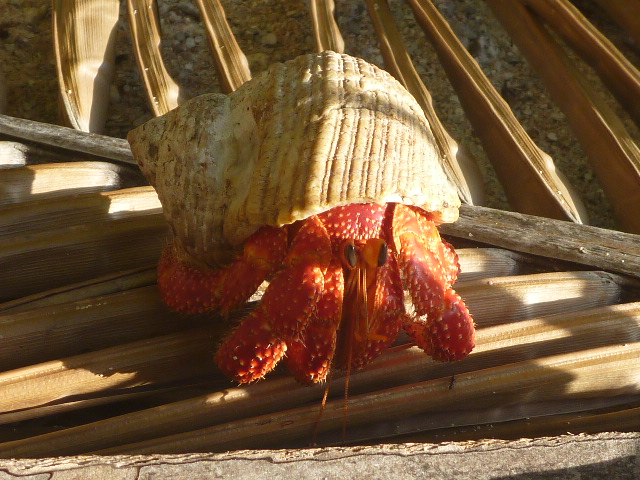 Then I noticed what appeared to be a sharp, flat stone in a sandy clearing just further on. As I approached it resolved into a coral tombstone accompanied by others, some in the shape of crosses, some simple slabs no larger than a large book, all inscriptions worn off by time. A small crypt stood to one side. Again, a subtle movement caught my eye coming from under a slab that had toppled against a tree forming a shelter beneath. Inside hermit crabs were stacked one on top of the other. Now a pattern was emerging. The sand in this small graveyard was criss-crossed with tracks that often resolved into a single path leading toward another shelter, crevices formed by other toppled stones or the shade of a large tree root scraped out to create more space below, and each time it was jammed three deep with hermit crabs. Back at the beach I bent down beneath a tree to snap a photo of just such a collection, and when I stood, the eyes of yet another hermit crab met mine, but at my eye level. I blinked; the crab did not, but instead remained in meditation upon the lagoon from its high perch on a limb as if to say that climbing trees to six and eight feet was perfectly normal for its kind. And such must be for the tree held several other hermits, each wedged into a notch at various heights and looking placidly out upon its private domain.
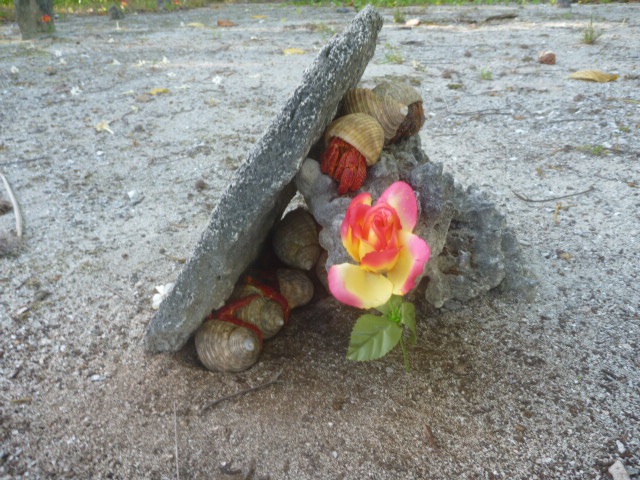 I spent the rest of the day counting hermit crabs, marveling at their numbers, their uniformity of size and color, the tracks they left in the sandy beach that often converged from all directions upon the nearest high object, like the mecca of a single coconut; I pondered the misnomer (they aren’t hermits!), the habit some had of hiding so quickly as I approached that their shell would often topple from whereever it was perched, while others would examine me from distance with such reciprocal curiosity I half expected them to initiate a conversation. Then, at crab number six thousand two hundred and seven, it occurred to me that Makemo was less science fiction than children’s book. I would not have been at all shocked to find around the next bend of dune a pink walrus having tea with a rabbit.
It was in this frame of mind that I set out next day to find the famous White Squille. A fantastic animal, the Squille (pseudosquilla ciliata) is a crustacean whose back half looks like a shrimp and whose front half has the triangular head and long, claw arms of a praying mantis. It grows to about sixteen inches, is called Varo by the Polynesians, and is reported to be delicious. That, in combination with a color photograph of a Squille being held aloft by a dark man standing on the edge of a lagoon constituted the entirety of my Squille knowledge. I spent the day wading the shallow, sandy shoreline for sign of Squille without knowing what that would be, and so was not surprised when all I encountered were baby reef sharks gnawing at my ankles and shells. All kinds of shells from Marlin Spikes to Money Cowry to Conch and everything in between. But in the afternoon it occurred to me that I found very few, undamaged, unoccupied hermit crab shells. Given the vast number of crabs, the paucity of domiciles must mean Makemo was suffering from a severe hermit crab housing shortage, and in fact, I had seen crabs carrying less than perfect homes on their backs. So I took the few perfect shells I had found, lined them neatly at the head of the beach, open side down, and left.
Next day the computer died, and I remained aboard all day.
 When I returned to my shell collection on the following morning, five of the nine shells had been turned over and examined and two had been exchanged. So there was ample interest, hermit crab home owners were shopping around, but only a few found my product to be of suitable quality. This meant the housing crisis was not at the peak I has supposed. There was either another source of adequate housing I had yet to find or the crab population was ridiculously stable.
In the afternoon I returned to the windward side of the atoll and spent several hours inventorying its trash, a line of plastic and glass perched just atop the levey that appeared to stretch for miles in either direction. There were Coke bottles and engine oil bottles and detergent bottles from the US; salt containers from Australia and England; transmission oil from Peru, scotch from Japan, scads of water bottles from Malaysia; fishnet floats from China. There were toothbrushes and shoes and broken hair combs and frayed broom heads and flip flops and orange plastic fencing and gnarled lumps of rope of all sizes; there were plastic buckets, plastic crates, plastic toys, fishing nets, clothes hangers, felt pens, a whole car bumper, a hard hat, and broken rafts constructed of bamboo bound together with plastic line … the list went on and on. It was as if the atoll was a giant net collecting whatever flotsam the ocean could not stomach.
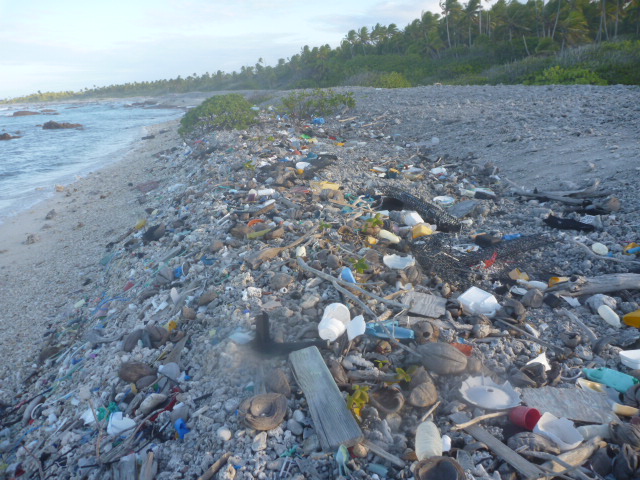 Much of what I found was unusable. Bottles were cracked, lids missing. Toothbrush bristles had been pulverized by sun and waves. Rope was frayed and tangled to an extent King Gordia could not have replicated. Shoes never came in pairs and never had laces. Without thinking I had begun to pile the few useful items together. Here was a whole five gallon bucket with handle still intact. And there a fish float without any cracks. I found a bent but apparently new flip flop in my size. This broken comb was still perfectly serviceable. Then I remembered I was not marooned. I had a home on the other side of the forest that contained several pairs of flip flops and new toothbrushes. Not to mention cold beer. So I left. But I took the bucket.
Before I knew it Murre and I had spent a week at Makemo with little sense of the passage of time. On the 21st I wrote in the log, “The last two days have been ‘atoll’ interesting, which is to say that in a land without an interior, with now mountains to climb or valley streams to follow, and whose sameness stretches out of sight, one explores each day a smaller and smaller area sifting minutia.” In fact, I’d gathered hundreds of small shells of all sorts, had harvested coconuts from trees at the near beach, had swum multiple times the several coral heads adjacent to Murre, but I hadn’t got more than a mile in either direction. There seemed little point.
 That said, the place was seductive beyond warrant, and the longer I stayed, the more detail emerged. I had begun to see the rats, dainty, dull creatures with oversized ears, staring down at me from the trees. Of birds there were the fruit doves, of course, but also a brown Tuamotu warbler with a song like that of a thrush; crested terns gathered on the beach in the evening and allowed a close approach. Boobies dove in the lagoon. Occasionally a Frigate swung overhead. Melon sized ghost crabs inhabited a salt water swamp to the east. Isaw more plant types with each visit ashore, and lacking a guide, I began to name them as best I could. The broad leafed, white flowered tree became Naupaka; another looked like Iron Wood; that pointy leafed bush, Ceanothus (no flowers), a tall fire weed sprang up in the forest, and under the palms there were ferns. Here and there, tufts of grass.
And there were insects: flies and spiders and wasps. One evening I stayed ashore to experience the grandeur of sunset from the beach, but as evening came on and the wind softened, I began to feel a stinging on my legs. Soon my arms and neck also stung, and I pounded back to the dingy as fast as I could, slapping and grunting as I ran. The atoll was infested with No-no flies after all. From that point forward I always departed the atoll well before dark.
By July 23rd I had finally resolved to move on. The sail covers were off, I’d brought Murre up to short anchor, and had donned the wet-suit for one last swim (the water of the lagoon was oddly cold), when a large, smart-looking catamaran made the point and approached closely. Two adults and two children on a boat named Pacific Bliss. We waved and yelled greetings. “How’s the fishing?” asked the man, pointing to the spear gun along Murre’s rail. I had no idea, I yelled back–didn’t know which fish were poison, which not–hadn’t taken the gun into the water. “There’s no Ciguatera in this lagoon!” yelled the man.
Ciguatera is a toxin found in reef fishes that consume coral, or the algae that forms on coral. The toxin has no effect on the fish but can cause nausea and vomiting, muscle and joint aches, and flashes of hot and cold in the humans that consume them. It can also cause death when consumed in quantity, say, by eating fishes like Barracuda or Jack that themselves live off reef fishes. The disease pervades the tropics, but is unevenly distributed, and the rule of thumb is “if unsure, ask a local”. I’d seen no one since arriving at Makemo, so had avoided all.
I put Murre back on regular anchor scope and hunted in earnest all afternoon, managing to spear only one fish, a Blue Fin Trevally, and only because he swung from the reef towards me to extend a greeting. I fired point blank. The spear passed through him with an audible thunk; he beat wildly, wide-eyed, wide-mouthed, bleeding profusely. I rushed him back to the dingy before the scent of death found the sharks, and that night I feasted, feeling more a man than I had in days.
Having neighbors was welcome, especially since they spoke English and were so interestingly named. They were Colin and Liz of Southampton on a two year cruise with their children, Zinnia and Cosmo. We had a long dinner aboard Pacific Bliss the following night, and Colin and I “shot” the deep reef the next day, but took only one cod, which made ceviche for three (not counting the kids) but barely.
I stayed two more days, departing on July 25th, after having spent so much time aboard Pacific Bliss that I fear Liz thought I’d ask to move aboard. It must have been with some relief that she saw Murre’s jib unfurl and her bow point toward the atoll of Kauehi.
—
*One theory has it that the famous white sand beach is produced entirely by coral-eating fish.
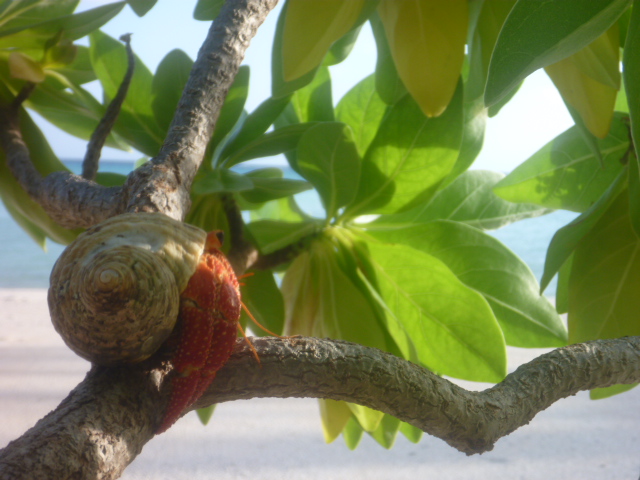

A Rapture at Makemo
One feature that attends my current occupation is the lack of access to world news. Newspapers in the villages, when available at all, are regionally focused, and only twice in the Marquesas did I encounter a television in a public place. A long, sleek flat-screen hung from the ceiling of the better grocery in Atuona and flashed with the bright colors of European football each time I made a trip in for bread and cheese. Another was in a one-table pizza restaurant, itself within a larger (four more tables) restaurant on Ua Pou. The television, small and ancient, sat on the counter and had its rabbit ears pinned to the wall; the images jumped and were obscured by snow but the program was obviously a French soap opera. Locals pulled their plastic chairs closer and pointed.
I do, however, hear snippets. “That Obama is still the president!” reported my dad when I once asked what was happening out there. When similarly queried, my wife described the marriage of Prince William and Miss Catherine in grand detail and then called it “a small affair compared to Diana’s”. And from some cruiser along the way I picked up that we were all recently to have been raptured. The cruiser scoffed that “only Americans could be such end-of-worlders”, from which I surmised that the date had come and gone, again. But I’m not so sure.
On July 19th at around seven in the morning I took a break from writing to make a second cup of coffee, ponder a transition, and stare out Murre’s cabin window at the turquoise water turned frothy by the wind. Even four days after making Makemo Atoll I couldn’t get over the strangeness of the place. We were anchored inside a snaking ribbon of sandy beach and palm forest that stretched as far as the eye could see. Never wider than a city block nor higher than the tallest tree, this thin barrier alone separated us from the big ocean, and my only company ashore–hermit crabs and rats.
When I sat back down to the laptop, its blue screen began to flicker. As I watched it slowly brightened and brightened until it was entirely white and without detail. In my memory of the event, soft ethereal music accompanied the fading away–the angelization, the rapture of my computer. I tapped it thrice, turned it off and then back on, removed and reinserted the battery, closed and opened the lid, shook it gently as one might shake someone from a deep sleep, and each time the computer woke, it was but a shell of its former self. My coffee grew cold, as did my heart.
No, I don’t mean to suggest that this machine was a person in the way that Murre is a “she” and my wind vane, Molly. Even at its best, even when we were getting on just fine, the thing was far too finicky and unpredictable to warrant the affection of a name. That said, a laptop is my link to my wife, to my friends, to family. It serves me in a way I very much enjoy, and where weather forecasts are concerned, in a way I cannot duplicate. Given this I had anticipated failure and planned redundancy. When I left San Francisco I had two laptops. The first was expensive and powerful and sexy and into it I managed to spill an entire bottle of beer before I had got it further south than San Diego. I have been using the cheap, backup computer ever since.
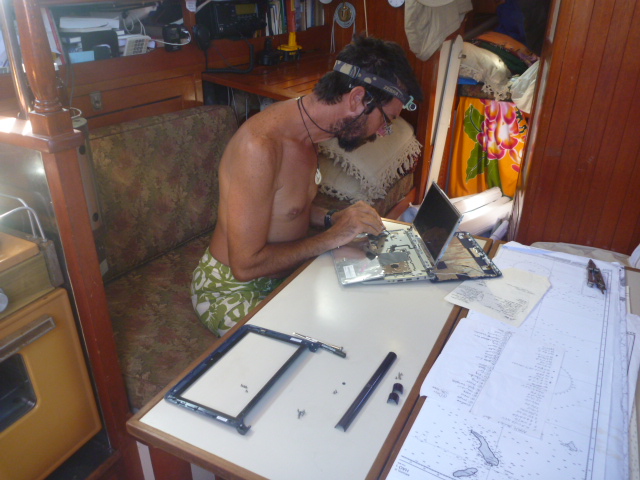 I retrieved my laptop repair kit from the cupboard, a small screw driver and a dentist’s tooth-cleaning prong, and set to work. Within the hour I had stacked neatly to one side of the salon table seventeen screws and most of the laptop’s casing that, separated into its various pieces, looked like the disassembled fuselage of a large insect. Outside the wind howled in the rigging and a tern croaked complaint as it gave up a fish to a swooping Frigate. The keyboard snapped out whole as did the screen itself, and some further digging revealed the screen’s wiring path into the main unit. This I followed until it disappeared below a trap door held down by two silver screws, which I removed. The door popped up and there I saw what I had been seeking, the socket that connected the screen to the computer. Covering the socket was a section of clear tape imprinted with the words DO NOT TOUCH in the big red letters of four languages. I peeled the tape back, unplugged the screen from the computer, and plugged it back in. It was all I knew to do. It had no effect. This took all afternoon.
Let me be clear–I don’t need the computer; I just like it. Summer backpack trips and weekends on Murre excepted, I estimate I’ve spent time with a computer on most days for much of the last twenty five years. Booting is as normal as checking the time, as habitual as reading. It’s a useful tool that I’m use to, and as they say, “sailors like what they are use to.” But not to all. Some take pains to “unplug” during their cruise arguing that our generation has become addicted to connectivity, that the virtual world we have built is a barrier between us and the raw nature we cruisers have set out to experience. OK, but only to a point. Barriers to raw experience abound and can be quite handy. My skin is a barrier, my clothes, the glasses I now ware, the metaphors I use. Makemo’s thin reef crushes the ocean swell. Even the boat is a barrier between me and the raw experience of drowning. I’m rather fond of that barrier.
Granted, I spend an inordinate number of hours out here tapping away and wouldn’t that time be better spent in gathering more experiences? Maybe, but how many experiences can one remember? Only a few months after my first crossing of the Pacific from Hawaii, I was shocked how many of its details were beyond recall. I had wanted to store away every last moment but found I was left with only a few scenes of waves and wind, snippets of conversation, the feeling of fear and of being seasick, and the untrustworthy recollection that the passage had actually occurred. Have I reacted too strongly, jumped too far the other way on this cruise?
More to the point, when my computer vanished without so much as a goodbye, I had been in conversation with Joanna. She was expecting a response, my list of needed supplies from the States and specifically where we would meet when she landed in Tahiti two weeks hence. We had discussed many times how to react if my emails just stopped; that is, don’t panic!, but I knew she would worry, and I for worrying her. The village at Makemo’s western entrance was only peopled during copra harvest; the one other boat I’d seen was the pleasure ship just inside the pass, now ten miles away, below the horizon or likely elsewhere by now. So when I switched on the cell phone it was more out of a sense of duty than hope. From the galley it connected, but without bars. I went on deck. Still nothing. I stood on top of the cabin and got a flicker. I climbed the main mast to the winches, into the free-flowing trades, and from there I called my wife.
Murre and I remained ten days at Makemo before sailing overnight to Kauehi Atoll where we anchored off the sleepy village of Tearavero for another four days, departing for Tahiti on July 30 (more on which later). Joanna arrived as scheduled and with two suitcases, one for her and one full of things for me–including another laptop. From our mooring outside the Tahiti Yacht Club in Arue I can see the lush mountains covered in cloud and with Cook Island pines so thick on their lower flanks the vista could be mistaken for one in the Pacific Northwest if it weren’t for the trades and the temperature. Apartments and homes blanket the hillsides giving the general impression of disarray. To my right is the blinding white of a huge cemetery; each plot is covered by a small roof structure and has a view to the North. I can hear the rush of the boulevard just beyond a row of palms that leads traffic into the city of Papeete. Coot plonks quietly at Murre’s side while I type. We are now nearly three months in French Polynesia and it feels but a moment.
No, he hasn’t sunk the boat. Update from the BWW.
Hello followers of Murre and Randall!
This is BWW. No, Murre and Randall haven’t sunk to the bottom of the Ocean.
Please don’t panic.
Randall shimmied up the mast today so he could get a cell signal (what a man does for love) and let me know that his computer is broken. This means no email, which means no blog updates until he gets to a computer again. The good news is I’m heading to Tahiti in two weeks and will have a shiny new laptop in my suitcase for him. Don’t you feel bad for me? I HAVE to go to Tahiti to deliver a laptop. Life is just hard.
From what I can tell Randall is finding the Tuamotu Islands very odd. “There are only palm trees and hermit crabs. It takes me about 15 minutes to walk from one side of the island to the other. And it only takes me 15 minutes because I have to hack my way through the jungle. If there was a path it would take me about 90 seconds. I’m the only one here.”
He’s off to the next island tomorrow where there is, apparently, a village. Maybe that’s where the cell phone signal came from.
I’ll update here (sorry not as poetically as Randall) as I hear new news.
More to come in August.
Makemo, In Reality
Current Position:
S16.30.693
W143.49.291
There is nothing slower than a sailboat on final approach to a much anticipated landfall, even when that boat is making her top speeds in fresh trades.
I knew not to look for Makemo too early. The Marquesas islands can often be seen thirty miles away, Hawaii to as much as one hundred. But DIP RANGE tables say an object 50 feet off the water, like a tall palm tree on a squat atoll, should only be visible to a small sailboat at eleven miles out. Even so, at twenty I looked to the horizon with expectation, and at fifteen, some worry. We were racing the sun. In all these months of cruising, I have taken pains to arrive at new anchorages in daylight. But this one–the trickiest–would not be so. The question was how dark would it be when we arrived and how much would it matter.
Then, at four in the afternoon, dark bumps on the horizon 10.8 miles distant that soon resolved to be islets (motus) topped with clumps of palms, widely separated from dead ahead to four points to port. We raced on as the sun sank. I raised my right arm and commanded the sun like Joshua, and then it set, and still we raced.
I saw that the moon I had counted on would be behind cloud for some time. Then suddenly we fell into the lee of Makemo, which broke the swell, and to my relief the pass was still evident in evening light, pouring out a furious ebb. I motored slowly up to its eastern lip, sounding around for the “visible” shoal, visible no more. I could hear surf and see its white flashes on a pale outline of shore. The depth went from unreadable to one hundred feet, then fifty, then eighteen in moments, and I was anchor-down by just after six o’clock. The wind whistled in the rigging, but Murre held still.
Still, but not secure. Cloud had moved off and a full moon shown on Makemo’s western end. Silhouetted palms shook atop low hillocks, surf boomed, and to leeward–in fact, in every direction except ahead–open ocean. If some anchorages feel safe as houses, this was a cliff side bivouac. But Murre was remarkably, ridiculously still. Anchoring in such a spot carried all the satisfaction of a well turned cheat, and I couldn’t help but giggle. I made a pot of lentils, had a glass of wine, changed into clean, dry clothes (clothes soaked in salt water are always damp and sticky), and was asleep by eight o’clock.
At one in the morning I woke to the growling of chain and saw that a flood tide had begun to pull us into the pass. We had drug and would have to reset. Murre rode strangely, her stern to the pass, but chain flowing under the bow. And it ground incredibly coming up, now and then catching on a coral head such that I had to jockey the boat to free it. At twenty feet it stuck hard and no pulling on my part brought up any more chain. Cranking on the windless only served to pull the bow down on the rise of swell, flexing the bow sprit until I thought the roller would tear out, taking the sprit with it. Leave behind my best heavy anchor and all my chain? I sat on the bow unsure what to do. Then with a snap, it freed. I hauled hard and fast and had the anchor catted in seconds. The whole operation had taken an hour.
I could not risk another try. Slowly, unwillingly I donned salt wet clothes and harness, opened half the jib and Murre and I returned to sea along the same course we had used for our approach. I dozed in thirty minute intervals as Murre sloshed and banged. Each time I went on deck to adjust the vane, I got soaked.
At dawn we were twenty miles off and I put Murre’s head back toward Makemo. Dawn was dirty with low cloud ahead and behind and rain. Wind had increased to twenty knots and waves to eight collapsed frequently. I was depressed. Approaching Makemo now meant breaking all of the cruising guides’ rules to atoll management, not just some.
Rules:
1. Get a good wind to carry you down and help time arrival for low slack. (First becalmed, now a snorting trade)
2. Plan an approach without rain in the forecast–you need sun to see the uncharted coral heads in the lagoons (There was no rain in the “forecast” but plenty falling from the the sky)
3. All anchorages are wind exposed; most also to fetch–plan accordingly. (Trades to twenty knots)
4. Even in the best weather, put crew on the bow to assist with conning around coral heads. (…) 5. This is serious business folks, and we’re not kidding!
My venture was beginning to look dangerous.
I wrote out my options in the log.
-Cut and run to Tahiti. Miss Tua’s altogether. To do this we’ll have to navigate around two sets of atolls, much at night and in dirty weather. -Find a better outside, lee anchorage and wait improved conditions.
-Tough it out at the ship anchorage just inside pass. Entirely exposed in deep (60 feet) water. May be coral again. Good enough holding? I’m ok with this, but…
-Push to reported “excellent” (fetch protected, sandy bottom) anchorage eight miles in. Can Murre motor against such headwind? Can I see coral patches in such weather?
We arrived at the pass with an hour to low slack. Rain had cleared but a hard wind and low cloud persisted. I poked around for the documented shoal and found its sandy portions to be too close to the pass and exposed to crazy currents. Fine for short periods, but not as a waiting ground. On the west side water was deep and the bottom was all coral but protected. Would work if required.
Standing atop the mast winches, I could see over the atoll and into the lagoon. The water was black, breaking white. Expected. Deeply disappointing. When bravery allies stupidity, break ranks for cowardice. Who said that, I wondered. Was it fitting?
Back at the pass, tide was at stand, so I decided it wouldn’t hurt to poke inside and see how the ship basin looked. Could dash back out before the flood if it was a mess; that, or be trapped for six hours. In the pass a steep chop began almost immediately and continued into the anchorage where a ship-yacht sawed back and forth and even its tenders, the size of Murre, bucked and chewed their thick painters. The area recommended for cruisers like Murre was worse–frothing lee shore within half a mile. This was an emergency anchorage only.
Without thinking I pointed Murre toward the “excellent” anchorage eight miles upwind. Just a test. Could we even make way? Slowly we crawled past the ship-yacht. The helicopter on its upper deck was bundled and lashed as if a storm were coming. Below the bridge was a glassed room with blond paneling, a dining hall or boardroom. The doors were closed. Inside stood a pale man in swim trunks talking to a man in a suit. At the stern a man in a white coat leant over a bucket peeling shrimp. Two others carried scuba gear from one part of the ship to the other. None one waved or even looked up. There was no name on the vessel. Murre dunked her bow and threw several gallons of water over her crew in the cockpit. Different worlds passing slowly by.
Out of the anchorage area water depths quickly went deep–80 to 120 feet–and stayed there. Ahead was an obvious coral patch breaking with white water. And just beyond that, a small spot of water turned from deep blue to greeny brown. Slowly we moved around these. Ahead were two more to port, and then far ahead I could see another. This was not what I’d expected: clean, deep water with widely separated reefs. We pounded on making four knots at times, often two. A squall of rain passed through. Wind increased such that the water-top became streaked. For a time visibility was zero, but then, as if by compensation, our speed dropped to one knot. And Murre pounded on. The palms ahead were at first gray silhouette and then they began to take on color and grow in size. There was some sun. Coral reefs became few. As we fell into the lee of the atoll’s arm, the chop lessened. And three hours after entering the lagoon we were anchor down in eighteen feet, sand. Wind whistled in the rigging, but Murre held still. Safe as houses, this one. I napped twice before dark and was in bed by eight.
end
Makemo, The Plan
Noon position(Tahiti): 15.57.912S by 143.40.367W
Course: 211t
Speed: 6.14, last hour
Wind: 14 – 16 E
Sky: Clear, but undefined cloud ahead
120 miles since last noon.
We exited the convection cell around midnight last night and the wind went immediately to 20 knots from the SSE. I had full sail up at that point and was forced to dowse the mizzen, put a reef in the main, and roll up the jib by two thirds. Remember, we were close hauled. In twenty knots of wind, that’s a very wet point of sail. By morning the wind had backed into the east where it has stayed all day, usually at just under 15 knots. Morning sky was a desert sky: thin cumulus clouds ahead, behind a high layer of thin cirrus, and you couldn’t have wrung a cup of water out of the whole lot.
Today’s Plan
We are making final approach for the Tapuhiria Pass on Makemo Atolls southwest tip.
Why Makemo?
Guidebooks go out of their way to impress upon their readers how challenging the Tuamotu Atolls can be. They were called the Dangerous Archipelago by the old square riggers, says one book. Even cruisers avoided them until recently, says another. Still another says be sure to have someone on the bow to help con around coral heads and only enter at slack water-the passes can have tide runs of 9 knots. Then they go on to describe each atoll, its pass and anchorages in detail. These aren’t really islands in the usual sense. Imagine Tahiti, high and green and surrounded by a reef. Now subtract the island and replace it with a lagoon, leave the reef, and you have an atoll. These are low islands, often the palm trees are the highest objects; so, they are not visible but a few miles off, and they are hard as rock.
So, we’ve chosen Makemo as our introductory atoll because: 1) it has a straight-shot approach from the Marquesas–no other atolls to go around first; 2) both entrances are used by ships and are marked with navigational aids (do remember that the French put green markers on the right–so it’s “Green Right Returning from Sea”); 3) the anchorage inside the SE arm is listed as “excellent, sandy, protected”; 4) I have tide tables for Makemo and so should be able to estimate low slack, my best shot for entering; 5) the Tapuhiria entrance is on the lee side of the island and has a shoal on the outside that can be used for anchoring if one is waiting for better conditions or slack water on which to enter.
That last bit is important. Being becalmed a day blew any chance we had at today’s slack low tide, which was at around ten in the morning. If this wind holds we’ll reach the shoal just as the sun is setting (there’s a full moon) and will have to anchor there overnight. It’s unclear if the anchorage is tenable for that long a term–it is, after all, in the ocean and the trade winds are booming again.
If the shoal anchorage fails, we’ll be forced to put back to sea and stand on and off all night, not a lovely prospect. But safe.
end
Enroute Tuamotus: How Charming
Last night’s report below.
Position as of this morning, 0630, July 14: 15.28.297S by 143.22.026 Course: 212t
Speed: 6 knots
Wind: 14 – 16 ESE
July 13
Noon Position: 14.13.503S by 142.39.889W*
Course: 215t
Speed: 4.6 knots
Wind: 9 knots SSE
Sea: 2 ft chop, no apparent swell
Sky: 50% occluded, full cloud cover dead ahead–large convection cell Bar: 1013, falling
20 miles since last noon, all after seven in the morning.
Answer: Anchor light. Not sure that’s technically the right answer, but that’s what I lit last night as we drifted, instead of running lights.
We were not sailing by midnight. The breeze that came up as I finished writing whispered softly of promises to keep and then departed.
In the night Murre contrived to turn cross to the swell such that we rolled and rolled, and I wore out both shoulders and both hips holding myself in my single-wide bunk.
I woke (for the last time) with the sun, made coffee, and said out loud “I’m ready for wind now.” The previous day had been charming, exactly what I had hoped for, but another might be worrisome and several, unnatural. A windship requires wind, without which she might as well be planted in concrete and on display in a museum.
Orange and vibrant, but only for a moment, the sun quickly squeezed up and behind a layer of light, cottony cloud that stretched from the eastern horizon all the way to where we sat admiring the day. It wasn’t yet awake, this cloud, its dull color blending with the slate as the sky, but then suddenly the sun achieved a magical altitude and in a single moment the entire sky of cloud lit as if switched on. From slate it went immediately to the soft white of eggshells.
An hour later a light breeze of five knots from the ESE as if by order, and with that we were underway, all plain sail, close hauled and making three easy knots in the right direction. The sea was flat and I made breakfast and tidied up and answered email in a cabin with so little movement I didn’t have to hold on. This was far better than Nuku Hiva where even at anchor it was “one had for you and one for the ship.”
How charming, I thought. The sea is such a lovely place.
But in the afternoon a dark cell of cloud directly ahead grew until it covered our way like a great lead wall. It did not move off with the wind, but sat there, and we sailed under its covering and it folded in behind us until the sky was all dark cloud. Rain to the west. Rain behind. The wind increased and backed into the south, and a chop rose up quickly that often took the bow and sometimes the sprit and stopped Murre cold.
Close hauled is not a ketch’s favorite point of sail. At least that’s the case with a particular ketch named Murre. Close hauled and the flow of wind from a tightened main sail no longer flows clear but presses against the back of the mizzen sail, turning the mizzen into a brake. The easy solution is to reef the mizzen. This flattens its luff, pulling it out of the draft from the main. Because the sail is small, the sail area lost in the reef is negligible. But the mizzen creates a flow of wind that presses against the wind vane, reducing its ability to steer the boat. All afternoon I experimented, and finally figured out that if the vane’s range of motion was moved off center and to windward, it could steer a close hauled Murre. It helps that close hauled, she needs almost no wheel.
Later, while on the sprit securing the plow of the anchor, which had come adrift, this due to a recent improvement I made to the chock that holds the shank, Murre rose high and dropped me up to my waist in froth. Even dry clothes didn’t warm me. The thermometer had dropped to 72 degrees. Downright cold. I put on a long sleeve shirt that it took some effort to find.
Wind continues to back until it is almost due south, making our southwesterly heading untenable. At a heading of 240 true, we lose about a mile an hour to our true course.
I have since put on a sweater. And wool socks. I made a pot of lentil stew. It is raining hard now, and the boat pounds away, close hauled for the Tuamotus, in Pacific Northwest weather.
How charming!
*Noon ship’s time is now Noon Tahiti, same as Hawaii. I know you’ve been worried about this.
end
Enroute Tuamotus: Becalmed
Noon Position (Marquesas Time): 14.04.708S by 142.22.896W
Course: 280t +/-
Speed: .5 knots +/-
Wind: 0
Sky: 10% cloud
Sea: 1 foot
Bar 1400
Temp: 83 degrees
54 miles since last noon.
Becalmed.
Wind softened all night until by morning any propulsion left in the sails was due to Murre’s heavy roll. From my bunk below the sound of sails slatting, blocks slamming one way and then the other, and the infinity of stowage shifting its position ever so minutely on each wave was a devil’s jam session. Imagine a bus load of pre-schoolers let loose in the percussion section of a high school band room and there you have it. That I slept soundly (not to mention at all) is a testament to a conscience at ease and the several glasses of wine that lubricated it before bedtime.
What small wind had managed to survive the night evaporated with the sun and all day the sea has been like undulating glass. Sails are furled. How we are making forward motion through water–half a knot, all west, all day–is beyond me.
In truth I was looking forward to being becalmed. A sailboat on the move implies wind and waves, and one’s speed through the water and the water’s churning disallow any view of what’s inside. One rarely has time to meet the neighbors when sailing through, and that’s usually the point. But I’m curious to know what’s down there. I wish to terry a while in a place where the water’s too deep to anchor. Today I’m getting my wish.
Given deep ocean’s reputation for being the aquatic equivalent of desert, you’d expect just clear blue water and the occasional scorpion.
You’d be wrong.
For starters, there’s a small, white water strider on the surface just bigger than a mosquito. That an insect can live atop water itself often whitecaps astonishes me. And within the hour of being becalmed, five inchling fry fish begin to use Murre’s shadow as protection. I try several times to net one for purposes of identification and maybe a snack, but they are too fast. They’ve been through this before.
My green plastic aquarium net is able, however, to bring up a few examples of what proliferates at and just below the surface–that is, small, clear “jellies”, not animals, but jelly-like capsules containing separated dark spots I presume to be eggs. Many capsules are perfectly planet shaped and range in size from that of a BB to a large pea. Some are like a short piece of thick noodle. Others are much larger, up to the size of a penny, and have irregular, amoeba-like shapes. All are clear and all contain the evenly spaced, suspended eggs of different colors, sizes and densities. Because they are clear, it takes a few moments to pick out their shapes from the moving, reflecting water surface, but once seen, these capsules are seen by the thousands.
This reminds me of a recent dinner with Glenn and Cynthia aboard COLUMBINE where the subject unexpectedly turned to species radiation. Yes, that was my doing, but I had first ascertained that my hosts were marine biologists and were thus trained to handle the excitement of such a subject. And I’d waited until our second round of beers before debuting my quandary, which was that land animals arrive at distant, remote places rarely and then often evolve out of all recognition (e.g. Honey Creepers of Hawaii) where as many of the aquatic species I’ve seen are exactly the same in the Marquesas as in Hawaii and Mexico, and each geography is separated by thousands of miles of water. Cynthia explains that the sea presents fewer barriers to entry for sea creatures. For example, it would be highly unusual for a finch egg to survive a 120 day drift from Panama, say, to the Marquesas, but that is exactly what the spawn of many fish are designed to do.
So then, are these capsules I’m seeing today tropical fish in the oceanic equivalent of suspended animation?
I dip my net and let its contents loose into a glass of seawater, and it is like watching a tiny solar system swirl. Beside the capsules, I also catch what appears to be a sapphire blue squid, but the size of a broccoli flower, and a small, classically shaped jellyfish of the same color but about half that size. Two or three other animals swim in the glass that are so small I can’t ascertain their shape or configuration, even with a magnifying glass.
A clear piece of ribbon floats by roughly a foot in length and an inch wide. I scoop it up and into my glass and see that its dark spot at one end appears to be a head and mouth. The head swims around looking for the exit, and the clear ribbon of body follows. It is so delicate, lifting it back into the water tears it in two.
There are Portuguese Man-o-War, lavender, moon-shaped, and Box-like jelly fishes.
A tiny insect jumps across the water top as though it were a frog.
And well below the surface from a foot to several swims an animal that shines back at me in green iridescence. I have been seeing this animal, and millions of its kind, almost since departing Mexico, but have no clue what it is. Today, though I am successful in getting it into the net, it either swims right back out or simply switches off its glow in my glass. In either case I remain as mystified now as ever.
One of the fry fish has gotten too use to me and my net, and a quick flick puts him into the glass too. His sides flash with black and blue stripes and his full-body dorsal fin reminds of a Dorado. His breathing is sheer panic, having never seen the world from a glass before–hideous, especially that perspiring monster with the flaming red nose.
For much of the day, so long I fear I’ve sun burned the bottoms of my feet, I lay on my stomach on the side deck gazing down, down into the water and flicking my wand, the net.
_ . _ . _
The quiet of being becalmed is startling. I had never expected to experience quiet here. A boat on the move is noisy. Her bow wave can sound like the roar of a jet engine. Her rigging moans like a choir. Then there’s the whipping of wind in your ears. But being becalmed is more like camping in the mountains in summer where the call of a stellar’s jays or the thud of a falling pine cone are such singular events, so separated by silence, that it’s the silence you hear. Today I have been hearing the silence of a rolling sea and billowing cloud.
_ . _ . _
Sunset and then dark. Anchor light or running lights when I am neither?
_ . _ . _
Still, I’m now ready for some wind. The dragon’s teeth of the Tuamotus are calling. I had wanted to get there before the full moon’s extreme tides, but the moon she is getting full. And I had wanted to get there before the big winds predicted for the day after tomorrow, but with 160 miles remaining, that is unlikely. For an hour now, a whisper of wind from the southeast. Will we be sailing again by midnight?
end
Champagne and Strawberries
Today’s Noon Position (Marquesas Time): 13.15.070S by 142.00.243W Course: 204t
Speed: 5 knots, average over last hour
Wind: ENE @ 4-7 knots
141 miles last twenty four hours.
Winds were steady from the ESE at 12 to 16 knots the first two days out of Nuku Hiva, and we scooted along quickly and easily under working jib, reefed main, and even a reefed mizzen when the wind eased a bit. By noon today we’d knocked out the first 280 of our 500 mile run to Makemo. I had done little except tweak wind vane.
But the forecast had called for diminishing trades the next two days and as if by order, the breeze fell and fell all morning until by early afternoon we hardly had five knots across the bow. Still Murre slipped through the blue water at a pace that felt respectable, and tonight the gentleness of the swell means we ride more smoothly than many a commercial airliner, certainly more smoothly than we did at anchor in Nuku Hiva.
It has been a great relief to get to sea again, the bright, warm, and open sea, and conditions have been such that this feels like a champagne and strawberries cruise. When I am not outright relaxing, I spend much of my time daydreaming–staring at the waves, staring at the clouds…
Yesterday, between beauty swoons, I rigged a new lure purchased in the village and plunked it over the side. It is of the type used by the local fishermen–a bright red plastic squid nearly a foot long under whose wavy tentacles hide two mean hooks. It is almost the only lure sold on the islands, and I take this to indicate that fish are plentiful. Compare Baja where marine stores dedicate entire walls to lures of nearly infinite variety, this beside a sea whose resource is dwindling due to over fishing.
I had no expectation. I have already fished too much with no reward to have expectation, only hope. But within the hour I had aboard a sleek, 31 inch Wahoo. Shaped like a torpedo with a beak sharp as a birds and black tiger stripes. The fish is typically silver, the stipes being saved for “when it is agitated,” said my guide book. And if being dragged through the water by a steel hook only to be hoisted up into a cockpit where he is beat to death isn’t cause for agitation, I don’t know what is.
I tossed the lure back in the water while I figured what to do next.
The fish cleaned easily, one half making two meals (sautd with rice that night and leftovers eaten for breakfast) and the other I cut into strips for drying. Fish will go off in hours in this heat, and lacking refrigeration, drying is really the only option. Drying instructions call for the fillet to be cut into “one inch strips half an inch thick”, a near impossibility with slippery flesh already unevenly shaped. My neat “strips” looked more like torn scraps of jerky.
About this time I remembered the lure and went to retrieve it. I didn’t need a second fish as I already had fish bits draped over any available space. But when I grabbed the line it was rock hard. I put on gloves and pulled for all I was worth but could not budge it–Murre was moving too fast or the fish was too big or both. I spilled wind out of the main and mizzen, reducing our speed by half, and only then was I able to real in the fish a mere six inches at a pull.
I should explain that my fishing get-up is fairly plain: heavy line wound around a two foot piece of plastic pipe. The lure is lowered over the side, and the extended line is cleated off to the stern. No fancy machinery to maintain. The disadvantage (I learned) is that when one has hooked a big fish, getting him in is all elbow grease.
It took half an hour to bring alongside a heavy Wahoo of over five feet in length. He fought little, having already drug so long behind Murre he was nearly drowned, but his weight and the speed of even a slowed boat made it rough heaving.
Just when I’d got him under our stern, and just as I was leaning over with the gaff, he drifted away. Fish and lure simply dropped astern, and I was left holding a piece of line dead ending in a clip swivel. On examination I saw that the clip had pulled out of its lock but had not straightened. As long as there was pressure on the line, the fish was mine. But that one moment’s pause at the stern allowed slack, and the leader slipped over the top of the open clip.
I was sad to lose the lure and sad to leave it buried in the mouth of a beautiful fish. But what if I had needed that fish–what if my survival depended on it?
I have removed the clip swivel from the tackle system.
And back in Nuku Hiva, I had bought more than one lure.
end
Enroute Tuamotus, redux
THIS IS A REPEAT WITH THE ADDITION OF A LITTLE TEXT THIS TIME AND WITHOUT THE SECTION SEPARATING DASHES (–) THAT WORDPRESS SO DISLIKES.
Date: July 10
Time: 7am, Marquesas (1630UTC)
Position: S10.39.233 W140.49.314
Course: 204t
Speed: 5.7 over ground last hour
Wind: ESE 10 – 13
Cloud: 40%, but full cloud approaching
Sea: 3ft E
Bar 1013, rising
Murre departed Nuku Hiva at 1030 (Marquesas Time) on July 9 and is enroute Makemo Atoll (S16.34.174 by W143.40.969) in the Tuamotu group. Distance to be sailed: 500 miles.
A wind from the east at 16 knots and a high, lumpy sea confused by its impact with the island settled within the hour, and Murre was soon making a steady 5.5 knots and better over the ground. Our knot meter is not functioning. It was grassed up by the foul water of Nuku Hiva, and the generous number of sharks in the bay kept me from diving on the impeller. Certainly they were Black Tipped Reef sharks who have no habit of dining on human flesh. But what is not a habit may be an interesting diversion or even an unintentional foray. The murky water in combination with the shark’s poor eyesight mean mistakes could be made. Why cause the shark such regret?
Sharks. They are not evenly distributed in the bays of the Marquesas. Here they are plentiful. Once Cynthia from COLUMBINE and I were observing a fishing party dress its catch at the head of the wharf. Several Wahoo the length of a grown man; Yellow Fin tuna as fat as pigs; a whole tub of Red Snapper. The trimmings went into the bay and were hoovered by two large sharks thrashing about in the brown water like mad dogs. Cowboy, a Marquesan local wearing a camouflage hat, a boar’s tooth necklace, and a mischievous smile, tied some left over Yellow Fin skin to a piece of rope, made the end of that rope into a lasso and tossed it into the bay. Three tries later and he’d lassoed a 200 pound shark. It nearly pulled him in, but three other men caught hold and soon the shark was tossing about on the cement wharf, the very definition of a fish out of water. One man got out his machete and approached. Another turned to me, I’d edged closer as the drama unfolded, and said, “you want picture?” Did I ever. But the camera was on the boat. When I said as much the life went out of the party. Cowboy tipped the great beast back into the water and walked away.
Another time on my row back to Murre a shark followed in our wake for a full five minutes before deciding COOT was not a dinner plate after all.
And on another occasion I was standing on the bow when two sharks, jaws locked together in bloody combat, flung themselves out of the water close enough that the splash wetted my feet.
So I did not dive on the impeller, please forgive, and our speed on this passage is over-the-ground speed generated by the chart plotter.
We ran all night with wind dead on the port beam and Murre under full working jib and reefed main only. She could have taken more sail for more speed, but was balanced so well with that configuration I did not touch the windvane much after midnight. Speed and course keeping ability must be taken together when one is singlehanding, and there is much to be said for running easy and true even if such is not always fast. I slept in one hour increments starting at 8pm and the rhythm of it came back quickly.
This morning full cloud approaches from the east and winds have decreased to 10 to 13 knots, so I’ve raised a reefed mizzen. The weather forecast is not entirely in our favor on this passage. We should have good wind for the first two days, but then things go very light in this part of the Pacific on the next two. And there is the chance of rain, which I would like to avoid on our actual approach to the atoll.
end
Enroute Tuamotus
Date: July 10
Time: 7am, Marquesas (1630UTC)
Position: S10.39.233 W140.49.314
Course: 204t
Speed: 5.7 over ground last hour
Wind: ESE 10 – 13
Cloud: 40%, but full cloud approaching
Sea: 3ft E
Bar 1013, rising
Everyone has a Story
When traveling in a remote country, one should not be surprised to find frequently challenged the uniqueness of one’s own exploits. Getting here is difficult. Everyone has a story.
Anchored to my left at Hakahau Harbor on Ua Pou’s northeast side is a battle-ax of a boat named KAYAK. Her ancient steel hull is a patchwork of worn beige and denting between the ribs. She lacks roller-furling; old sails in old bags hang from the head stays. Her wind vane is home-built and of the type used by singlehanders in the 60s. The newest things about her are her present crew, Brian and Kelly. Brian acquired the boat in La Paz just one month before departing for the South Pacific–there he met Kelly, and she came aboard two weeks later. Neither had seen their twenty fifth birthday nor had either made a crossing. Kelly had never sailed a small boat. But for them the twenty nine day passage to Hiva Oa was a lark, the biggest difficulties they reported those of surviving the other’s taste in music and getting the vane to steer a coarse with straightness in it.

Boats at anchor below "El Capitan", Hakahau Bay, Ua Pou
Or there’s MORA MORA, anchored to my right, manned by Yves, a French singlehander most recently from Portugal who is making his way back to Madagascar where in his youth he acquired a taste for travel on the cheap. As an adult he’s rarely worked more than a year before taking off to a new place. “MORA MORA” means ‘slow slow’ because for me even walking is too fast and I like the sea,” he says by way of explaining his choice of names and mode of transport. “Maybe I go to Madagascar,” he says, “and maybe not; I like people; I want to see new places, but maybe I stay in the Marquesas. Here it is tranquil…and French.” He is approaching 50 and is built lean, the result of a simple diet supplemented regularly with hand rolled cigarettes. Except to buy beer neither his curiosity nor he often leaves the boat.
There’s DON QUIXOTE, a large catamaran containing a family emigrating to New Zealand where the husband has found more gainful employment than he could have imagined in the States. Job accepted, his employer asked how long the move would take. Jacob said ten months. The employer’s confusion was transformed to amazement when Jacob said his home was a sailboat in Florida that he was unwilling to sell, but the timing was accepted. Now the two sons and two daughters are having the adventure of their lives.
There’s the green sloop ATEA moored off the quay on which lives another family, the local doctor and his wife, also a doctor, and their two little girls. Years ago the couple cruised here from France on a small boat and without children, but these islands so captured their imaginations that they stayed. For her the romance is doubled because it is here she became pregnant–twice. Having two young ones required a larger boat. To afford the boat the couple had to work in the infirmary on Ua Pou, a village that has the convenience of good schools for the girls. Each morning at seven o’clock the family commutes from the quay to the dock by dingy, a trip requiring all of three minutes. It takes longer to start the outboard motor. A Marquesan flag the size of a bed sheet flies from the spreaders. The wife is thin to the point of being frail, but she’s quick. I watch her bathe the kids from the boat’s stern in the evenings, dunking each in the bay followed by a rub-down so furious it should produce smoke. The husband is small too, pale, balding, but liberally tattooed.
Or there’s Xavier who floats in the small bay on a foam board every afternoon, bobbing between boats and passing on whatever fresh rumor he has acquired. “Kelly and Brian are going to the Reggae festival–did you know this?” he asks me. “She went to the pension for internet yesterday and stayed all afternoon. I think she is unhappy. You are leaving soon, I think, yes? The doctors too–they just quit–will start cruising next month. Do you need crew? I am available.” He arrived from Paris as an English teacher, but back in Paris after his term found himself “wrecked for civilization”. He returned to Ua Pou and bought a house. “My mistake,” he says. “Now I’m stuck.” But one wonders if his stuckness, like his swimming, is more a gentle repose.
Or there’s today.
I too have accessed the free internet offered to cruisers by the pension on the hill. The main room is a roofed patio with couches and a sitting table that looks out to sea and here, for the price of a beer (400 Pacific Francs) one can sit all day undisturbed. A large coconut tiki sits in one corner. On the wall hangs a map of the island, hand drawn onto tapa. Here I become acquainted with Jerome, the pension’s owner, a compact Frenchman covered in Marquesan tattoos whose features are fine to the point of being beautiful and do not suggest his background–25 years in the French Marine Corps. On my second visit I learn that he leads hiking tours into the mountains once a week, and so on Thursday morning at seven o’clock I meet him behind the pension where another young couple is waiting, David and Audrey with young Anise already encased in a backpack. They are French professionals from Tahiti on their first tour of the northern islands.
We cram into Jerome’s small truck and are driven by Jerome’s wife, an islander born in Tahuata, over rough roads that climb and climb until, just short of the cloud layer, we are disembarked in the dripping jungle. The truck and the wife return to the pension leaving us alone in the silence.
Instruction begins immediately. While we stand swatting mosquitoes and black clouds of nono, Jerome explains,
“Ze hike it goes up for 100 meters and zen down and zen up 200 meters and then down; zen at 300 meters we have a nice view and zen down for ze lunch in ze next village.”
The trail, he continues, is an abandoned horse track used by those who harvested first coconut for copra and then coffee beans from the steep hillsides. But it was abandoned when most of the islands switched to raising Noni, which is easier, which requires no work beyond that of planting the tree. The fruit of the Noni is the size of a plum but with nodules similar to pineapple. When ripe it looks like a ghostly pale exploding golf ball, smells strongly of Limburger cheese and tastes worse. The entire French Polynesian Noni harvest is purchased by a Utah based company that produces from it a tonic said to benefit the immune system and slow tumor growth. So the trail was abandoned when Noni, happy in the more easily farmed valleys, boomed in the late 90s. Over planting lead to a Noni price fixing by powerful Tahiti, and now little Noni is harvested in the Marquesas, but few have returned to harvesting coconut and none to coffee.
All this before I’ve got my pack on.

Audrey and David on a steep ascent
As promised, the trail’s incline is immediate, and though Jerome has said it is maintained, over growth is such that Jerome frequently clears a way with his machete. Here and there low hanging branches require David get on all fours so that baby Anise on his back can pass without being scraped. He does not always succeed, and from my position at the rear, I can see scratch marks on her legs to match the mosquito bites, but she does not cry. She pulls at David’s hair, bounces in her seat. Now and then I retrieve one of her shoes kicked off without David’s knowing.
At the first ridge we have a partial view of Hakahau Bay, now so far below I can’t see Murre at anchor. Jerome climbs a Guava tree and dislodges a few fruits, and while we eat, sifting the soft, fragrant pulp from the extravagance of seed, Jerome retrieves a large yellow flower from another tree and begins to talk.
“Beach Hibiscus,” he says. “Coconut was ze most useful plant to ze ancients, but zis was second.” The flower has a maroon interior and a purple stamen which he removes, rubbing the anther on his arm. “A good antiseptic,” he says, “and used as eye shadow by ze ladies.” He pulls down the tree’s large, leathery heart-shaped leaf. “Very nice oven mits,” he says. Or also used as plates or drinking cups. Or in bunches they are good bedding or a final covering over a fire pit. The back side, which is rougher, becomes toiled paper, and the leaf’s stem “iz nice for to clean ze nails after”. The bark, peeled in strips, makes a crude rope strong enough to tie several kilos of banana to their carrying pole. It can also be used to make tapa, mats, grass skirts. On and on.
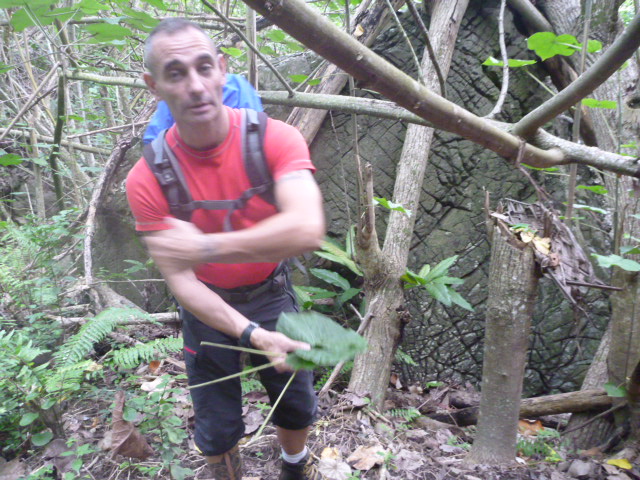
The uses of Hibiscus
His explanations are always in English and without translation for the French couple. Occasionally he gets stuck. “Oh, how do you say…” And usually Audrey will provide the answer. “Float,” she says. “Yes, ze wood of Beach Hibiscus is used as ze float for ze pirogue, but not ze …” He makes a round shape with his hand. “Hull,” says Audrey.
We descend into a valley that once had a bridge crossing its tiny stream and steep gorge, but last year’s rains washed it out. Now we descend and climb the sheer sides with a piece of knotted rope tied on one side to a stump and the other a large metal stake. David negotiates both sides while Anise snoozes, head lolling to one side as if a good shake would send it rolling down into the ravine.
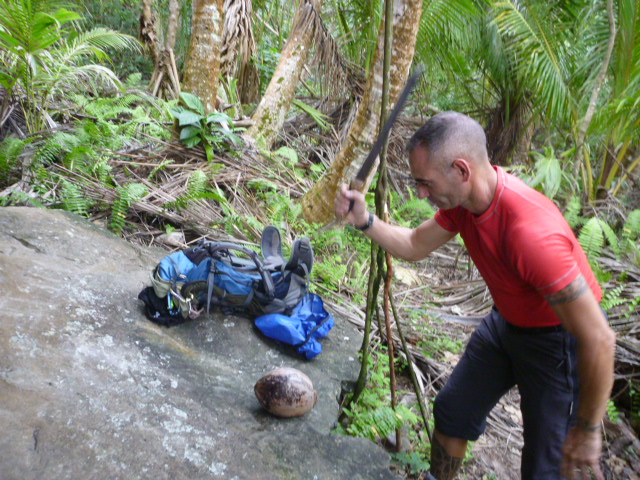
Husking a coconut
At a turn in the trail dominated by overhung boulders we pause for a lesson in coconut husking. Earlier I had mentioned the hour required for me to get at the meat using only my Bowie knife, at which Jerome smiled. “You must ask yourself if you are made for survival,” he says cryptically. On a flat spot in the rock he sets the coconut with stem-top facing away from him and with his machete he hacks out a “V” in the husk. Then he pries the rest of the husk off with the knife’s tip. Pointing to three small indentations in the now bare nut, he digs at each, finding the one that gives-up white meat. “Sink of zis as ze mouth–ze other two ze eyes,” he explains. Then he draws an imaginary line from the eyes over the forehead to the top of the nut. He positions this line so that the back of his machete blade meets it perpendicularly. One strong whack and the nut splits exactly in half. Eight minutes, start to finish.
“Now you,” he says, pointing to me. “If you will survive, you must practice.” I take his machete, position another nut, and raise the blade overhead. “Wait!” says Jerome. “Maybe you make your friend very sad,” he says, pointing to my left hand which still rests on the husk. “In the islands we call machete ‘coupe-coupe’, which is ‘cut-cut’–when you cut with machete, you cut twice. Cut coconut and cut off hand. Cut at grass and cut off leg. Cut at high branch and cut off head of man behind you. Be careful with coupe-coupe. Remember, in survival, you are the big enemy.”
It takes me twelve minutes to husk the nut, find the white-meat eye and whack the top of the nut’s head. But nothing happens. I whack again. The nut bounces out of my hand and rolls away. “Harder! Ze coconut she is laughing,” says Jerome. Harder, and harder, and then the nut splits. We lounge, eating our snack as Jerome explains that under these boulders the old hunters slept when it rained.

Giant Pototainui
We soon exit the jungle and begin to hike a spine of lichen-covered rock up to a high and windy point from which our view expands to take in several of Ua Pou’s spiring peaks. “Eight of the twelve,” says Jerome proudly, “including ze big two.” Suddenly he is telling the Marquesan story of creation. God’s wife is unhappy; she is weary of living in cloud above blue ocean, so God builds a home at sea level. The island of Ua Pou (two pillars, two spires) is created as the supporting posts between which an Hiva Oa (long pole) was placed and connected by Nuku Hiva (roof beams) and then covered with Fatu Hiva (nine woven palm fronds). Jerome expands his chest and calls out the island names with the voice of a warrior.
On the descent Jerome stops to point at a seed the size of a small avocado resting in the trail. “Zis is ze seed of ze Belle Mama…” he says. I pick it up, smell it. “…it is poison–don’t touch it,” he says. He snaps a leaf from the tree and white sap oozes from the stem. “Locals used this for their enemies. Maybe zis is for ze tea of your wife’s mozur?” he asks me. Audrey explains that “Belle Mama” is French euphemism for mother-in-law. She hands me one of the flowers, white, round and delicate as Plumeria, but with black veins. I explain that my mother-in-law is English, so I would have no use for such a tree. No one laughs.
At our next rest stop I ask Jerome about his tattoos, black-ink graphic designs that cover his shoulders, chest, back and legs. In answer he retrieves a brown nut no larger than a peach pit from a nearby tree. “Ama,” he says, “Or you say Candlenut.” Dried and strung together the oil-rich nut was burnt to light the inside of homes, and half a coconut shell placed over the flame collected the thick soot. This soot, mixed with water, became tattoo ink. Among Polynesians, the Marquesan love of tattoos is legendary. The ancient practice was both painful and expensive–tattoos came to signify both bravery and wealth and conferred status. Warriors were so covered in tattoos that their bodies were mostly ink, and even today most locals one meets in town are tattooed. Jerome points to the designs on his shoulder: the Marquesan cross, hatch marks like fishing net, round designs are coiled shellfish, these triangles are Pandanus, these others are shark’s teeth, those curves, edible fern. The designs tell no story but are combined in ways the artist or wearer considers to be beautiful. There are few artists left, says Jerome, so he makes his own design combinations. And he tattoos himself…where ever he can reach.
In the valley at last Jerome leads the way to the waterfall in whose pool we bathe as little Anise sleeps under blanket between two rocks. And later in the village, we feast on goat in coconut sauce and roast duck with breadfruit. Over lunch I ask Jerome how he, a military man, ended up a civilian on a tiny island in the middle-of-nowhere South Pacific. His answer is that he and the wife bought the pension from her parents upon their retirement. That wasn’t the answer I was looking for. I had meant to ask what drew him to these islands he knew so well. But on reflection that was obvious.
Back at the harbor two new boats, two new stories, have arrived while we were away. Red-hulled GUPPY under command of 16 year old Laura, who is attempting to be the youngest woman to circumnavigate the globe and GALACTIC, a boat I know from San Francisco but whose new owners are using her as a base for their explorations in marine biology as they slowly make their way home to Tasmania.
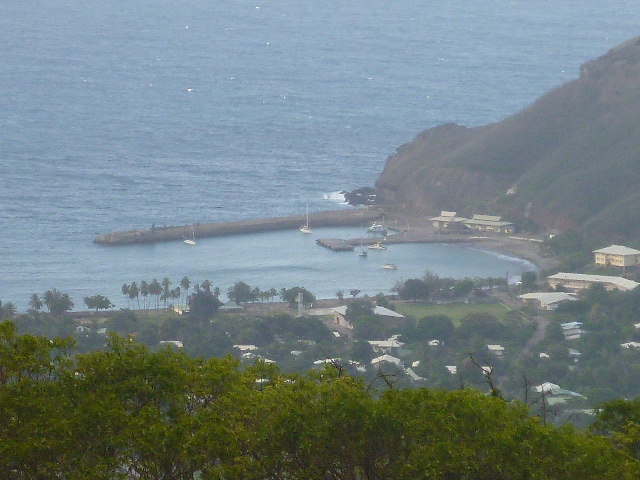
Hakahau Harbor from ridgetop
Ua Pou PHOTOGRAPHS
We stayed on Ua Pou a week and were the most active here of any island so far. To see a large set of photographs, click here. Order is chronological this time.

The Size Issue
Size isn’t relative. But it appears to be so.
Each Marquesan island looks larger than the last. Over the several hours of Murre’s slow approach it grows from a low silhouette to an intricate mass of rock and vegetation that explodes in the eyes. The mountains are fold upon fold of ridge and canyon whose dark rock has the weight of iron. They shoot straight up out the sea, rarely pausing long enough to form a sandy beach, and into the cloud, cloud that hides the peaks and gives the impression of infinite height. Next to this the fringe of waves that lines the shore is small and pretty but unsubstantial, decoration, pearls hung from the neck of a giant.
But this is illusion.
In fact the islands are mere specks on the Pacific. In terrestrial terms the Pacific Ocean’s 64 million square miles of area is truly vast. The United States, including Alaska and Hawaii, could fit into it 16 times. It could hold all the earth’s continents plus yet another Africa and still have room left over. Looked at another way, if a road trip from San Francisco to New York requires about three and a half days (assuming 12 hour driving days at an average of 50 miles an hour), then 18 days would be needed for a similar trip crossing one of the Pacific’s wider parts, Tokyo to Santiago, Chile. The Pacific’s a big place.
Next to this the area of the South Pacific that describes French Polynesia seems rather small. Yet its 1.5 million square miles of ocean is half the area of the continental US. Scattered within it are 121 islands in five archipelagoes, the Marquesas, Society, Tuamotu, Gambier and Astral groups, whose combined area is just 1,418 square miles, not much larger than the state of Rhode Island. In French Polynesia there’s roughly one square mile of land to every 10,000 square miles of water. The Marquesas group is but ten of these islands, and their combined area is 385 square miles. Some Los Angeles celebrities have homes with larger footprints.
Other comparisons. The Marquesas Islands could fit into the area of Tahiti, one of the Society Islands. All of the Society Islands together are smaller than Maui, the second largest Hawaiian island. All of French Polynesia is barely one third the area of the Big Island of Hawaii.
The Marquesas are too small (or too remote or both) to support an endemic land animal and there are only ten species of native birds. Of the 320 species of vascular plants found in the Marquesas, roughly 42% are indigenous, a large percentage for oceanic islands of similar size. But this pales in comparison to Hawaii’s 1,138 species of plants, 86% of which are indigenous.
An estimated 246,000 people reside in French Polynesia, about 70% of whom are of Polynesian descent. Compare smaller Rhode Island at over one million residents. About 80% of French Polynesia’s people live on the island of Tahiti, and 80% of those in the capital city of Pepeete.
When Europeans first encountered the Marquesans, the culture was at its apex and its population topped 80,000 inhabitants. First settled between 150 BC and 100 AD by the peoples of eastern Asia, population consistently expanded until between 1100 and 1400 AD all livable valleys and plateaus were at saturation point. By the time of Cook’s arrival on Tahuata in 1774, Marquesan tribes invaded each other and fought over land to such an extent that war was a way of life. Many islanders had migrated to valley settlements for protection from raids. One theory has it that the rise of cannibalism in the Marquesas was due to a shortage of protein in the diet of a population that was expanding faster than its ability to supply fish and domestic meats.
But western contact cures all ills. After Cook, the rapid increase in visits from sandalwood traders and whalers introduced diseases, arms and alcohol, and the population plummeted until an 1880 census showed that only 4,865 Marquesans remained. Numbers have rebounded since then and continue to grow, and the most recent census put the population at 8,800. The typical American Baseball Park has a capacity that exceeds that by a factor of four.
The islands are so small that when the town shuts down for a holiday (an amazingly frequent occurrence) no one is inconvenienced because there are only two general stores, one hardware store, and one restaurant.
The jail on Nuku Hiva is left unlocked because inmates have nowhere to run. Often they can be seen lounging on the stoop; on visiting days the family and the inmate may have a picnic on the front lawn.
The power plant on each island is smaller than the village church. Recently a Reggae festival on the beach of Taiohea blew a circuit at the plant and for an hour the whole island went dark. Locals responded by turning up their car stereos and the party continued unabated.
The airport control tower at Nuku Hiva speaks only French, which means any inbound charter traffic must either have or hire a French-speaking pilot, effectively reducing to nearly zero the number of non-French inbound charter planes.
The few miles of road on each island contain no speed limit signs, though the Gendarmerie strictly enforces a seat belt law and a helmet law for motorbikes. The all-Marquesan police force (I’ve counted as many as two officers on Nuku Hiva) does not carry guns. They ride scooters.
Still, I cannot get over the grandeur of the islands–those spires on Ua Pou that rise up out of the jungle like the Empire State Building or that great granite cliff near the port that still looks as big as Yosemite’s El Capitan, even though I have since climbed it in an afternoon.
Size isn’t relative. But it appears to be so.
__
SOURCES
-LANDFALLS OF PARADISE, Earl Hinz, University of Hawaii Press, 1999.
-THE MARQUESAS ISLANDS, Chester, Baumgartner, Frechoso and Oetzel, Wandering Albatross Press, 2004.
-“The History of the Marquesas Islands”, Dr Janet Sumner-Fromeyer. ONLINE RESOURCE.
-“Introduction to the Flora and Vegetation of the Marquesas Islands”, Jaque Florence and David H. Lorence, February, 1997. ONLINE RESOURCE. -Wikipedea.org.
end
Hiva Oa and Tahuata Island PHOTOGRAPHS
Murre is anchored near the fish wharf of Baie Taiohaea’s small town, which is on the south side of Nuku Hiva. Here the WIFI signal from the boat is just fast enough to allow the posting of some images.
To see a selection of photographs from our time on Hiva Oa and Tahuata, please click here. Picture order is chronological, but in reverse, and not random as it may appear. Apologies if the story and locations are not easier to follow.
The Time of our Lives
June 14, 2011
My wife and I lead different lives. And while this remark may seem beyond obvious to any married couple, consider the following:
On the morning of my audience with William and our co-creation of the “nice Marquesan dictionaire,” my wife left our San Francisco home on the 6 A.M. flight for Chicago. As she sped across country at an altitude of 39,000 feet, I explored a trail on the east side of Hanaiapa Bay that led up into the mountains toward those rocks too large to be boulders and the waterfall I’d spied on entering. Joanna ordered a club soda and wondered if she’d seen the in-flight movie as I walked a broad, rock-lined path free of over growth that, true to type, dwindled as it proceeded toward ridge top. For a time it became a clear single-track trail, then a goat track where droppings replaced bread crumbs. Then for long stretches it was nothing at all. I got to the base of the boulders on all fours, the largest of which were overhung and scrawled with the word TAPU in large capital letters (“tabu” in Marquesan), before stopping for lunch and then turning back.
While my wife snoozed over the Rocky Mountains, I wandered lost on the side of a nearly vertical gorge covered in wild cardamom where goat trails intertwined but always found ways to lead out onto scrabbley cliff edges whose only advantage was that if I slipped, I would not bounce before being swallowed by the surf. By this time the rock and low scrub had scraped most of the skin off my shins. My left knee was swollen, the result of a bee sting.
That evening Murre’s cabin temperature held steady at 80 degrees, as it had been now for months, while Joanna dashed into buildings to get out of the cold. I prepared a dinner of lentils with rice and ate standing over the galley sink; my wife dined at a sushi restaurant.
While she slept, I weighed anchor. Murre and I departed for the next Marquesan island to the north, round Ua Pou, at midnight. The forecasted trades to twenty knots did not develop beyond five knots dead astern, so we motored the 65 miles to Hakahau Bay and saw nothing but stars. My wife rode in taxis to meet with clients in the high rises of Chicago and led conference calls for her staff in San Francisco, Los Angeles, and New York, while I slowly approached an island only ten miles wide but four thousand feet high and whose population struggles toward 2,000. Here the airport receives five flights a week from a twin-engine plane holding up to fifteen passengers; the supply ship comes once in three. It is the very definition of rural, except that its mountains of gray granite spire above the jungle and into the cloud like ancient, fossilized sky scrapers, a metropolis of rock whose penthouses are reserved for the tropic birds.
Murre moved gently above the milky water of this tiny bay and a full moon rose through the acacias on the hill as Joanna boarded another plane, this one for New York. She fastened her seat belt, turned off her cell phone, and, as if by reflex, tuned out the litany of flight attendant warnings while I watched women on the beach practice hula and men return their canoes to the rack after a late evening row.
Next day was eventful in Ua Pou–the copra steamer, Aranui 3, arrived. From the harbor mouth it off-loaded two work boats on the fly that sped about the bay ensuring that Aranui had enough room to maneuver between the anchored sailboats on one side and the concrete riprap on the other. Slowly the white, twin craned ship rolled up channel and then spun while the work boats ran lines to shore easing its 300 feet of steel and tons of cargo into place with such a slow grace it was as though the wharf were magnetic. Immediately the gangway lowered, disembarking its French passengers before the safety net could be rigged. They filed up the pier to the palapa on the beach where locals had, hours and hours earlier, set up tables stacked with bone and seed necklaces, carved stones, dark wooden tikis with polished shells for eyes. Three men with ukuleles jammed away in the corner, smiling so broadly as they played they could barely keep their mouths singing.
Back at the ship the real work got underway. The cranes rose and lowered forklifts to the pier that began to shift within reach of the ship the crates of oranges, limes, bananas, noni, copra, and case upon case of empty Hinano beer bottles being returned to the Tahiti brewery for recycling. As if by way of exchange, a large racing canoe was lowered onto the dock, as was a small fishing boat, an old dump truck, two pallets of lumber, two white refrigeration containers.
All the dock work was done by the ship’s crew and all the crew members were Polynesian. A local sitting next to me pointed out the captain, a casually dressed man indistinguishable from the other workers except for the large briefcase he carried–cash, I was told, to pay villagers for the goods taken onboard. The crew, he said, was mostly Tahitian, except for the men running the forklifts and manning the chain hooks for the crane. These men were always from the Austral Islands because “they like the heavy work.” Those locals not selling wares in the palapa or meeting friends or receiving goods lined the rocks and the beach watching as if this routine delivery was a parade.
But Ua Pou wasn’t the only happening place. In New York my wife rose early and caught a cab from her Union Square hotel down to Wall Street. Many from her company were already there, and all were gathering to participate in a rare and historic event for any company–its initial public offering. The street pounded with automobiles–the sound of horns, the screech of brakes, and that low, throbbing white noise that is the unsleeping voice of the city. Sidewalks were so crowded with people on their way to work that stopping outside the stock exchange risked a pile up. Joanna had her picture taken there at the epicenter of world commerce.
Early the next morning I sipped coffee from Murre’s cockpit as my wife boarded a plane for San Francisco. I admired mount Putetainui, a gray column rising straight up out of the earth, sheer all the way to its summit at 3,200 feet. Up and into the clouds it pushed with a purpose and poise not unlike the Empire State Building. I wondered if the ridge to its base had a goat trail.
Joanna’s friends roll their eyes when she describes what her husband is up to–“How can you let him do that? Aren’t you scared? Aren’t you lonely?”–and likewise, cruisers I meet are deeply suspicious that a couple can be happy when one of its constituents is still a “wage slave in the big city.” But adventure’s definition is no more uniform than normality’s. Each is subject to context and perspective in equal measure. My wife speaks of my time in “paradise” with envy, and I miss her and our neat, little home near Golden Gate Park more than I can tell. But the truth is that we’re both having the time of our lives.
end
Business is booming in Hanaiapa
June 10 – 12
Hanamenu may have been full of mystery, but it wasn’t all that pretty, so at ten o’clock on the second afternoon I weighed anchor without the usual regret and motored the short, nine miles to the next bay east, Hanaiapa. Murre pushed into a stiffening headwind that settled in at twenty knots on the nose by two o’clock, reducing our speed to three and four knots over the ground.
Hanaiapa began to take shape as we rounded Metatepai Point and even from sea it was evident that its features were as bold and grand as Hanamenu’s were drab. To the west an exactly vertical cliff several hundred feet high and nearly a mile wide announced the bay, its face so smooth as to have been cut by a knife. From a low dip on its western flank, a waterfall flowed over its sharp edge, flew out and then tumbled, expanding into an even mist as it fell the impossibly long way to the sea. To the far east, the cliff-top descended quickly, directing one’s eye to the black and imposing tower of Rocher Fatutue rimmed with breakers. We gave it a wide berth, even averted our eyes as if turning away from Medusa. Back from the cliff, a mountain spine topped with stacked, broken rock too large to be boulders moved south and became the bay’s western arm before dropping into the jungle of the valley over which coconut palms were a dense forest and where lay the village. Black rock descended sharply into the sea on both sides of the bay; waves boomed through spout holes throwing mist fifty feet into the air.
We lowered the anchor into twenty feet of water and a sandy bottom, or so said the chart. But as I backed down the chain growled in a way I’d never heard, and even when Murre hooked and held I was suspicious. Immediately after switching off the engine, I jumped into the pale blue water to see how the anchor was situated. The bubbles of my splash rose slowly around me as my skin woke to the warm, delicious wetness; I cleared the snorkle; inhaled; pulled myself down the chain–and as the bottom took shape, a large shadow. A dolphin? A shark? I halted. No, a Giant Manta Ray glided forward with the grace of an albatross and on wings equally as wide. It turned toward me. Mantas are famously friendly and curious, but this was my first encounter, and I could not help but back away. It swung close and by and was lost in the haze in seconds. Back on the trail of the anchor chain I found it dropped into a coral garden and was wound around two large coral heads as if tied to a bollard and beyond which the anchor lay exposed on the hard crust, biting nothing.
Not knowing what else to do, I left it, and upon invitation from COLUMBINE, the only other boat in the bay, rowed ashore in the early evening for an explore of the village. Cynthia and Glenn had been at the anchorage a day already and had met some of the locals whom they were visiting again with gifts of jam and beer. The beach landing is rocky, and back of it, a grassy park area cut by a stream connects to a clean concrete road that connects to the village a quarter mile back from the bay.
We had just passed the main square when we were hailed by an old man on his stoop waiving us up his drive and into his home for coffee. In the tradition of explorers past, we followed. Cynthia, who carries a small French dictionary and possesses a smattering of phrases, became the designated translator, earning her a seat next to our host who we learned was Sal. Sal: in his sixties; dressed in shorts, t-shirt, baseball hat; a sweet smile mostly absent of teeth, three children, all in Tahiti; wife in Tahiti; has lived on the island twenty years; lives alone now in a house of two rooms; works copra, but not much, father came from Czechoslovakia as a young man–never left. On the wall, an ornately carved bone knife hung next to an amateurish painting of Jesus. On the dresser, a boom box, polished shells, family pictures, an orange European football towel–“Manchester United, 1987”. Sal directed his attention at Cynthia, and not because of her expertise in French. He laid his hand gently on her arm.
At the previous anchorage, Cynthia (not Glenn) had been invited to go trolling for tuna along the coast. The owner of the boat spoke in Marquesan and Cynthia was unclear what he was requesting in exchange until he made a lewd gesture. Then in French he explained there were few women on the island–he wanted a wife for the afternoon, longer if it suited Cynthia. Cynthia indicated she was already married, which the boatman acknowledged with a smile, and the fishing expedition proceeded without incident, except for the landing of a yellow tail.
With coffee Sal brought out a translucent, lightly sweet pudding whose contents Cynthia could not translate beyond the word “mousse”. In fact, the conversation repeatedly spluttered because Sal could not understand much of Cynthia’s basic French. Simple phrases–what is this? where is your family?–said slowly and with precise pronunciation met with a blank look and we were forced into pantomime, which worked surprisingly well, but deeply frustrated Cynthia. Our meeting ended with the offer of bunches of bananas if we returned the next day at three. Cynthia was the last to approach the front stoop where Sal puckered his lips almost to exaggeration and took a big, juicy kiss before she knew what was coming.
Famous among cruisers is a villager named William who has kept a log of all visiting boats since the middle 1970s. His house, where cruisers are invited to register, is announced by a sign near the street made from one end of a cardboard box and on which is written in dark pencil, “Hanaiapa Yacht Cluhb” [sic] and below this, “William”.
Here I signed Murre into a log that consisted of several dilapidated ring binders going back only to 1990. William explained the house had burned down that year, taking previous records with it. He was a man of medium height, a paunch, and was pale for a Marquesan. He had a gray head and beard died black but not recently enough to hide the truth. He had a ready smile. But his chief attribute was that he spoke some English. The beer was given, and in exchange we received grapefruit, limes, tomatoes, watercress, and wild peppers on the stem. I showed interest in the first page of his log, a few typed words of Marquesan translated into English.
“Come tomorrow,” said William, “and I will make you a nice Marquesan dicionaire.” I agreed to return at ten in the morning. Then came the question that every cruiser records … “Do you have any Rum or Whisky?” asked William. I said I would return with some Tequila. William did not know what this was, but when Cynthia made a gesture for “it makes you loopy”, William smiled with satisfaction. “You come at ten o’clock then,” he said again.
Marquesans are famous for their kindness, and old cruising books are full of stories of gifted bananas, coconuts, and other aid with no expectation of return. But things have changed. In a country that is cash poor but produce rich and where liquor is twice as expensive as in the states, a barter system with well-supplied cruisers was bound to develop. William was, in fact, the village entrepreneur who had invented a way for keeping his bar stocked during the cruising season at no cost to himself.
I returned at ten the next day to find William at his table and looking down the path in expectation of my arrival. Once inside he laid out two sheets of typing paper. The left hand side of the first was stacked with Marquesan words in neat block letters as was but half of the second. The right hand column of each was blank. William handed me a pen and said, “Now we make a nice Marquesan dictionaire.”
There were forty words in all, clearly written in the order in which they had come to mind. First was KAOHANUI/Hello followed by ENATA/People, EAHANA/Men, VEHINE/Wife, MAHAI/Son, MOI/Daughter. A man has priorities, after all. Notable, however, was the absence of the word for husband. Nor had William listed words for father or mother even though both were buried under white crosses in the front yard.
Next came the animals: PEPE, NUHE, EMOA, PUAA, PIFA, KEUKEU, SOARE, EIKA. I wrote down their English counterparts in the column to the right: puppy, dog, chicken, pig, cow, goat, horse and fish respectively.
As we moved through the list, I said each new word aloud in my best Marquesan accent, which was not very good, for William often failed to understand me and had to consult what he’d written. He would look at the word for a long while as if it were in a foreign language. “What is this?” he would say. Then, “Oh, NUHE–yes, is Dog.”
At IKA we ran into difficulty. “Fish,” said William.
“But I thought EIKA was fish,” I said.
“Yes, EIKA is Fish,” said William.
“Then what is this?” I said, pointing to IKA.
William put his glasses on this time to look at IKA. Then, “Yes, IKA is fish.”
“So, IKA and EIKA mean fish,” I said.
“No. Yes. Is fish, but make finish,” said William, gesturing that I should cross out EIKA. Privately I was gratified to meet a man whose struggles with spelling rivaled my own.
The words continued into the fruits–MEIKA, Banana and ANANI, Orange–but soon became random. POPOUINUI, Early Morning was followed by PURUETE, Wheelbarrow and FAEBURE, Church and MAHINA, Moon and KOTEREPRAKE, Plywood. How had these connected up, I wondered. Finally William had tired of his labors for his last word, KAAPEE, meant Sit Down.
With that the meeting ended. The tequila was gratefully accepted and I walked down the path wondering how I could use my forty words of Marquesan.
Glenn, Cynthia and I returned to Sal’s house at three for our bananas. This second conversation was as awkward as the first except for the polite smiles when we presented our gifts: cranberry jam, mexican hot sauce, and a cuban cigar. The cigar received the warmest reaction, and Sal pointed to two large stalks of green bananas on the back stoop, our prizes. Through mime and the occasional comprehended word, we came to realize that Sal had walked with a wheelbarrow three kilometers into the jungle for our bananas. But the mystery of why he would travel so far when the village was planted almost entirely in bananas could not be resolved. Such effort, however, deserved more than jam, hot sauce, and a cigar, so I produced my last small bottle of Tequila, which likewise produced in Sal a smile of immense proportion. And suddenly I understood: William’s great success had given rise to a competitor.
end
 Murre and the Pacific